Kirjojen hintavertailu. Mukana 12 390 323 kirjaa ja 12 kauppaa.

Kirjailija

Lina Svedin

Kirjat ja teokset yhdessä paikassa: 7 kirjaa, julkaisuja vuosilta 2003-2020, suosituimpien joukossa Creating Culture through Health Leadership Volume 2. Vertaile teosten hintoja ja tarkista saatavuus suomalaisista kirjakaupoista.

7 kirjaa

Kirjojen julkaisuhaarukka 2003-2020.

Creating Culture through Health Leadership Volume 2

Creating Culture through Health Leadership Volume 2

Lina Svedin

University of Cincinnati Press
2020
nidottu
The challenges to health, wellness, and health equity in the United States are massive. No matter what side of the discussion health care leaders are on, insufficient mental health care, adverse childhood experiences, substance use disorders, high infant mortality rate, and declining life expectancy for women are issues that leadership can rally around. The second volume in the Interdisciplinary Community-Engaged Research for Health series explores hands-on approaches that leaders can take in their community. Creating Culture through Health Leadership focuses on the practitioner’s view of community engagement and how health care leaders can build a culture of health through community-grown solutions. Volume editor Lina Svedin invites contributors from the Robert Wood Johnson Foundation’s Culture of Health Leaders program to share transformative leadership skills that advance health and equity for all. Svedin’s contributors span the fields of business, technology, architecture, education, urban farming, and the arts, and represent subject matter experts, mentors, and coaches in the private, public, nonprofit, and social sectors. The volume is a collection of innovative, engaging case studies that illuminate how health care administrators and managers can collaborate to lead change within their organization, in their regional system, and throughout the nation.

Community–Academic Partnerships for Early Childhood Health

Community–Academic Partnerships for Early Childhood Health

Farrah Jacquez; Lina Svedin

University of Cincinnati Press
2020
nidottu
Community-Academic Partnerships for Early Childhood Health is the first volume in the Interdisciplinary Community-Engaged Research for Health series. In this first volume, series editors Farrah Jacquez and Lina Svedin have invited academics around the country who participated in the first cohort of the Robert Wood Johnson Foundation’s (RWJ) prestigious, innovative Interdisciplinary Research Leaders (IRL) program to share results from their efforts. These three-person teams composed of two researchers and one community partner used applied research to create measurable change in healthcare and health outcomes for young children. Spanning disciplines from public health, psychology, policy, economics, medicine, nutrition and geography, academics teamed up with community partners, including medical practitioners, nonprofit leaders, and policymakers to create action and community benefit through research, intervention, and policy development. From research on the nonmedical needs of women in the Mississippi Delta, WIC programs in Puerto Rico, and children’s advocacy in Cincinnati, Ohio, the contributors describe seven cases depicting valuable stepping stones for academic and community partners to collaborate and create a culture of health in the United States.
Perspektiv på krishantering

Perspektiv på krishantering

Edward Deverell; Dan Hansén; Eva-Karin Gardell; Fredrik Bynander; Anne-Charlott Callerstig; Pär Daleus; Jesper Falkheimer; Anders Johansson; Kristina Lindholm; Lars Nord; Lina Svedin

Studentlitteratur AB
2015
nidottu
Du tycker att samhällsfrågor är spännande och har ett särskilt intresse för kriser och oförutsedda händelser. Vad gör egentligen de som har ansvar och förväntningar på sig att ställa saker till rätta i en krissituation? Hur fungerar mediernas granskning och hur agerar andra parter som har till uppgift att utkräva ansvar? När väl den akuta fasen är över, vad lär sig de inblandade aktörerna, och hur fungerar förändringsarbetet och införandet av nya policyer? Perspektiv på krishantering är till för dig som vill fördjupa dig i dessa frågor.De perspektiv som presenteras är olika sätt att närma sig och studera krishantering som fenomen.Boken är indelad i tre övergripande perspektiv: hantera, granska och förändra. Genomgående i boken presenteras fallbeskrivningar av verkliga händelser och faktiskt handlande. Men fokus ligger inte på händelserna som sådana, utan på förståelsen av dem – de teoretiska perspektiven. Även om boken är rik på perspektiv gör den inte anspråk på att vara heltäckande. Snarare inbjuder den dig som är intresserad och engagerad att själv studera krishantering och bidra till kunskapsfältet.
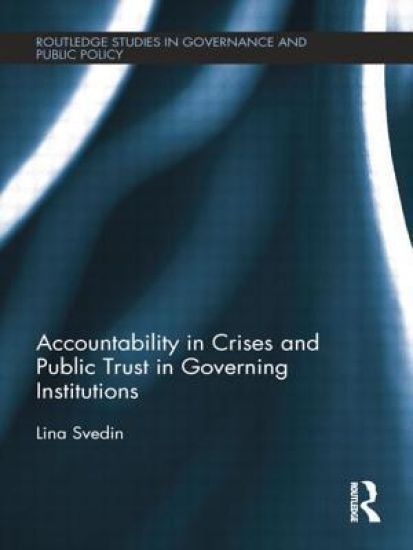
Accountability in Crises and Public Trust in Governing Institutions
This book examines how efforts to exert accountability in crises affect public trust in governing institutions. Using Sweden as the case study, this book provides a framework to analyse accountability in crises and looks at how this affects trust in government.Crises test the fabric of governing institutions. Threatening core societal values, they force elected officials and public servants to make consequential decisions under pressure and uncertainty. Public trust in governing institutions is intrinsically linked to the ability to hold decision-makers accountable for the crucial decisions they make. The book presents empirical evidence from examination of the general bases for accountability in public administration, and at the accountability mechanisms of specific administrative systems, before focusing on longer term policy changes. The author finds that within the complex web of bureaucratic and political moves democratic processes have been undermined across time contributing to misplaced and declining trust in governing institutions.Accountability in Crises and Public Trust in Governing Institutions will be of interest to students, scholars and practitioners of public policy, political leadership and governance.
Accountability in Crises and Public Trust in Governing Institutions
This book examines how efforts to exert accountability in crises affect public trust in governing institutions. Using Sweden as the case study, this book provides a framework to analyse accountability in crises and looks at how this affects trust in government.Crises test the fabric of governing institutions. Threatening core societal values, they force elected officials and public servants to make consequential decisions under pressure and uncertainty. Public trust in governing institutions is intrinsically linked to the ability to hold decision-makers accountable for the crucial decisions they make. The book presents empirical evidence from examination of the general bases for accountability in public administration, and at the accountability mechanisms of specific administrative systems, before focusing on longer term policy changes. The author finds that within the complex web of bureaucratic and political moves democratic processes have been undermined across time contributing to misplaced and declining trust in governing institutions.Accountability in Crises and Public Trust in Governing Institutions will be of interest to students, scholars and practitioners of public policy, political leadership and governance.
Auckland Unplugged

Auckland Unplugged

Eric Stern; Lindy Newlove; Lina Svedin

Lexington Books
2005
nidottu
Virtually all of the socio-technical systems that maintain public order, quality of life, and commerce depend on a reliable electric supply, and critical infrastructure failures such as 'blackouts' have profound implications for citizens and for those who govern in their name. Social scientists have noted the impact of such failures on society, and undertake the study of crisis management to improve our knowledge of why critical systems fail and how such systems can be made more reliable. Auckland Unplugged is a major contribution to this field. Using the 1998 blackout of the central business district of Auckland, New Zealand, as a case study, the authors reveal a number of important insights into the central challenges of crisis governance in post-industrial, democratic societies. These challenges include: _ Finding an appropriate division of responsibility and labor between public- and private-sector actors. _ Crafting and coordinating a crisis response that addresses perceived threats to community values and avoids the twin perils of underreaction (e.g., passivity or paralysis) and overreaction (e.g., 'crying wolf' or political grandstanding). _ Coping with competence/authority discrepancies under stress: Those who have expert knowledge of the technical issues rarely have the authority to make policy; those who have the authority generally lack the technical expertise to comprehend the subtleties and uncertainties of the issues at stake. _ Maintaining credibility and legitimacy when facing acute, ill-structured problmes in politicized, publicized, and highly uncertain environments. Such challenges are by no means specific to Auckland or to the problem of coping with urban 'blackouts.' Auckland Unplugged clearly describes and carefully explores general and recurring problems faced by crisis managers around the world.
Auckland Unplugged

Auckland Unplugged

Eric Stern; Lindy Newlove; Lina Svedin

Lexington Books
2003
sidottu
Virtually all of the socio-technical systems that maintain public order, quality of life, and commerce depend on a reliable electric supply, and critical infrastructure failures such as "blackouts" have profound implications for citizens and for those who govern in their name. Social scientists have noted the impact of such failures on society, and undertake the study of crisis management to improve our knowledge of why critical systems fail and how such systems can be made more reliable. Auckland Unplugged is a major contribution to this field. Using the 1998 blackout of the central business district of Auckland, New Zealand, as a case study, the authors reveal a number of important insights into the central challenges of crisis governance in post-industrial, democratic societies. These challenges include: · Finding an appropriate division of responsibility and labor between public- and private-sector actors. · Crafting and coordinating a crisis response that addresses perceived threats to community values and avoids the twin perils of underreaction (e.g., passivity or paralysis) and overreaction (e.g., "crying wolf" or political grandstanding). · Coping with competence/authority discrepancies under stress: Those who have expert knowledge of the technical issues rarely have the authority to make policy; those who have the authority generally lack the technical expertise to comprehend the subtleties and uncertainties of the issues at stake. · Maintaining credibility and legitimacy when facing acute, ill-structured problmes in politicized, publicized, and highly uncertain environments. Such challenges are by no means specific to Auckland or to the problem of coping with urban "blackouts." Auckland Unplugged clearly describes and carefully explores general and recurring problems faced by crisis managers around the world.