Kirjojen hintavertailu. Mukana 12 657 676 kirjaa ja 12 kauppaa.
Kirjailija
Linda Booth Sweeney
Kirjat ja teokset yhdessä paikassa: 6 kirjaa, julkaisuja vuosilta 2013-2026, suosituimpien joukossa Do Bees Pee?. Vertaile teosten hintoja ja tarkista saatavuus suomalaisista kirjakaupoista.
This silly and informational picture book explores how ecosystems work and celebrates the interconnectedness of nature. When you think of pee and poo, do you say ewww? If you're a human, you probably flush your poo down the loo. But in the wild, animal poo and pee helps nature stay healthy, strong, and pollution-free! This fun, informational picture book that's just right for the youngest readers pairs bright, graphic art and brief, silly text to explore closed-loop, zero waste systems and celebrate the interconnectedness of the natural world.
A lyrical dip into the noisy, magical world of a vernal pool "This book literally has everything you would want in a science and nature title for younger readers ... Beautiful from tip to tail and back again." --Betsy Bird, A Fuse 8 Production In this vibrant and poetic informational picture book, two curious siblings observe the hidden world of a vernal pool: a special kind of puddle habitat that pops up in the spring, dries up by summer, reappears in the fall, and freezes over in the winter--only to come back again in the spring. Young naturalists and future water stewards will be encouraged to listen, watch, and wait to witness the seasonal changes of the ever-changing puddle and its inhabitants. As readers follow along with the rhythmic text, they will be fascinated to discover many familiar and not-so-familiar creatures that make up the surprising web of interrelationships living in these vital pop-up pools. With buoyant, lyrical text and beautiful cut-paper collage illustrations, The Noisy Puddle is an immersive introduction to "now-you-see-me, now-you-don't" wetland habitats.
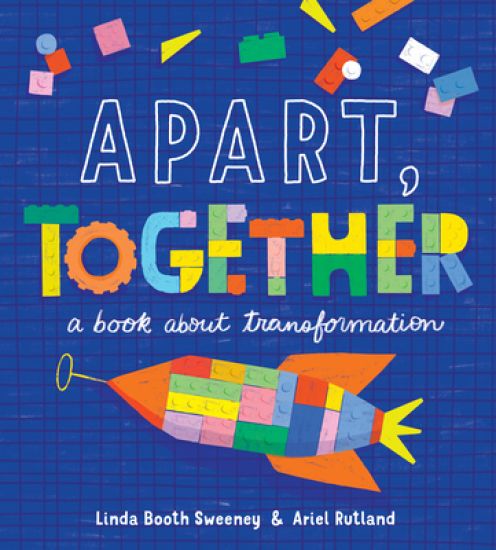
This bold, surprising picture book demonstrates the magic of everyday transformations (and introduces cause-and-effect) for the youngest readers.What happens when 1+1 equals . . . something other than 2?Apart, blue is blue and yellow is yellow . . . but together they make green. Bees and flowers together make honey. Soap and water become foam!With playful art and a simple, lyrical structure, this picture book is a delightful read-aloud and the perfect way to talk about all the wonderful ways that, so often, the whole is greater than the sum of its parts.
This is the story of how a farmboy became America’s foremost sculptor. After failing at academics, Dan was working the family farm when he idly carved a turnip into a frog and discovered what he was meant to do. Sweeney’s swift prose and Fields’s evocative illustrations capture the single-minded determination with which Dan taught himself to sculpt and launched his career with the famous Minuteman Statue in his hometown of Concord, Massachusetts. This is also the story of the Lincoln Memorial, French’s culminating masterpiece. Thanks to this lovingly created tribute to the towering leader of Dan’s youth, Abraham Lincoln lives on as the man of marble, his craggy face and careworn gaze reminding millions of seekers what America can be. Dan’s statue is no lifeless figure, but a powerful, vital touchstone of a nation’s ideals. Now Dan French has his tribute too, in this exquisite biography that brings history to life for young readers.
Can a butterfly's sneeze actually change the weather thousands of miles away? Our world is full of such surprising interdependencies. But how do we help our children understand such complexity -- especially when it impacts the events and the world around them? WHEN A BUTTERFLY SNEEZES teaches us how. Aided by systems thinking, children learn to ask simple questions: What happens next? What happens to this if there is more or less of that? They start to look for patterns in how things happens, to understand why problems arise, and to figure out what they can do about them. This powerful resources includes a fun, detailed discussion of systems thinking, and a comprehensive guide to 12 favorite children's stories that illustrate key systems thinking concepts. A must-have resource for educators and parents who want to help children understand the interconnections in our world. Review: Brandon, How to use stories to unveil the real world, February 14, 2018 I'd been looking for this book for years without knowing it. I use stories to help kids understand the world of complexity - science, history, technology, math, art, and so on. I've long suspected, though, that we can do more than TELL kids stories: stories are things kids can climb into, can play with. A story, I've suspected, can be the start of a sort of game that helps us see how we might live. Sweeney's book is helping me better understand how we might do that. A story, she points out, actually HIDES how the world works. In the real world, everything links up with everything; events transpire in cycles that are hidden. But stories catch our attention precisely because they simplify that complex reality, and give us a handful of protagonists who desire, strive, and then succeed/fail. Sweeney, though, doesn't tell us to turn away from stories, but rather to embrace them and use them (or some of them) to show how the world really functions. As an aside, this book also teaches the basics of complexity theory (formerly chaos theory) more clearly than many popular books in the genre. A close study of the chart on page 10 is worth a few books. Especially useful for anyone who's in love with the Imaginative Education approach of Kieran Egan.
This book has become a favorite of K-12 teachers, university faculty, and corporate consultants. It provides short gaming exercises that illustrate the subtleties of systems thinking. The companion DVD shows the authors introducing and running each of the thirty games.The thirty games are classified by these areas of learning: Systems Thinking, Mental Models, Team Learning, Shared Vision, and Personal Mastery. Each description clearly explains when, how, and why the game is useful. There are explicit instructions for debriefing each exercise as well as a list of all required materials. A summary matrix has been added for a quick glance at all thirty games. When you are in a hurry to find just the right initiative for some part of your course, the matrix will help you find it.Linda Booth Sweeney and Dennis Meadows both have many years of experience in teaching complex concepts. This book reflects their insights. Every game works well and provokes a deep variety of new insights about paradigms, system boundaries, causal-loop diagrams, reference modes, and leverage points. Each of the thirty exercises here was tested and refined many times until it became a reliable source of learning. Some of the games are adapted from classics of the outdoor education field. Others are completely new. But all of them complement readings and lectures to help participants understand intuitively the principles of systems thinking.