Kirjojen hintavertailu. Mukana 12 298 576 kirjaa ja 12 kauppaa.

Kirjailija

Linda Sawyer

Kirjat ja teokset yhdessä paikassa: 4 kirjaa, julkaisuja vuosilta 2003-2013, suosituimpien joukossa Scanning Electron Microscopy and X-Ray Microanalysis. Vertaile teosten hintoja ja tarkista saatavuus suomalaisista kirjakaupoista.

4 kirjaa

Kirjojen julkaisuhaarukka 2003-2013.

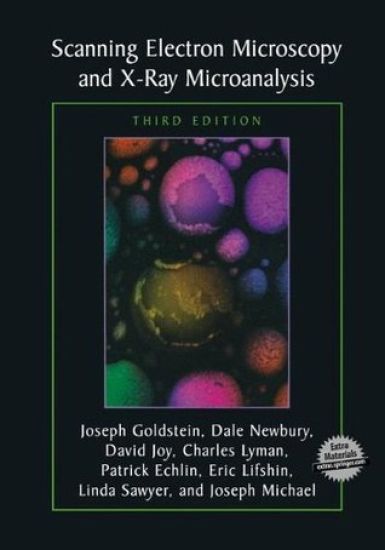
Scanning Electron Microscopy and X-Ray Microanalysis

Scanning Electron Microscopy and X-Ray Microanalysis

Joseph Goldstein; Dale E. Newbury; David C. Joy; Charles E. Lyman; Patrick Echlin; Eric Lifshin; Linda Sawyer; J.R. Michael

Springer-Verlag New York Inc.
2013
nidottu
In the decade since the publication of the second edition of Scanning Electron Microscopy and X-Ray Microanalysis, there has been a great expansion in the capabilities of the basic scanning electron microscope (SEM) and the x-ray spectrometers. The emergence of the variab- pressure/environmental SEM has enabled the observation of samples c- taining water or other liquids or vapor and has allowed for an entirely new class of dynamic experiments, that of direct observation of che- cal reactions in situ. Critical advances in electron detector technology and computer-aided analysis have enabled structural (crystallographic) analysis of specimens at the micrometer scale through electron backscatter diffr- tion (EBSD). Low-voltage operation below 5 kV has improved x-ray spatial resolution by more than an order of magnitude and provided an effective route to minimizing sample charging. High-resolution imaging has cont- ued to develop with a more thorough understanding of how secondary el- trons are generated. The ?eld emission gun SEM, with its high brightness, advanced electron optics, which minimizes lens aberrations to yield an - fective nanometer-scale beam, and “through-the-lens” detector to enhance the measurement of primary-beam-excited secondary electrons, has made high-resolution imaging the rule rather than the exception. Methods of x-ray analysis have evolved allowing for better measurement of specimens with complex morphology: multiple thin layers of different compositions, and rough specimens and particles. Digital mapping has transformed classic x-ray area scanning, a purely qualitative technique, into fully quantitative compositional mapping.

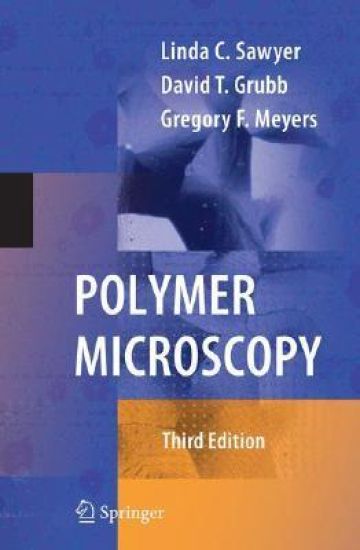
Polymer Microscopy

Polymer Microscopy

Linda Sawyer; David T. Grubb; Gregory F. Meyers

Springer-Verlag New York Inc.
2010
nidottu
Polymer Microscopy, Third Edition, is a comprehensive and practical guide to the study of the microstructure of polymers, and is the result of the authors' many years of academic and industrial experience. To address the needs of students and professionals from a variety of backgrounds, introductory chapters deal with the basic concepts of both polymer morphology and processing and microscopy and imaging theory. The core of the book is more applied, with many examples of specimen preparation and image interpretation leading to materials characterization. Microscopy is applied to the characterization of a wide range of polymer systems, including fibers, films, engineering resins and plastics, composites, nanocomposites, polymer blends, emulsions and liquid crystalline polymers. Light microscopy, atomic force microscopy, and scanning and transmission electron microscopy techniques are all considered, as are emerging techniques such as compositional mapping in which microscopy is combined with spectroscopy. This extensively updated and revised Third Edition closes with a problem solving guide, which gives a systematic framework for deciding on suitable approaches to the characterization of polymer microstructure. Key Features: Revised and updated, this Third Edition remains the gold standard for information on the characterization of polymer microstructure Presents a wide variety of polymer systems and characterization techniquesCovers the major advances in microscopy and polymers since the publication of the Second Edition in 1996Describes new methods for use with the SPM and related to advances in cryo-TEM as well as new polymer materials such as nanocompositesIncludes both basic and applied topics making this book ideal as a professional reference and as a teaching text
Polymer Microscopy

Polymer Microscopy

Linda Sawyer; David T. Grubb; Gregory F. Meyers

Springer-Verlag New York Inc.
2008
sidottu
Polymer Microscopy, Third Edition, is a comprehensive and practical guide to the study of the microstructure of polymers, and is the result of the authors' many years of academic and industrial experience. To address the needs of students and professionals from a variety of backgrounds, introductory chapters deal with the basic concepts of both polymer morphology and processing and microscopy and imaging theory. The core of the book is more applied, with many examples of specimen preparation and image interpretation leading to materials characterization. Microscopy is applied to the characterization of a wide range of polymer systems, including fibers, films, engineering resins and plastics, composites, nanocomposites, polymer blends, emulsions and liquid crystalline polymers. Light microscopy, atomic force microscopy, and scanning and transmission electron microscopy techniques are all considered, as are emerging techniques such as compositional mapping in which microscopy is combined with spectroscopy. This extensively updated and revised Third Edition closes with a problem solving guide, which gives a systematic framework for deciding on suitable approaches to the characterization of polymer microstructure. Key Features: Revised and updated, this Third Edition remains the gold standard for information on the characterization of polymer microstructure Presents a wide variety of polymer systems and characterization techniquesCovers the major advances in microscopy and polymers since the publication of the Second Edition in 1996Describes new methods for use with the SPM and related to advances in cryo-TEM as well as new polymer materials such as nanocompositesIncludes both basic and applied topics making this book ideal as a professional reference and as a teaching text
Scanning Electron Microscopy and X-Ray Microanalysis

Scanning Electron Microscopy and X-Ray Microanalysis

Joseph Goldstein; Dale E. Newbury; David C. Joy; Charles E. Lyman; Patrick Echlin; Eric Lifshin; Linda Sawyer; J.R. Michael

Kluwer Academic/Plenum Publishers
2003
sidottu
In the decade since the publication of the second edition of Scanning Electron Microscopy and X-Ray Microanalysis, there has been a great expansion in the capabilities of the basic scanning electron microscope (SEM) and the x-ray spectrometers. The emergence of the variab- pressure/environmental SEM has enabled the observation of samples c- taining water or other liquids or vapor and has allowed for an entirely new class of dynamic experiments, that of direct observation of che- cal reactions in situ. Critical advances in electron detector technology and computer-aided analysis have enabled structural (crystallographic) analysis of specimens at the micrometer scale through electron backscatter diffr- tion (EBSD). Low-voltage operation below 5 kV has improved x-ray spatial resolution by more than an order of magnitude and provided an effective route to minimizing sample charging. High-resolution imaging has cont- ued to develop with a more thorough understanding of how secondary el- trons are generated. The ?eld emission gun SEM, with its high brightness, advanced electron optics, which minimizes lens aberrations to yield an - fective nanometer-scale beam, and “through-the-lens” detector to enhance the measurement of primary-beam-excited secondary electrons, has made high-resolution imaging the rule rather than the exception. Methods of x-ray analysis have evolved allowing for better measurement of specimens with complex morphology: multiple thin layers of different compositions, and rough specimens and particles. Digital mapping has transformed classic x-ray area scanning, a purely qualitative technique, into fully quantitative compositional mapping.