Kirjojen hintavertailu. Mukana 12 434 747 kirjaa ja 12 kauppaa.

Kirjailija

Lindsay Farmer

Kirjat ja teokset yhdessä paikassa: 5 kirjaa, julkaisuja vuosilta 1996-2026, suosituimpien joukossa Public Interest in Criminal Prosecution in the Modern Era. Vertaile teosten hintoja ja tarkista saatavuus suomalaisista kirjakaupoista.

5 kirjaa

Kirjojen julkaisuhaarukka 1996-2026.

Public Interest in Criminal Prosecution in the Modern Era

Public Interest in Criminal Prosecution in the Modern Era

Lindsay Farmer

BLOOMSBURY PUBLISHING PLC
2026
sidottu
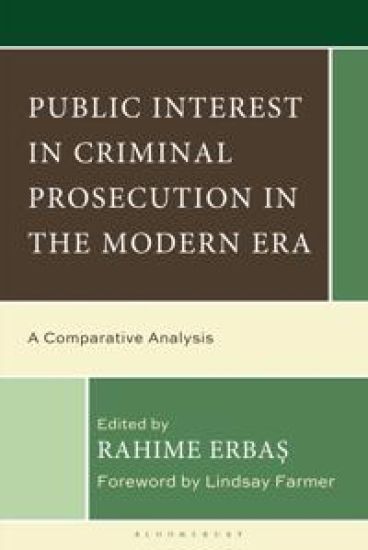
Contributors from across the globe investigate how criminal justice systems grapple with the tension between procedural fairness, institutional efficiency and the general welfare of the public. Drawing on legal frameworks and practices from around the world, this book explores the structural and philosophical challenges that shape modern criminal courts - asking not only what works, but what ought to work. Identifying common patterns and divergent approaches, contributors ultimately offer a holistic perspective on how justice systems can uphold the rule of law while meeting the demands of speed, cost, and caseload management. The timely and thought-provoking contributions provide actionable insights for scholars, practitioners and policymakers seeking to reform criminal justice in ways that serve both principle and practicality.
Making the Modern Criminal Law

Making the Modern Criminal Law

Lindsay Farmer

Oxford University Press
2016
sidottu
The Criminalization series arose from an interdisciplinary investigation into criminalization, focussing on the principles that might guide decisions about what kinds of conduct should be criminalized, and the forms that criminalization should take. Developing a normative theory of criminalization, the series tackles the key questions at the heart of the issue: what principles and goals should guide legislators in deciding what to criminalize? How should criminal wrongs be classified and differentiated? How should law enforcement officials apply the law's specifications of offences? This, the fifth book in the series, offers a historical and conceptual account of the development of the modern criminal law in England and as it has spread to common law jurisdictions around the world. The book offers a historical perspective on the development of theories of criminalization. It shows how the emergence of theories of criminalization is inextricably linked to modern understandings of the criminal law as a conceptually distinct body of rules, and how this in turn has been shaped by the changing functions of criminal law as an instrument of government in the modern state. The book is structured in two main parts. The first traces the development of the modern law as a distinct, and conceptually distinct body of rules, looking in particular at ideas of jurisdiction, codification and responsibility. The second part then engages in detailed analysis of specific areas of criminal law, focusing on patterns of criminalization in relation to property, the person, and sexual conduct.
The Trial on Trial: Volume 3

The Trial on Trial: Volume 3

Lindsay Farmer; R A Duff; Sandra Marshall; Victor Tadros

Hart Publishing
2007
sidottu
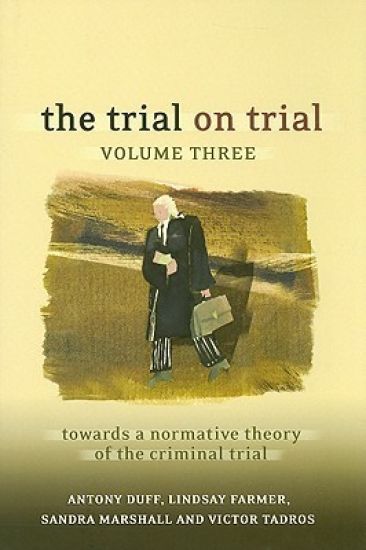
The criminal trial is under attack. Traditional principles have been challenged or eroded; in England and Wales the right to trial by jury has been restricted and rules concerning bad character evidence, double jeopardy and the right to silence have been substantially altered to "rebalance" the system in favour of victims. In the pursuit of security, particularly from terrorism, the right to a fair trial has been denied to some altogether. In fact trials have for a long time been an infrequent occurrence, most criminal convictions being the consequence of a guilty plea. Moreover, while this very public struggle over the future of the criminal trial is conducted, there is also a less publicly observed controversy about the significance of trials in modern society. Trials are under normative attack, their value being doubted by those who seek different kinds of process - conciliatory or restorative - to address the needs of victims and move away from the imposition of state power through trials and punishments. This book seeks to develop a normative theory of the criminal trial as a way of defending the importance of trials in our criminal justice system. The trial, it is suggested, calls defendants to answer a charge and, if they are criminally responsible, to account for their conduct. The trial is seen as a communicative process through which the defendant can challenge claims of wrongdoing made against him, including the norms in the light of which those claims are made. The book develops this communicative theory by first making a careful study of the history of trials, before moving on to outline the theory, which is then developed through chapters looking at the practices and principles of trials, alternative regulatory models, the roles of participants, the relationship between investigation and trial and trials as public fora.
Criminal Law, Tradition and Legal Order

Criminal Law, Tradition and Legal Order

Lindsay Farmer

Cambridge University Press
2005
pokkari
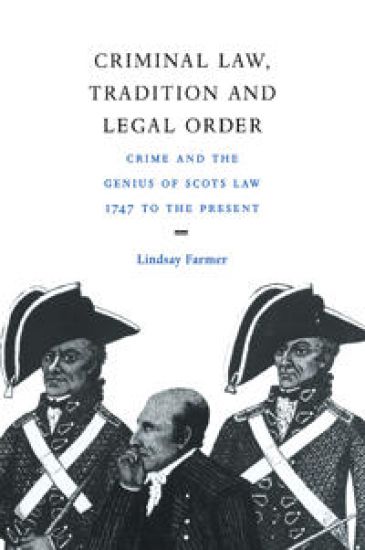
This book examines the relationship between legal tradition and national identity to offer a critical and historical perspective on the study of criminal law. It develops a radically different approach to questions of responsibility and subjectivity, and was among the first studies to combine appreciation of the institutional and historical context in which criminal law is practised with a critical understanding of the law itself. Applying contemporary social theory to the particular case of nineteenth-century Scottish law, Lindsay Farmer is able to develop a critique of modern criminal law theory in general. He traces the development of the modern characteristics of criminal law and legal order, tracing the relationship between legal practice and national culture, and showing how contemporary criminal law theory fundamentally misrepresents the character of modern criminal justice.
Criminal Law, Tradition and Legal Order

Criminal Law, Tradition and Legal Order

Lindsay Farmer

Cambridge University Press
1996
sidottu
This book examines the relationship between legal tradition and national identity to offer a critical and historical perspective on the study of criminal law. It develops a radically different approach to questions of responsibility and subjectivity, and was among the first studies to combine appreciation of the institutional and historical context in which criminal law is practised with a critical understanding of the law itself. Applying contemporary social theory to the particular case of nineteenth-century Scottish law, Lindsay Farmer is able to develop a critique of modern criminal law theory in general. He traces the development of the modern characteristics of criminal law and legal order, tracing the relationship between legal practice and national culture, and showing how contemporary criminal law theory fundamentally misrepresents the character of modern criminal justice.