Kirjojen hintavertailu. Mukana 12 657 676 kirjaa ja 12 kauppaa.
Kirjailija
Lingyu Wang
Kirjat ja teokset yhdessä paikassa: 13 kirjaa, julkaisuja vuosilta 2006-2021, suosituimpien joukossa Preserving Privacy Against Side-Channel Leaks. Vertaile teosten hintoja ja tarkista saatavuus suomalaisista kirjakaupoista.
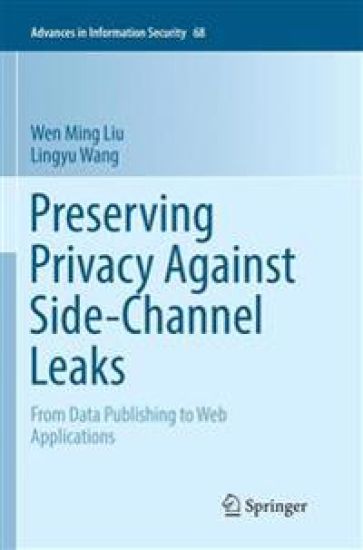
This book offers a novel approach to data privacy by unifying side-channel attacks within a general conceptual framework. This book then applies the framework in three concrete domains. First, the book examines privacy-preserving data publishing with publicly-known algorithms, studying a generic strategy independent of data utility measures and syntactic privacy properties before discussing an extended approach to improve the efficiency. Next, the book explores privacy-preserving traffic padding in Web applications, first via a model to quantify privacy and cost and then by introducing randomness to provide background knowledge-resistant privacy guarantee. Finally, the book considers privacy-preserving smart metering by proposing a light-weight approach to simultaneously preserving users' privacy and ensuring billing accuracy. Designed for researchers and professionals, this book is also suitable for advanced-level students interested in privacy, algorithms, or web applications.
This book offers a novel approach to data privacy by unifying side-channel attacks within a general conceptual framework. This book then applies the framework in three concrete domains. First, the book examines privacy-preserving data publishing with publicly-known algorithms, studying a generic strategy independent of data utility measures and syntactic privacy properties before discussing an extended approach to improve the efficiency. Next, the book explores privacy-preserving traffic padding in Web applications, first via a model to quantify privacy and cost and then by introducing randomness to provide background knowledge-resistant privacy guarantee. Finally, the book considers privacy-preserving smart metering by proposing a light-weight approach to simultaneously preserving users' privacy and ensuring billing accuracy. Designed for researchers and professionals, this book is also suitable for advanced-level students interested in privacy, algorithms, or web applications.
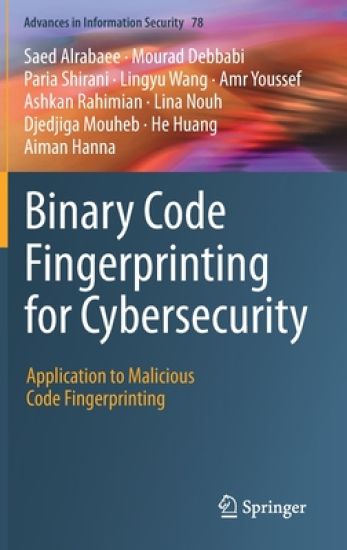
This book addresses automated software fingerprinting in binary code, especially for cybersecurity applications. The reader will gain a thorough understanding of binary code analysis and several software fingerprinting techniques for cybersecurity applications, such as malware detection, vulnerability analysis, and digital forensics. More specifically, it starts with an overview of binary code analysis and its challenges, and then discusses the existing state-of-the-art approaches and their cybersecurity applications. Furthermore, it discusses and details a set of practical techniques for compiler provenance extraction, library function identification, function fingerprinting, code reuse detection, free open-source software identification, vulnerability search, and authorship attribution. It also illustrates several case studies to demonstrate the efficiency, scalability and accuracy of the above-mentioned proposed techniques and tools. This book also introduces several innovative quantitative and qualitative techniques that synergistically leverage machine learning, program analysis, and software engineering methods to solve binary code fingerprinting problems, which are highly relevant to cybersecurity and digital forensics applications. The above-mentioned techniques are cautiously designed to gain satisfactory levels of efficiency and accuracy. Researchers working in academia, industry and governmental agencies focusing on Cybersecurity will want to purchase this book. Software engineers and advanced-level students studying computer science, computer engineering and software engineering will also want to purchase this book.
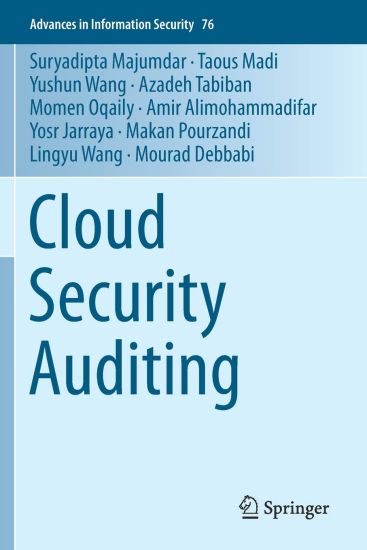
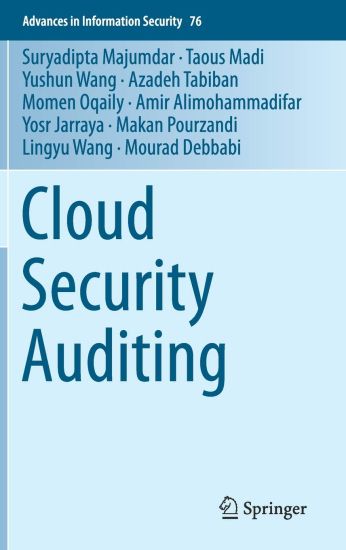
This book provides a comprehensive review of the most up to date research related to cloud security auditing and discusses auditing the cloud infrastructure from the structural point of view, while focusing on virtualization-related security properties and consistency between multiple control layers. It presents an off-line automated framework for auditing consistent isolation between virtual networks in OpenStack-managed cloud spanning over overlay and layer 2 by considering both cloud layers’ views. A runtime security auditing framework for the cloud with special focus on the user-level including common access control and authentication mechanisms e.g., RBAC, ABAC and SSO is covered as well. This book also discusses a learning-based proactive security auditing system, which extracts probabilistic dependencies between runtime events and applies such dependencies to proactively audit and prevent security violations resulting from critical events. Finally, this book elaborates the design and implementation of a middleware as a pluggable interface to OpenStack for intercepting and verifying the legitimacy of user requests at runtime.Many companies nowadays leverage cloud services for conducting major business operations (e.g., Web service, inventory management, customer service, etc.). However, the fear of losing control and governance still persists due to the inherent lack of transparency and trust in clouds. The complex design and implementation of cloud infrastructures may cause numerous vulnerabilities and misconfigurations, while the unique properties of clouds (elastic, self-service, multi-tenancy) can bring novel security challenges. In this book, the authors discuss how state-of-the-art security auditing solutions may help increase cloud tenants’ trust in the service providers by providing assurance on the compliance with the applicable laws, regulations, policies, and standards. This book introduces the latest research results on both traditional retroactive auditing and novel (runtime and proactive) auditing techniques to serve different stakeholders in the cloud. This book covers security threats from different cloud abstraction levels and discusses a wide-range of security properties related to cloud-specific standards (e.g., Cloud Control Matrix (CCM) and ISO 27017). It also elaborates on the integration of security auditing solutions into real world cloud management platforms (e.g., OpenStack, Amazon AWS and Google GCP).This book targets industrial scientists, who are working on cloud or security-related topics, as well as security practitioners, administrators, cloud providers and operators.Researchers and advanced-level students studying and working in computer science, practically in cloud security will also be interested in this book.
This book addresses automated software fingerprinting in binary code, especially for cybersecurity applications. The reader will gain a thorough understanding of binary code analysis and several software fingerprinting techniques for cybersecurity applications, such as malware detection, vulnerability analysis, and digital forensics. More specifically, it starts with an overview of binary code analysis and its challenges, and then discusses the existing state-of-the-art approaches and their cybersecurity applications. Furthermore, it discusses and details a set of practical techniques for compiler provenance extraction, library function identification, function fingerprinting, code reuse detection, free open-source software identification, vulnerability search, and authorship attribution. It also illustrates several case studies to demonstrate the efficiency, scalability and accuracy of the above-mentioned proposed techniques and tools. This book also introduces several innovative quantitative and qualitative techniques that synergistically leverage machine learning, program analysis, and software engineering methods to solve binary code fingerprinting problems, which are highly relevant to cybersecurity and digital forensics applications. The above-mentioned techniques are cautiously designed to gain satisfactory levels of efficiency and accuracy. Researchers working in academia, industry and governmental agencies focusing on Cybersecurity will want to purchase this book. Software engineers and advanced-level students studying computer science, computer engineering and software engineering will also want to purchase this book.
This book provides a comprehensive review of the most up to date research related to cloud security auditing and discusses auditing the cloud infrastructure from the structural point of view, while focusing on virtualization-related security properties and consistency between multiple control layers. It presents an off-line automated framework for auditing consistent isolation between virtual networks in OpenStack-managed cloud spanning over overlay and layer 2 by considering both cloud layers’ views. A runtime security auditing framework for the cloud with special focus on the user-level including common access control and authentication mechanisms e.g., RBAC, ABAC and SSO is covered as well. This book also discusses a learning-based proactive security auditing system, which extracts probabilistic dependencies between runtime events and applies such dependencies to proactively audit and prevent security violations resulting from critical events. Finally, this book elaborates the design and implementation of a middleware as a pluggable interface to OpenStack for intercepting and verifying the legitimacy of user requests at runtime.Many companies nowadays leverage cloud services for conducting major business operations (e.g., Web service, inventory management, customer service, etc.). However, the fear of losing control and governance still persists due to the inherent lack of transparency and trust in clouds. The complex design and implementation of cloud infrastructures may cause numerous vulnerabilities and misconfigurations, while the unique properties of clouds (elastic, self-service, multi-tenancy) can bring novel security challenges. In this book, the authors discuss how state-of-the-art security auditing solutions may help increase cloud tenants’ trust in the service providers by providing assurance on the compliance with the applicable laws, regulations, policies, and standards. This book introduces the latest research results on both traditional retroactive auditing and novel (runtime and proactive) auditing techniques to serve different stakeholders in the cloud. This book covers security threats from different cloud abstraction levels and discusses a wide-range of security properties related to cloud-specific standards (e.g., Cloud Control Matrix (CCM) and ISO 27017). It also elaborates on the integration of security auditing solutions into real world cloud management platforms (e.g., OpenStack, Amazon AWS and Google GCP).This book targets industrial scientists, who are working on cloud or security-related topics, as well as security practitioners, administrators, cloud providers and operators.Researchers and advanced-level students studying and working in computer science, practically in cloud security will also be interested in this book.
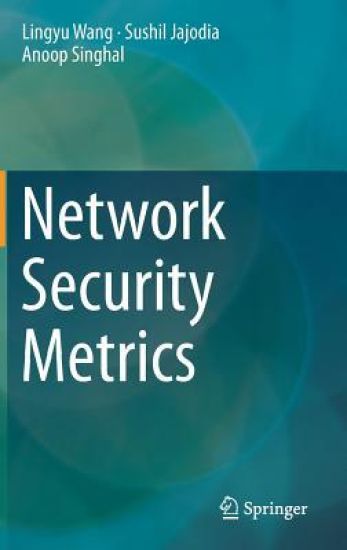
This book examines different aspects of network security metrics and their application to enterprise networks. One of the most pertinent issues in securing mission-critical computing networks is the lack of effective security metrics which this book discusses in detail. Since “you cannot improve what you cannot measure”, a network security metric is essential to evaluating the relative effectiveness of potential network security solutions. The authors start by examining the limitations of existing solutions and standards on security metrics, such as CVSS and attack surface, which typically focus on known vulnerabilities in individual software products or systems. The first few chapters of this book describe different approaches to fusing individual metric values obtained from CVSS scores into an overall measure of network security using attack graphs. Since CVSS scores are only available for previously known vulnerabilities, such approaches do not consider the threat of unknownattacks exploiting the so-called zero day vulnerabilities. Therefore, several chapters of this book are dedicated to develop network security metrics especially designed for dealing with zero day attacks where the challenge is that little or no prior knowledge is available about the exploited vulnerabilities, and thus most existing methodologies for designing security metrics are no longer effective. Finally, the authors examine several issues on the application of network security metrics at the enterprise level. Specifically, a chapter presents a suite of security metrics organized along several dimensions for measuring and visualizing different aspects of the enterprise cyber security risk, and the last chapter presents a novel metric for measuring the operational effectiveness of the cyber security operations center (CSOC). Security researchers who work on network security or security analytics related areas seeking new research topics, as well as security practitioners including network administrators and security architects who are looking for state of the art approaches to hardening their networks, will find this book helpful as a reference. Advanced-level students studying computer science and engineering will find this book useful as a secondary text.
This book examines different aspects of network security metrics and their application to enterprise networks. One of the most pertinent issues in securing mission-critical computing networks is the lack of effective security metrics which this book discusses in detail. Since “you cannot improve what you cannot measure”, a network security metric is essential to evaluating the relative effectiveness of potential network security solutions. The authors start by examining the limitations of existing solutions and standards on security metrics, such as CVSS and attack surface, which typically focus on known vulnerabilities in individual software products or systems. The first few chapters of this book describe different approaches to fusing individual metric values obtained from CVSS scores into an overall measure of network security using attack graphs. Since CVSS scores are only available for previously known vulnerabilities, such approaches do not consider the threat of unknownattacks exploiting the so-called zero day vulnerabilities. Therefore, several chapters of this book are dedicated to develop network security metrics especially designed for dealing with zero day attacks where the challenge is that little or no prior knowledge is available about the exploited vulnerabilities, and thus most existing methodologies for designing security metrics are no longer effective. Finally, the authors examine several issues on the application of network security metrics at the enterprise level. Specifically, a chapter presents a suite of security metrics organized along several dimensions for measuring and visualizing different aspects of the enterprise cyber security risk, and the last chapter presents a novel metric for measuring the operational effectiveness of the cyber security operations center (CSOC). Security researchers who work on network security or security analytics related areas seeking new research topics, as well as security practitioners including network administrators and security architects who are looking for state of the art approaches to hardening their networks, will find this book helpful as a reference. Advanced-level students studying computer science and engineering will find this book useful as a secondary text.
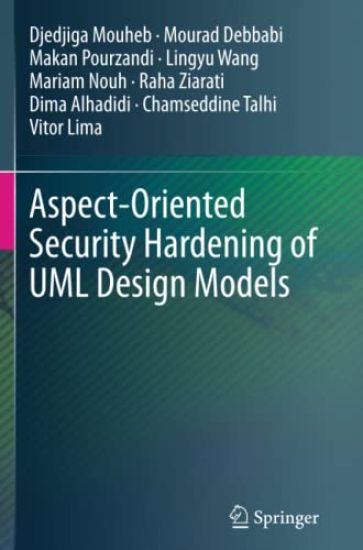
This book comprehensively presents a novel approach to the systematic security hardening of software design models expressed in the standard UML language. It combines model-driven engineering and the aspect-oriented paradigm to integrate security practices into the early phases of the software development process. To this end, a UML profile has been developed for the specification of security hardening aspects on UML diagrams. In addition, a weaving framework, with the underlying theoretical foundations, has been designed for the systematic injection of security aspects into UML models.The work is organized as follows: chapter 1 presents an introduction to software security, model-driven engineering, UML and aspect-oriented technologies. Chapters 2 and 3 provide an overview of UML language and the main concepts of aspect-oriented modeling (AOM) respectively. Chapter 4 explores the area of model-driven architecture with a focus on model transformations. The main approaches that are adopted in the literature for security specification and hardening are presented in chapter 5. After these more general presentations, chapter 6 introduces the AOM profile for security aspects specification. Afterwards, chapter 7 details the design and the implementation of the security weaving framework, including several real-life case studies to illustrate its applicability. Chapter 8 elaborates an operational semantics for the matching/weaving processes in activity diagrams, while chapters 9 and 10 present a denotational semantics for aspect matching and weaving in executable models following a continuation-passing style. Finally, a summary and evaluation of the work presented are provided in chapter 11.The book will benefit researchers in academia and industry as well as students interested in learning about recent research advances in the field of software security engineering.
This book comprehensively presents a novel approach to the systematic security hardening of software design models expressed in the standard UML language. It combines model-driven engineering and the aspect-oriented paradigm to integrate security practices into the early phases of the software development process. To this end, a UML profile has been developed for the specification of security hardening aspects on UML diagrams. In addition, a weaving framework, with the underlying theoretical foundations, has been designed for the systematic injection of security aspects into UML models.The work is organized as follows: chapter 1 presents an introduction to software security, model-driven engineering, UML and aspect-oriented technologies. Chapters 2 and 3 provide an overview of UML language and the main concepts of aspect-oriented modeling (AOM) respectively. Chapter 4 explores the area of model-driven architecture with a focus on model transformations. The main approaches that are adopted in the literature for security specification and hardening are presented in chapter 5. After these more general presentations, chapter 6 introduces the AOM profile for security aspects specification. Afterwards, chapter 7 details the design and the implementation of the security weaving framework, including several real-life case studies to illustrate its applicability. Chapter 8 elaborates an operational semantics for the matching/weaving processes in activity diagrams, while chapters 9 and 10 present a denotational semantics for aspect matching and weaving in executable models following a continuation-passing style. Finally, a summary and evaluation of the work presented are provided in chapter 11.The book will benefit researchers in academia and industry as well as students interested in learning about recent research advances in the field of software security engineering.
This Springer Brief examines the tools based on attack graphs that help reveal network hardening threats. Existing tools detail all possible attack paths leading to critical network resources. Though no current tool provides a direct solution to remove the threats, they are a more efficient means of network defense than relying solely on the experience and skills of a human analyst. Key background information on attack graphs and network hardening helps readers understand the complexities of these tools and techniques. A common network hardening technique generates hardening solutions comprised of initially satisfied conditions, thereby making the solution more enforceable. Following a discussion of the complexity issues in this technique, the authors provide an improved technique that considers the dependencies between hardening options and employs a near-optimal approximation algorithm to scale linearly with the size of the inputs. Also included are automated solutions for hardening a network against sophisticated multi-step intrusions. Network Hardening: An Automated Approach to Improving Network Security is a valuable resource for researchers and professionals working in network security. It is also a useful tool for advanced-level students focused on security in computer science and electrical engineering.
Preserving Privacy for On-Line Analytical Processing addresses the privacy issue of On-Line Analytic Processing (OLAP) systems. OLAP systems usually need to meet two conflicting goals. First, the sensitive data stored in underlying data warehouses must be kept secret. Second, analytical queries about the data must be allowed for decision support purposes. The main challenge is that sensitive data can be inferred from answers to seemingly innocent aggregations of the data. This volume reviews a series of methods that can precisely answer data cube-style OLAP, regarding sensitive data while provably preventing adversaries from inferring data. Preserving Privacy for On-Line Analytical Processing is appropriate for practitioners in industry as well as graduate-level students in computer science and engineering.
Preserving Privacy for On-Line Analytical Processing addresses the privacy issue of On-Line Analytic Processing (OLAP) systems. OLAP systems usually need to meet two conflicting goals. First, the sensitive data stored in underlying data warehouses must be kept secret. Second, analytical queries about the data must be allowed for decision support purposes. The main challenge is that sensitive data can be inferred from answers to seemingly innocent aggregations of the data. This volume reviews a series of methods that can precisely answer data cube-style OLAP, regarding sensitive data while provably preventing adversaries from inferring data. Preserving Privacy for On-Line Analytical Processing is appropriate for practitioners in industry as well as graduate-level students in computer science and engineering.