
Kirjailija
Lionel Wee
Kirjat ja teokset yhdessä paikassa: 23 kirjaa, julkaisuja vuosilta 2010-2026, suosituimpien joukossa Language on Display. Vertaile teosten hintoja ja tarkista saatavuus suomalaisista kirjakaupoista.
23 kirjaa
Kirjojen julkaisuhaarukka 2010-2026.

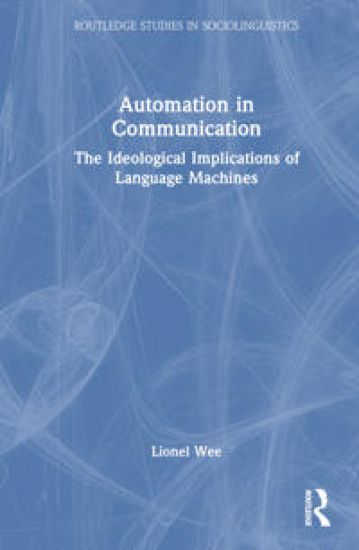
By drawing on multiple examples from healthcare, religion, service encounters and poetry, Lionel Wee presents rich insights into the use of automation in communication through a posthumanist lens. As communication becomes increasingly automated, the use of automation creates significant conceptual challenges for ideologies about language, beliefs about the nature of language, as well as assumptions about the roles that interpretation, anthropomorphism, and folk theories of mind play when language is used in communication. This book unravels the ideological implications of automation in communication and provides a new theoretical ground to address the major issues raised by automation. Wee discusses the importance of thinking carefully about how we identify and distinguish the roles of speaker and hearer. He also argues that we re-evaluate our understanding of the relationship between language and community.This book will be vital to students interested in studying the intersections of AI, language and communication, as well as researchers working in communication studies, linguistics and the broader sociology of language in the age of technological change.
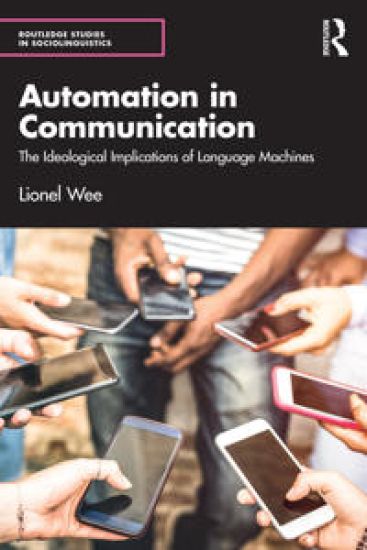
By drawing on multiple examples from healthcare, religion, service encounters and poetry, Lionel Wee presents rich insights into the use of automation in communication through a posthumanist lens. As communication becomes increasingly automated, the use of automation creates significant conceptual challenges for ideologies about language, beliefs about the nature of language, as well as assumptions about the roles that interpretation, anthropomorphism, and folk theories of mind play when language is used in communication. This book unravels the ideological implications of automation in communication and provides a new theoretical ground to address the major issues raised by automation. Wee discusses the importance of thinking carefully about how we identify and distinguish the roles of speaker and hearer. He also argues that we re-evaluate our understanding of the relationship between language and community.This book will be vital to students interested in studying the intersections of AI, language and communication, as well as researchers working in communication studies, linguistics and the broader sociology of language in the age of technological change.
Samosir and Wee examine how the immensely popular Korean Wave ("K-wave") also known as Hallyu is wielded as soft power through the use of communication for persuasion and attraction on the global stage. The Korean Wave refers to the global spread and popularity of South Korean culture, particularly its pop music ("K-pop"), serialised dramas ("K-dramas") and films ("K-films"). Given the South Korean government’s involvement in providing funding and publicity, the Korean Wave raises interesting sociolinguistic questions about the relationship between artistry and citizenship, the use of social media in facilitating the consumption of cultural products, and, ultimately, the nature of soft power itself.Studies of soft power have tended to come from the field of international relations. This book shows that sociolinguistics actually has a number of tools in its conceptual arsenal – such as indexicality, stance taking, affect, and styling – that can shed light on the Korean Wave as a form of soft power. As the first book-length sociolinguistic analysis of the Korean Wave and soft power, this book demonstrates how K-pop, K-dramas, and K-films have been able to encourage in consumers an anthropological stance towards all things Korean.This volume will be of particular interest to students and scholars in sociolinguistics, political science, cultural studies, and Korean studies.The Open Access version of this book, available at www.taylorfrancis.com, has been made available under a Creative Commons Attribution-Non Commercial-No Derivatives (CC-BY-NC-ND) 4.0 license.
Samosir and Wee examine how the immensely popular Korean Wave ("K-wave") also known as Hallyu is wielded as soft power through the use of communication for persuasion and attraction on the global stage. The Korean Wave refers to the global spread and popularity of South Korean culture, particularly its pop music ("K-pop"), serialised dramas ("K-dramas") and films ("K-films"). Given the South Korean government’s involvement in providing funding and publicity, the Korean Wave raises interesting sociolinguistic questions about the relationship between artistry and citizenship, the use of social media in facilitating the consumption of cultural products, and, ultimately, the nature of soft power itself.Studies of soft power have tended to come from the field of international relations. This book shows that sociolinguistics actually has a number of tools in its conceptual arsenal – such as indexicality, stance taking, affect, and styling – that can shed light on the Korean Wave as a form of soft power. As the first book-length sociolinguistic analysis of the Korean Wave and soft power, this book demonstrates how K-pop, K-dramas, and K-films have been able to encourage in consumers an anthropological stance towards all things Korean.This volume will be of particular interest to students and scholars in sociolinguistics, political science, cultural studies, and Korean studies.The Open Access version of this book, available at www.taylorfrancis.com, has been made available under a Creative Commons Attribution-Non Commercial-No Derivatives (CC-BY-NC-ND) 4.0 license.
How exactly do linguistic landscapes communicate and what theoretical significance might follow from such an inquiry? This book addresses these questions by taking as its starting point the insight that the individual or organisation that is responsible for the production of a sign may not be physically present at the landscape itself. The information to be conveyed is typically designed as a piece of signage to be emplaced at the site. Drawing on Goffman’s notion of a production format, the book argues that the constructed piece of sign and its intended placement within the landscape combine to constitute an animator complex. This raises the possibility of a disruption to the sign and its placement in the landscape. The book describes various ways in which the integrity of the animator complex can be disrupted (e.g. the sign may be moved out of place through vandalism or acts of nature, or the organisation that the sign represents may no longer be in business), identifi es different types of animators, and expands on the implications for phenomena such as affect, multivocality, footing and the materiality of language. In doing so, the book also demonstrates the value of bringing in Bakhtin’s work on heteroglossia and the dialogicity of communication, integrating the ideas of Bakhtin with those of Goffman.
Language, Space and Cultural Play
Lionel Wee; Robbie B. H. Goh
Cambridge University Press
2022
pokkari
This multimodal approach to linguistic landscapes examines the role of linguistic and semiotic regimes in constructing landscape affect. Affect, as distinct from emotion, is object-oriented, and can be analysed in terms of structures of language and signs which operate on individuals and groups in specific spatial settings. Analysing a series of landscape types - including 'kawaii', 'reverenced', 'romance', 'friendly', 'luxury' and 'digital' landscapes - Lionel Wee and Robbie B. H. Goh explore how language plays a crucial role in shaping affective responses to, and interactions with, space. This linguistic and semiotic construction of different spaces also involves cultural contestations and modulations in spatial responses, and the book offers an account of the different conditions under which 'affective economies' gain or lose momentum.
A posthumanist approach problematizes the separateness and centrality of humans in understanding the world around us. Posthumanism does not deny the role of humans but questions the assumption that it is human activity and agency that should be given pride of place in any analysis of social activity. This carries important and interesting implications for the study of World Englishes, some of which are explored in this Element. Sections 3 and 4, respectively, explore posthumanism in relation to two specific topics in World Englishes, creativity and language policy. These topics have been chosen because they allow us to see the contributions that posthumanism can make to a micro-level (creativity) as well as macro-level (language policy) topic.
How exactly do linguistic landscapes communicate and what theoretical significance might follow from such an inquiry? This book addresses these questions by taking as its starting point the insight that the individual or organisation that is responsible for the production of a sign may not be physically present at the landscape itself. The information to be conveyed is typically designed as a piece of signage to be emplaced at the site. Drawing on Goffman’s notion of a production format, the book argues that the constructed piece of sign and its intended placement within the landscape combine to constitute an animator complex. This raises the possibility of a disruption to the sign and its placement in the landscape. The book describes various ways in which the integrity of the animator complex can be disrupted (e.g. the sign may be moved out of place through vandalism or acts of nature, or the organisation that the sign represents may no longer be in business), identifi es different types of animators, and expands on the implications for phenomena such as affect, multivocality, footing and the materiality of language. In doing so, the book also demonstrates the value of bringing in Bakhtin’s work on heteroglossia and the dialogicity of communication, integrating the ideas of Bakhtin with those of Goffman.
Singlish is the colloquial variety of English spoken in Singapore. It has sparked much public debate, but so far the complex question of what Singlish really is and what it means to its speakers has remained obscured. This important work explores some of the socio-political controversies surrounding Singlish, such as the political ideologies inherent in Singlish discourse, the implications of being restricted to Singlish for those speakers without access to standard English, the complex relationship between Singlish and migration, and the question of whether Singlish is an asset or a liability to Singaporeans. These questions surrounding Singlish illustrate many current issues in language, culture and identity in an age of rapid change. The book will be of interest to scholars and advanced students of World Englishes and sociolinguistics. Its detailed analysis of the Singlish controversy will illuminate broader questions about language, identity and globalization.
Language, Space and Cultural Play
Lionel Wee; Robbie B. H. Goh
Cambridge University Press
2019
sidottu
This multimodal approach to linguistic landscapes examines the role of linguistic and semiotic regimes in constructing landscape affect. Affect, as distinct from emotion, is object-oriented, and can be analysed in terms of structures of language and signs which operate on individuals and groups in specific spatial settings. Analysing a series of landscape types - including 'kawaii', 'reverenced', 'romance', 'friendly', 'luxury' and 'digital' landscapes - Lionel Wee and Robbie B. H. Goh explore how language plays a crucial role in shaping affective responses to, and interactions with, space. This linguistic and semiotic construction of different spaces also involves cultural contestations and modulations in spatial responses, and the book offers an account of the different conditions under which 'affective economies' gain or lose momentum.
The ways in which commercial organizations and service providers 'style' themselves - creating the image they wish to portray to their potential consumers - is a long-established area of research in the fields of sociology and business studies. However, language also plays an important role in organizational styling, something which until now has been largely overlooked in the literature. This is the first book-length study of the linguistics of organizational styling, looking at the language and semiotic resources used by holiday resorts, pharmaceutical companies, restaurants and insurance companies in order to project their identities, and style themselves. It discusses in detail a number of case studies and presents an innovative take on the notion of style, as well as bringing together work from linguistics, business studies and sociology. This interdisciplinary book will be of interest to scholars and advanced students in sociolinguistics, and scholars of sociology and business studies.

Singlish is the colloquial variety of English spoken in Singapore. It has sparked much public debate, but so far the complex question of what Singlish really is and what it means to its speakers has remained obscured. This important work explores some of the socio-political controversies surrounding Singlish, such as the political ideologies inherent in Singlish discourse, the implications of being restricted to Singlish for those speakers without access to Standard English, the complex relationship between Singlish and migration, and the question of whether Singlish is an asset or a liability to Singaporeans. These questions surrounding Singlish illustrate many current issues in language, culture and identity in an age of rapid change. The book will be of interest to scholars and advanced students of World Englishes and sociolinguistics. Its detailed analysis of the Singlish controversy will illuminate broader questions about language, identity and globalization.
‘Consumption, Cities and States’ examines the fascinating intersection of consumption, citizenship and the state in a cross-section of global cities in Asia and the West. It focuses on a number of theoretical and empirical analyses: developing and amplifying the intersection of consumption, citizenship and the state in late modernity in relation to a range of cities; examining the concept of the global city as an ‘aspirational’ category for cities in Asia and the West; and considering case studies which highlight the intersection of consumption and the state. As Ann Brooks and Lionel Wee demonstrate, the interface between citizen status and consumer activity proves a crucial point of analysis in the light of the neoliberal assertion that individuals and institutions perform at their best within a free market economy.

The global spread of English both reproduces and reinforces oppressive structures of inequality. But such structures can no longer be seen as imposed from an imperial center, as English is now actively adopted and appropriated in local contexts around the world. This book argues that such conditions call for a new critique of global English, one that is sensitive to both the political economic conditions of globalization and speakers’ local practices. Linking Bourdieu’s theory of the linguistic market and his practice-based perspective with recent advances in sociolinguistics and linguistic anthropology, this book offers a fresh new critique of global English. The authors highlight the material, discursive, and semiotic processes through which the value of English in the linguistic market is constructed, and suggest possible policy interventions that may be adopted to address the problems of global English. Through its serious engagement with current sociolinguistic theory and insightful analysis of the multiple dimensions of English in the world, this book challenges the readers to think about what we need to do to confront the social inequalities that are perpetuated by the global spread of English

The ways in which commercial organizations and service providers 'style' themselves - creating the image they wish to portray to their potential consumers - is a long-established area of research in the fields of sociology and business studies. However, language also plays an important role in organizational styling, something which until now has been largely overlooked in the literature. This is the first book-length study of the linguistics of organizational styling, looking at the language and semiotic resources used by holiday resorts, pharmaceutical companies, restaurants and insurance companies in order to project their identities, and style themselves. It discusses in detail a number of case studies and presents an innovative take on the notion of style, as well as bringing together work from linguistics, business studies and sociology. This interdisciplinary book will be of interest to scholars and advanced students in sociolinguistics, and scholars of sociology and business studies.
‘Consumption, Cities and States’ examines the fascinating intersection of consumption, citizenship and the state in a cross-section of global cities in Asia and the West. It focuses on a number of theoretical and empirical analyses: developing and amplifying the intersection of consumption, citizenship and the state in late modernity in relation to a range of cities; examining the concept of the global city as an ‘aspirational’ category for cities in Asia and the West; and considering case studies which highlight the intersection of consumption and the state. As Ann Brooks and Lionel Wee demonstrate, the interface between citizen status and consumer activity proves a crucial point of analysis in the light of the neoliberal assertion that individuals and institutions perform at their best within a free market economy.
The global spread of English both reproduces and reinforces oppressive structures of inequality. But such structures can no longer be seen as imposed from an imperial center, as English is now actively adopted and appropriated in local contexts around the world. This book argues that such conditions call for a new critique of global English, one that is sensitive to both the political economic conditions of globalization and speakers’ local practices. Linking Bourdieu’s theory of the linguistic market and his practice-based perspective with recent advances in sociolinguistics and linguistic anthropology, this book offers a fresh new critique of global English. The authors highlight the material, discursive, and semiotic processes through which the value of English in the linguistic market is constructed, and suggest possible policy interventions that may be adopted to address the problems of global English. Through its serious engagement with current sociolinguistic theory and insightful analysis of the multiple dimensions of English in the world, this book challenges the readers to think about what we need to do to confront the social inequalities that are perpetuated by the global spread of English
Style, Identity and Literacy: English in Singapore is a qualitative study of the literacy practices of a group of Singaporean adolescents, relating their patterns of interaction – both inside and outside the classroom – to the different levels of social organization in Singaporean society (home, peer group and school). Combining field data gathered through a series of detailed interviews with available classroom observations, the study focuses on six adolescents from different ethnic and social backgrounds as they negotiate the learning of English against the backdrop of multilingual Singapore. This book provides social explanations for the difficulties and challenges these adolescents face by drawing on current developments in sociolinguistics, literacy studies, English language teaching and language policy.