Kirjojen hintavertailu. Mukana 12 595 353 kirjaa ja 12 kauppaa.

Kirjailija

Lisa Brooks

Kirjat ja teokset yhdessä paikassa: 6 kirjaa, julkaisuja vuosilta 2008-2022, suosituimpien joukossa Plymouth Colony. Vertaile teosten hintoja ja tarkista saatavuus suomalaisista kirjakaupoista.

6 kirjaa

Kirjojen julkaisuhaarukka 2008-2022.

Plymouth Colony

Plymouth Colony

Lisa Brooks; Kelly Wisecup

The Library of America
2022
sidottu
For the 400th anniversary of the Mayflower's arrival, a landmark collection of firsthand accounts charting the history of the English newcomers and their fateful encounters with the region's native peoples For centuries the story of the Pilgrims and the Mayflower has been told and retold--the landing at Plymouth Rock and the first Thanksgiving, and the decades that followed, as the colonists struggled to build an enduring and righteous community in the New World wilderness. But the place where the Plymouth colonists settled was no wilderness: it was Patuxet, in the ancestral homeland of the Wampanoag people, a long-inhabited region of fruitful and sustainable agriculture and well-traveled trade routes, a civilization with deep historical memories and cultural traditions. And while many Americans have sought comfort in the reassuring story of peaceful cross-cultural relations embodied in the myth of the first Thanksgiving, far fewer are aware of the complex history of diplomacy, exchange, and conflict between the Plymouth colonists and Native peoples. Now, published for the 400th anniversary of the arrival of the Mayflower, Plymouth Colony brings together for the first time fascinating first-hand narratives written by English settlers--Mourt's Relation, the classic account of the colony's first year; Governor William Bradford's masterful Of Plimouth Plantation; Edward Winslow's Good News from New England; the heterodox Thomas Morton's irreverent challenge to Puritanism, New English Canaan; and Mary Rowlandson's landmark "captivity narrative" The Sovereignty and Goodness of God--with a selection of carefully chosen documents (deeds, patents, letters, speeches) that illuminate the intricacies of Anglo-Native encounters, the complex role of Christian Indians, and the legacy of Massasoit, Weetamoo, Metacom ("King Philip"), and other Wampanoag leaders who faced the ongoing incursion into their lands of settlers from across the sea. The interactions of Plymouth Colony and the Wampanoag culminated in the horrors of King Philip's War, a conflict that may have killed seven percent of the total population, Anglo and Native, of New England. While the war led to the end of Plymouth's existence as a separate colony in 1692, it did not extinguish the Wampanoag people, who still live in their ancestral homeland in the twenty-first century.
My Earl of Depravity: A Clean Regency Romance

My Earl of Depravity: A Clean Regency Romance

Lisa Brooks

Independently Published
2019
nidottu
In early 19th century England, moving from one class to another was almost impossible. Rebecca Thomas, the beautiful daughter of the local blacksmith encounters Sir William Courtenay, the dashing and handsome Earl of Devon who falls in love with her as soon as he sees her. Described as a wraith, many believe her to be one of the magical forest dwellers, because she is so different and so beautiful. The Earl, recently graduated from the University of Edinburgh, has a reputation as a lady's man, and has been dubbed "the earl of depravity" because of the rumors of his sordid past. The earl, along with his advisor, Dodsworth, offer to train Rebecca to be a lady as a way to marry her, and to improve her lot. Through a series of difficult and challenging adventures, balls, soirees, lessons, duels, and pranks, their relationship develops into a powerful and all-consuming love affair. There are many twists and turns on the road to happiness though, and it is by no means clear that this uncommon and, in some ways dangerous relationship will be allowed to develop.
A Foreign Affair: A Clean Regency Romance

A Foreign Affair: A Clean Regency Romance

Lisa Brooks

Independently Published
2019
nidottu
How can an eligible young lady in the 1818 season be expected to find a suitable husband? This was the riddle that wealthy Lady Emma Shaftesbury was wrestling with as she looked over the crop of young dandies who had attended this season's balls.She felt strongly that it was important she see the world before she married, and her mother agreed, deciding to take her on The Grand Tour, first to France, where she sees the beauty of the fashion world and, with luck, her future wedding dress. She had decided she would only marry a man who can buy her the dress she saw in a shop on the Champs lys e...Then to Italy where she would experience great art and, possibly, true love. Nobody had counted on Emma's perseverance, strength of character, and ability to love. In the dazzling season in Regency England, Emma is one young lady you will never forget
Our Beloved Kin

Our Beloved Kin

Lisa Brooks

Yale University Press
2019
pokkari
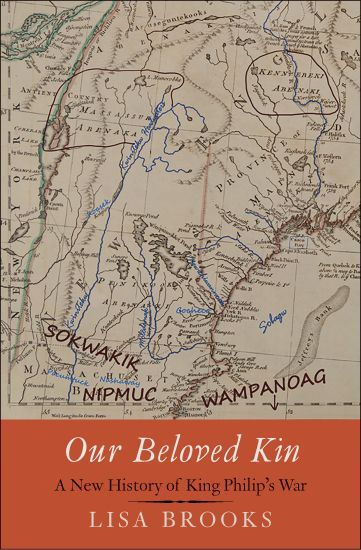
Winner of the 2019 Bancroft Prize: A compelling and original recovery of Native American resistance and adaptation to colonial America“By making what we thought was a small story very large indeed—Ms. Brooks really does give us ‘A New History of King Philip’s War.’”—The Wall Street Journal“Provides a wealth of information for both scholars and lay readers interested in Native American history.”—Publishers Weekly With rigorous original scholarship and creative narration, Lisa Brooks recovers a complex picture of war, captivity, and Native resistance during the “First Indian War” (later named King Philip’s War) by relaying the stories of Weetamoo, a female Wampanoag leader, and James Printer, a Nipmuc scholar, whose stories converge in the captivity of Mary Rowlandson. Through both a narrow focus on Weetamoo, Printer, and their network of relations, and a far broader scope that includes vast Indigenous geographies, Brooks leads us to a new understanding of the history of colonial New England and of American origins. Brooks’s pathbreaking scholarship is grounded not just in extensive archival research but also in the land and communities of Native New England, reading the actions of actors during the seventeenth century alongside an analysis of the landscape and interpretations informed by tribal history.
The Snow Lord and the Spring Fairy

The Snow Lord and the Spring Fairy

Lisa Brooks

Createspace Independent Publishing Platform
2017
nidottu
After the Paradise Prince lost his princess in a tragic accident, he couldn't bear to live on their beautiful, tropical island anymore. Grief-stricken, he moved to the most desolate place on earth-the Antarctic. Now known as the Snow Lord, he lives in an ice castle with his only friend, an albatross named Riley. Evolet, the Spring Fairy, knew her crocus bulbs couldn't survive in the Snow Lord's icy domain, but she planted them anyway. Furious at seeing the colorful blossoms peeking up through the snow, the Snow Lord captures the Spring Fairy and puts her in a cage. Unless Evolet can find a way to escape, there won't be any spring flowers this year. The Snow Lord and the Spring Fairy gently confronts the difficult emotions that come with the loss of a loved one. Evolet's determination, compassion and sense of responsibility make her the hero in this story. Today's female generation needs strong, positive role models to emulate, and boys must learn what qualities make a good man. As Lisa Brooks's readers have come to expect, this action-filled fantasy teems with compelling real-world facts that will fascinate children and encourage them to understand themselves as empowered stewards of the natural world.
The Common Pot

The Common Pot

Lisa Brooks

University of Minnesota Press
2008
nidottu
Illuminates the significance of writing to colonial-era Native American resistanceLiterary critics frequently portray early Native American writers either as individuals caught between two worlds or as subjects who, even as they defied the colonial world, struggled to exist within it. In striking counterpoint to these analyses, Lisa Brooks demonstrates the ways in which Native leaders-including Samson Occom, Joseph Brant, Hendrick Aupaumut, and William Apess-adopted writing as a tool to reclaim rights and land in the Native networks of what is now the northeastern United States. “The Common Pot,” a metaphor that appears in Native writings during the eighteenth and nineteenth centuries, embodies land, community, and the shared space of sustenance among relations. Far from being corrupted by forms of writing introduced by European colonizers, Brooks contends, Native people frequently rejected the roles intended for them by their missionary teachers and used the skills they acquired to compose petitions, political tracts, and speeches; to record community councils and histories; and most important, to imagine collectively the routes through which the Common Pot could survive.Reframing the historical landscape of the region, Brooks constructs a provocative new picture of Native space before and after colonization. By recovering and reexamining Algonquian and Iroquoian texts, she shows that writing was not a foreign technology but rather a crucial weapon in the Native Americans’ arsenal as they resisted-and today continue to oppose-colonial domination.