Kirjojen hintavertailu. Mukana 12 595 353 kirjaa ja 12 kauppaa.

Kirjailija

Lisa M Harrington

Kirjat ja teokset yhdessä paikassa: 21 kirjaa, julkaisuja vuosilta 2013-2025, suosituimpien joukossa Suitability of Missions for the Air Force Reserve Components. Vertaile teosten hintoja ja tarkista saatavuus suomalaisista kirjakaupoista.

Mukana myös kirjoitusasut: Lisa M. Harrington

21 kirjaa

Kirjojen julkaisuhaarukka 2013-2025.

Air Force Nonrated Technical Training

Air Force Nonrated Technical Training

Kathleen Reedy; Lisa M Harrington; Bart E Bennett; Barbara Bicksler; James R Broyles; Robert Corsi; Paul Emslie; Charles A Goldman; Daniel Ibarra; Darrell D Jones; Rita Karam; Matthew Walsh

RAND
2020
nidottu
The authors identify insights and best practices upon which the Air Force could draw to improve its nonrated technical training pipeline. The researchers examined three topics of interest identified by the Air Force: (1) how colleges and universities right-size their instructor corps, (2) best practices associated with supply chain management, and (3) approaches for developing a flexible instructor pool.
Suitability of Missions for the Air Force Reserve Components

Suitability of Missions for the Air Force Reserve Components

Albert A. Robbert; James H. Bigelow; John E. Boon; Lisa M. Harrington; Michael McGee; S. Craig Moore; Daniel M. Norton; William W. Taylor

RAND
2014
pokkari
The composition of Air Force active and reserve forces is often contentious, especially during a force drawdown. This document seeks to inform force composition decisions by clarifying issues that affect the suitability of missions for assignment to the reserve components.
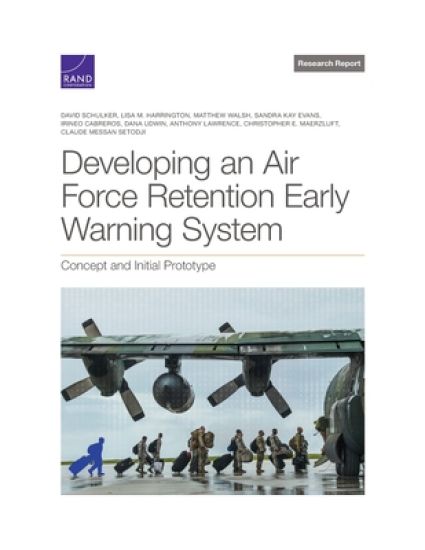
Developing an Air Force Retention Early Warning System

Developing an Air Force Retention Early Warning System

David Schulker; Lisa M Harrington; Matthew Walsh; Sandra Kay Evans; Irineo Cabreros; Dana Udwin; Anthony Lawrence; Christopher E Maerzluft; Claude Messan Setodji

RAND
2021
nidottu
Tasked with developing a new capability for U.S. Air Force human resources planners, the authors have developed an initial prediction prototype tool that can be used to alert decisionmakers of emerging problems and thus allow them enough time to consider adjusting accession and retention policies before shortages occur.
Air Force Non-Rated Technical Training

Air Force Non-Rated Technical Training

Lisa M Harrington; Kathleen Reedy; John A Ausink; Bart E Bennett; Barbara Bicksler; Darrell D Jones; Daniel Ibarra

RAND
2018
nidottu
In recent years the U.S. Air Force has faced persistent resource constraints while trying to deliver necessary training to its officer and enlisted forces. The Air Force therefore asked RAND Project AIR FORCE (PAF) to identify opportunities for optimizing processes at all levels of the nonrated technical training pipeline. This report presents PAF's assessment and recommends process and policy changes that could improve efficiency.
Rare Birds

Rare Birds

Caitlin Lee; Bart E Bennett; Lisa M Harrington; Darrell D Jones

RAND
2017
nidottu
To assist the Air Force in its goal of increasing representation in the most-senior joint positions, this report examines which senior joint positions matter most and why, quantifies Air Force representation in those positions, and recommends how the Air Force might control factors shaping joint leader selection.
Air Force Manpower Requirements and Component Mix

Air Force Manpower Requirements and Component Mix

Albert A. Robbert; Lisa M. Harrington; Tara L. Terry; Hugh G. Massey

RAND
2014
pokkari
Processes for determining U.S. Air Force manpower requirements vary across and within the workforces. The primary focus of this report is on quantitative manpower requirements processes and the extent to which they are validated, coordinated, and consistent. For wartime or deployment needs, this report seeks to determine if a common-sight picture of demands is available, particularly for non-operational, non-maintenance activities referred to as agile combat support. It also explores the qualitative side of personnel requirements.
Assessing Needs for Civilian Stem Talent in the Department of the Air Force

Assessing Needs for Civilian Stem Talent in the Department of the Air Force

Sean Robson; Lisa M Harrington; Kelly Atkinson; Alvin Moon; Nathan Thompson; Jonah Kushner; Grace Falgoust; Alice Nguyen; Barbara Bicksler; Joanna Zakzewski

RAND Corporation
2025
pokkari
In line with the Department of the Air Force's (DAF's) objective of enhancing technical capabilities across its civilian workforce, the authors of this report address challenges in determining DAF's science, technology, engineering, and mathematics (STEM) talent needs for this workforce, such as tracking the supply of such talent and identifying potential gaps in technical competencies.
Improving Trauma and Critical Care Proficiency and Readiness for Air Force Personnel in Critical Medical Specialties

Improving Trauma and Critical Care Proficiency and Readiness for Air Force Personnel in Critical Medical Specialties

Lisa M Harrington; Edward W Chan; Carl Berdahl; Matthew Walsh; Sean Mann; Jonah Kushner; Shreyas Bharadwaj; Mark Toukan; Thomas Goughnour

RAND Corporation
2024
pokkari
Most U.S. Air Force (USAF) medical personnel care for patients with ailments far less complex or urgent than the trauma-related injuries they would see in war, and the USAF must ensure that these personnel receive the training and experience they need for high-casualty environments. The authors present findings, recommendations, and a prototype framework to suggest readiness activities and policies that could be employed to prepare personnel for war.
Managing Military Personnel Costs

Managing Military Personnel Costs

Matthew Walsh; Lisa M Harrington; Thomas Light

RAND Corporation
2023
pokkari
To ensure a ready workforce without undercutting modernization and sustainment efforts, the U.S. Air Force must explore options to limit military personnel costs while considering the nonmonetary trade-offs and risks that these options entail. RAND Project AIR FORCE conducted a workforce futures policy game that simulates the monetary and nonmonetary effects of workforce and personnel policies in real time.
Air Force Manpower Determinants

Air Force Manpower Determinants

Albert A Robbert; Lisa M Harrington; Louis T Mariano; Susan A Resetar; David Schulker; John S Crown; Paul Emslie; Sean Mann; Gary Massey

RAND
2020
nidottu
The authors examine the process the Air Force uses to determine manpower requirements, compare it with processes used in other services and organizations, and evaluate options for increasing the efficiency of the Air Force process.
General and Flag Officer Costs

General and Flag Officer Costs

David Knapp; Michael Vasseur; Hannah Acheson-Field; Jonathan Welch; Lisa M Harrington

RAND
2020
nidottu
Researchers estimate average annual total costs of typical general and flag officers (G/FOs) as well as the annual total costs of specific G/FO positions in support of the Secretary of Defense's congressional reporting requirement. Estimated costs range from $270,000 for O-7 pay grades with no staff or travel to over $10 million for O-10 pay grades that receive continuous protection and must use government aircraft for official travel.
Air Force Institutional Requirements

Air Force Institutional Requirements

Lisa M Harrington; Kathleen Reedy; Paul Emslie; Darrell D Jones; Tara L Terry

RAND
2017
nidottu
Institutional requirements are funded manpower positions that can be difficult to fill because they do not align with traditional career fields, and they compete for the same personnel as operational and staff requirements. This report documents how the Air Force could reduce the impact of these requirements on career fields while ensuring that the organizations that depend on institutional requirements are staffed with qualified personnel.
Using Rand's Military Career Model to Evaluate the Impact of Institutional Requirements on the Air Force Space Officer Career Field
This report models the effect of filling institutional requirement (IR) positions on a career field's health. The report also examines how changing the number of IRs affects the operational development, career experience diversity, and career paths of space officers. The fill rates of most space jobs would not be affected by reductions in the total number of IRs allocated to the space career field. IR effects on space officers' careers could be lessened by careful job selection and position prioritization.
Air Force Management of the Defense Acquisition Workforce Development Fund

Air Force Management of the Defense Acquisition Workforce Development Fund

John A. Ausink; Lisa M. Harrington; Laura Werber; William A. Williams; John E. Boon; Michael H. Powell

RAND
2016
pokkari
Since the establishment of the Defense Acquisition Workforce Development Fund (DAWDF), the U.S. Air Force s Director of Acquisition Career Management (DACM) has received funds sufficient to pay for all initiatives that satisfy DAWDF criteria. Recognizing that this will not always be the case, the DACM asked the RAND Corporation to develop a decision framework to help prioritize DAWDF initiatives and ensure that the funds are used effectively."
A Methodology for Modeling the Flow of Military Personnel Across Air Force Active and Reserve Components

A Methodology for Modeling the Flow of Military Personnel Across Air Force Active and Reserve Components

Lisa M. Harrington; James H. Bigelow; Alexander Rothenberg; James Pita; Paul D. Emslie

RAND
2016
pokkari
Given the need for more integrated human capital management, the Assistant Secretary of the Air Force for Manpower and Reserve Affairs asked RAND PAF to help improve Air Force capability to analyze and capitalize on military personnel flows across the total force. In response, RAND built the Total Force Flow Model. Its description and capabilities will interest manpower and personnel managers and analysts both in and outside the Air Force.
Reserve Component General and Flag Officers

Reserve Component General and Flag Officers

Lisa M. Harrington; Igor Mikolic-Torreira; Geoffrey McGovern; Michael J. Mazarr; Peter Schirmer; Keith Gierlack; Jonathan Welch

RAND
2016
pokkari
Increased use of the reserve component, particularly since September 11, 2001, and an expectation that this role will continue and possibly increase in the future has renewed interest in the question of the appropriate number of reserve component general and flag officers (RC G/FOs). RAND researchers conducted a review of requirements and authorized strength for RC G/FOs.
Promoting Airmen with the Potential to Lead

Promoting Airmen with the Potential to Lead

Kirsten M. Keller; Sean Robson; Kevin O'Neill; Paul D. Emslie; Lane F. Burgette; Lisa M. Harrington; Dennis Curran

RAND
2014
pokkari
As the Air Force s operational environment has changed, more leadership responsibility is being pushed down to noncommissioned officers (NCOs). To ensure that it is selecting master sergeants (the first level of senior NCOs) who are able to fulfill these leadership responsibilities, RAND researchers assessed the current promotion system and explored areas for possible improvement."
Air Force-Wide Needs for Science, Technology, Engineering, and Mathematics (Stem) Academic Degrees

Air Force-Wide Needs for Science, Technology, Engineering, and Mathematics (Stem) Academic Degrees

Lisa M. Harrington; Lindsay Daugherty; S. Craig Moore; Tara L. Terry

RAND
2014
pokkari
Understating the needs for officers and civilians with science, technology, engineering, and mathematics degrees can diminish the Air Force s ability to maintain vital technical skills. RAND researchers defined which degrees were STEM and asked career field managers and senior authorities to identify those necessary now and in future. The results point to specific areas that the Air Force should review for current and emerging needs."