

Kirjailija
Livy
Kirjat ja teokset yhdessä paikassa: 106 kirjaa, julkaisuja vuosilta 1919-2025, suosituimpien joukossa Livy. Vertaile teosten hintoja ja tarkista saatavuus suomalaisista kirjakaupoista.
106 kirjaa
Kirjojen julkaisuhaarukka 1919-2025.



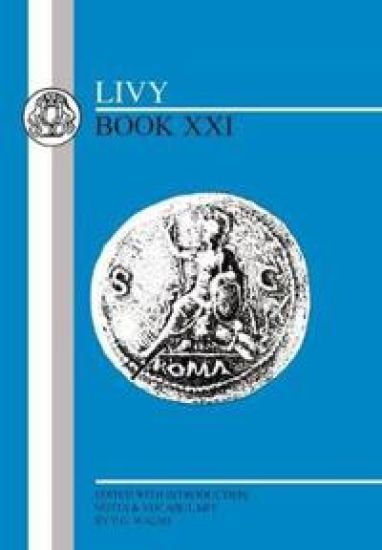
Book XXI of Livy's history of Rome is one of the most frequently read either in its entirety or in extracts, for it includes Carthaginian campaigns in Spain and Hannibal's momentous crossing of the Alps to invade Italy.P.G. Walsh's edition is designed specifically for use by students at A-Level. The commentary explains points of historical and literary importance, and elucidates grammatical peculiarities and passages of unusual difficulty. The introduction sets Livy in the context of Roman historiography as a whole, and deals in particular with Book XXI. There is a full vocabulary as well as an index of names and illustrative maps and plans.



Selections From the First Five Books, together With the Twenty-First and Twenty-Second Books Entire. Chiefly From the Text of Alschefski. With English Notes For Schools and Colleges. by J.L. Lincoln ... With An Accompanying Plan of Rome, and A Map of the P
Livy
University of Michigan Library
2006
pokkari

Livy’s first book covers the 'mythical' period of Rome, from the arrival of Aeneas in Italy, including the founding of Alba Longa and Rome, the lives of Romulus and Remus, and the period of Kingship up to the banishment of the last of the seven kings, Tarquinus Superbus and the election of the first consuls. The book opens with Livy’s important Preface which explains his rationale for writing this history.This edition, with introduction, commentary notes and vocabulary by H.E. Gould and J.L. Whiteley, was first published in Macmillan’s Modern School Classics series. The introduction covers the life and work of Livy, his role as an historian, Livy’s writing, style, grammar and syntax, and the historical context of the period. The edition’s comprehensive annotation, vocabulary and introduction elucidates essential points of historical content as well as providing all the linguistic support needed to understand the text, including glosses of obscure words, explanations of difficult phrases and grammatical support. A translation of the Preface and maps of Latium and Rome of the Regal Period are also included.

Roger Nichols’ translations provide a lively and highly readable collection of some of the best stories in Roman history. The selected stories, together with the linking narrative and commentary, give an account of the early history of Rome which will make an ideal topic for study on Roman civilisation and classical studies courses. The selection will also be useful to those taking classical literature in translation papers, who want to consider Livy’s role as a writer and historian.

T. Livii Patavini Historiarum Ab Urbe Condita Libri Qui Supersunt Omnes
Livy; Arnold Drakenborch; Johann Freinsheim
Hutson Street Press
2025
sidottu
T. Livii Patavini Historiarum Ab Urbe Condita Libri Qui Supersunt Omnes, Volume 15, Part 2, presents a comprehensive collection of Livy's surviving books on the history of Rome from its founding. This edition includes the complete notes of esteemed scholars such as Laur. Vallae, M. Ant. Sabellici, Beati Rhenani, and others, offering invaluable insights and interpretations of Livy's work. As a cornerstone of classical literature, Livy's history provides a detailed and engaging account of Rome's rise to power, its military campaigns, political developments, and social customs. This volume is essential for students and scholars of Roman history and Latin literature, providing a rich resource for understanding the ancient world through the eyes of one of its greatest historians. Preserving the original Latin text, this edition ensures the accessibility and enduring relevance of Livy's monumental work. This work has been selected by scholars as being culturally important, and is part of the knowledge base of civilization as we know it. This work was reproduced from the original artifact, and remains as true to the original work as possible. Therefore, you will see the original copyright references, library stamps (as most of these works have been housed in our most important libraries around the world), and other notations in the work. This work is in the public domain in the United States of America, and possibly other nations. Within the United States, you may freely copy and distribute this work, as no entity (individual or corporate) has a copyright on the body of the work. As a reproduction of a historical artifact, this work may contain missing or blurred pages, poor pictures, errant marks, etc. Scholars believe, and we concur, that this work is important enough to be preserved, reproduced, and made generally available to the public. We appreciate your support of the preservation process, and thank you for being an important part of keeping this knowledge alive and relevant.
The History of Rome by Titus Livius. Translated From the Original, With Notes and Illustrations, by G. Baker. VOL. V, THE THIRD EDITION
Livy; George A. M. Baker
Hutson Street Press
2025
sidottu
Title: The History of Rome by Titus Livius. Translated from the original, with notes and illustrations, by G. Baker. Publisher: British Library, Historical Print Editions The British Library is the national library of the United Kingdom. It is one of the world's largest research libraries holding over 150 million items in all known languages and formats: books, journals, newspapers, sound recordings, patents, maps, stamps, prints and much more. Its collections include around 14 million books, along with substantial additional collections of manuscripts and historical items dating back as far as 300 BC. The HISTORY OF THE ANCIENT WORLD collection includes books from the British Library digitised by Microsoft. Titles in this series include lectures, compiled sketches, and chronological discourses on Greece, Rome, and other early European and African civilisations. The collection also has a selection of physical and classical geography texts. ++++ The below data was compiled from various identification fields in the bibliographic record of this title. This data is provided as an additional tool in helping to insure edition identification: ++++ British Library Livy; Baker, George A.M.; 1822. 6 vol.; 8 . 9040.ff.8. This work has been selected by scholars as being culturally important, and is part of the knowledge base of civilization as we know it. This work was reproduced from the original artifact, and remains as true to the original work as possible. Therefore, you will see the original copyright references, library stamps (as most of these works have been housed in our most important libraries around the world), and other notations in the work. This work is in the public domain in the United States of America, and possibly other nations. Within the United States, you may freely copy and distribute this work, as no entity (individual or corporate) has a copyright on the body of the work. As a reproduction of a historical artifact, this work may contain missing or blurred pages, poor pictures, errant marks, etc. Scholars believe, and we concur, that this work is important enough to be preserved, reproduced, and made generally available to the public. We appreciate your support of the preservation process, and thank you for being an important part of keeping this knowledge alive and relevant.
Livy, Book 2 offers readers an enduring gateway into the historical narratives of ancient Rome. Written in Latin, this volume provides an invaluable resource for students and scholars alike, presenting Livy's compelling account of Rome's early history and the transition to the Republic. Edited by Robert Seymour Conway, this edition enhances accessibility, making it an essential addition to any classical library. Livy's work remains a cornerstone of historical and literary study, providing insight into the values, conflicts, and key figures that shaped Roman civilization. This book invites readers to explore the foundational myths and realities that continue to influence our understanding of power, politics, and society. This work has been selected by scholars as being culturally important, and is part of the knowledge base of civilization as we know it. This work was reproduced from the original artifact, and remains as true to the original work as possible. Therefore, you will see the original copyright references, library stamps (as most of these works have been housed in our most important libraries around the world), and other notations in the work. This work is in the public domain in the United States of America, and possibly other nations. Within the United States, you may freely copy and distribute this work, as no entity (individual or corporate) has a copyright on the body of the work. As a reproduction of a historical artifact, this work may contain missing or blurred pages, poor pictures, errant marks, etc. Scholars believe, and we concur, that this work is important enough to be preserved, reproduced, and made generally available to the public. We appreciate your support of the preservation process, and thank you for being an important part of keeping this knowledge alive and relevant.


Rome, from the beginning.Livy (Titus Livius), the great Roman historian, was born at Patavium (Padua) in 64 or 59 BC, where after years in Rome he died in AD 12 or 17. Livy’s history, composed as the imperial autocracy of Augustus was replacing the republican system that had stood for over five hundred years, presents in splendid style a vivid narrative of Rome’s rise from the traditional foundation of the city in 753 or 751 BC to 9 BC and illustrates the collective and individual virtues necessary to achieve and maintain such greatness.Of its 142 books, conventionally divided into pentads and decades, we have 1–10 and 21–45 complete, and short summaries (periochae) of all the rest except 41 and 43–45; 11–20 are lost, and of the rest only fragments and the summaries remain.The third decade constitutes our fullest surviving account of the momentous Second Punic (or Hannibalic) War, featuring a famous gallery of leaders Roman, Carthaginian, and Greek, all memorably drawn. It comprises two recognizable pentads: Books 21–25 narrate the run-up to conflict and Rome’s struggles in its first phase, with Hannibal dominant; Books 26–30 relate Rome’s revival and final victory, as the focus shifts to Scipio Africanus.This edition of the third decade, which replaces the original Loeb editions by B. O. Foster (Books 21–22) and Frank Gardner Moore (Books 23–30), offers a text based on the critical editions by John Briscoe (Books 21–25) and P. G. Walsh (Books 26–30), a fresh translation, and ample annotation fully current with modern scholarship.

Rome, from the beginning.Livy (Titus Livius), the great Roman historian, was born at Patavium (Padua) in 64 or 59 BC, where after years in Rome he died in AD 12 or 17. Livy’s history, composed as the imperial autocracy of Augustus was replacing the republican system that had stood for over five hundred years, presents in splendid style a vivid narrative of Rome’s rise from the traditional foundation of the city in 753 or 751 BC to 9 BC and illustrates the collective and individual virtues necessary to achieve and maintain such greatness.Of its 142 books, conventionally divided into pentads and decades, we have 1–10 and 21–45 complete, and short summaries (periochae) of all the rest except 41 and 43–45; 11–20 are lost, and of the rest only fragments and the summaries remain.The third decade constitutes our fullest surviving account of the momentous Second Punic (or Hannibalic) War, featuring a famous gallery of leaders Roman, Carthaginian, and Greek, all memorably drawn. It comprises two recognizable pentads: Books 21–25 narrate the run-up to conflict and Rome’s struggles in its first phase, with Hannibal dominant; Books 26–30 relate Rome’s revival and final victory, as the focus shifts to Scipio Africanus.This edition of the third decade, which replaces the original Loeb editions by B. O. Foster (Books 21–22) and Frank Gardner Moore (Books 23–30), offers a text based on the critical editions by John Briscoe (Books 21–25) and P. G. Walsh (Books 26–30), a fresh translation, and ample annotation fully current with modern scholarship.

Rome, from the beginning.Livy (Titus Livius), the great Roman historian, was born at Patavium (Padua) in 64 or 59 BC, where after years in Rome he died in AD 12 or 17. Livy’s history, composed as the imperial autocracy of Augustus was replacing the republican system that had stood for over five hundred years, presents in splendid style a vivid narrative of Rome’s rise from the traditional foundation of the city in 753 or 751 BC to 9 BC and illustrates the collective and individual virtues necessary to achieve and maintain such greatness.Of its 142 books, conventionally divided into pentads and decades, we have 1–10 and 21–45 complete, and short summaries (periochae) of all the rest except 41 and 43–45; 11–20 are lost, and of the rest only fragments and the summaries remain.The third decade constitutes our fullest surviving account of the momentous Second Punic (or Hannibalic) War, featuring a famous gallery of leaders Roman, Carthaginian, and Greek, all memorably drawn. It comprises two recognizable pentads: Books 21–25 narrate the run-up to conflict and Rome’s struggles in its first phase, with Hannibal dominant; Books 26–30 relate Rome’s revival and final victory, as the focus shifts to Scipio Africanus.This edition of the third decade, which replaces the original Loeb editions by B. O. Foster (Books 21–22) and Frank Gardner Moore (Books 23–30), offers a text based on the critical editions by John Briscoe (Books 21–25) and P. G. Walsh (Books 26–30), a fresh translation, and ample annotation fully current with modern scholarship.

Rome, from the beginning.Livy (Titus Livius), the great Roman historian, was born at Patavium (Padua) in 64 or 59 BC, where after years in Rome he died in AD 12 or 17. Livy’s history, composed as the imperial autocracy of Augustus was replacing the republican system that had stood for over five hundred years, presents in splendid style a vivid narrative of Rome’s rise from the traditional foundation of the city in 753 or 751 BC to 9 BC and illustrates the collective and individual virtues necessary to achieve and maintain such greatness.Of its 142 books, conventionally divided into pentads and decades, we have 1–10 and 21–45 complete, and short summaries (periochae) of all the rest except 41 and 43–45; 11–20 are lost, and of the rest only fragments and the summaries remain.The third decade constitutes our fullest surviving account of the momentous Second Punic (or Hannibalic) War, featuring a famous gallery of leaders Roman, Carthaginian, and Greek, all memorably drawn. It comprises two recognizable pentads: Books 21–25 narrate the run-up to conflict and Rome’s struggles in its first phase, with Hannibal dominant; Books 26–30 relate Rome’s revival and final victory, as the focus shifts to Scipio Africanus.This edition of the third decade, which replaces the original Loeb editions by B. O. Foster (Books 21–22) and Frank Gardner Moore (Books 23–30), offers a text based on the critical editions by John Briscoe (Books 21–25) and P. G. Walsh (Books 26–30), a fresh translation, and ample annotation fully current with modern scholarship.

An epic endeavor by a man genuinely enamored of his native Rome, Livy's "History of Rome" was originally written in 142 books spanning the entire history of the Roman people up to Livy's day in the time of Augustus in the first century BC. Of this monumental history, which took most of the Livy's life to complete, only 45 books still survive today. Livy begins with Aeneas' landing in Italy and the myth of the founding of Rome by Romulus. In later books Livy thoroughly covers the numerous wars and rulers of Rome. Though the work is a bit biased, its countless references to other sources are a testament of Livy's attempt to create an accurate, understandable history of the Roman Kingdom and later the Republic. Simultaneously a glorification of Rome and a passionate warning to future Romans, "Ab Urbe Condita" reflects the magnificence and ignominy, the opinions and interests, and the myths and political realities of one of history's most remarkable civilizations. This edition, which is printed on a premium acid-free paper and follows the translation of D. Spillan, collects the first five books of Livy's history beginning with the landing of Aeneas and concluding with the conquest of the Gauls.