Kirjojen hintavertailu. Mukana 12 595 353 kirjaa ja 12 kauppaa.

Kirjailija

Lloyd Rodwin

Kirjat ja teokset yhdessä paikassa: 8 kirjaa, julkaisuja vuosilta 1956-2013, suosituimpien joukossa The Future Metropolis. Vertaile teosten hintoja ja tarkista saatavuus suomalaisista kirjakaupoista.

8 kirjaa

Kirjojen julkaisuhaarukka 1956-2013.

The Future Metropolis

The Future Metropolis

Lloyd Rodwin

Literary Licensing, LLC
2011
sidottu
The Future Metropolis by Lloyd Rodwin is a comprehensive analysis of urban planning and design in the 21st century. The book explores the challenges and opportunities facing modern cities, such as population growth, sustainability, and social equity. It provides an in-depth analysis of the history of urban planning and design, and examines the successes and failures of past approaches.The book also looks at innovative solutions to urban problems, such as green infrastructure, smart technology, and community engagement. It argues that a holistic approach to urban planning is necessary for creating livable, sustainable, and equitable cities.Throughout the book, Rodwin draws on examples from cities around the world, including New York, Paris, and Singapore. He also provides case studies of successful urban projects, such as the High Line in New York City and the Cheonggyecheon River Restoration Project in Seoul.The Future Metropolis is a valuable resource for urban planners, designers, policymakers, and anyone interested in the future of cities. It offers a comprehensive overview of the challenges and opportunities facing modern cities, and provides practical solutions for creating livable, sustainable, and equitable urban environments.Contributing Authors Include Oscar Handlin, Raymond Vernon, Aaron Fleisher, And Many Others.This scarce antiquarian book is a facsimile reprint of the old original and may contain some imperfections such as library marks and notations. Because we believe this work is culturally important, we have made it available as part of our commitment for protecting, preserving, and promoting the world's literature in affordable, high quality, modern editions, that are true to their original work.
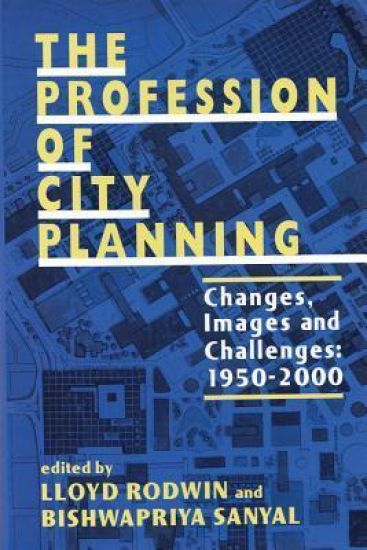
The Profession of City Planning

The Profession of City Planning

Lloyd Rodwin

Centre for Urban Policy Research,U.S.
2001
sidottu
In thirty-four provocative and insightful chapters, the nation's leading planners present a definitive assessment of fifty years of city planning and establish a benchmark for the profession for the next fifty years. The book appraises what planners do and how well they do it, how and why their current activities differ from past practices, and how much and in what ways planners have or have not enhanced the quality of urban life and contributed to the intellectual capital of the field.How have the goals, values, and practices of planners changed? What do planners say about their roles and the problems they confront? What is the relevance of their skills, from design capabilities and environmental savvy to intermediate and long-term perspectives and the pragmatics of implementation? The contributors seeking to answer these questions include Anthony Downs, Nathan Glazer, Philip B. Herr, Judith E. Innes, Terry S. Szold, Lawrence J. Vale, and Sam Bass Warner, Jr.The Profession of City Planning contrasts with the main changes in the US over the second half of the twentieth century in city planning. Sector images of the practice and effects of planning on housing, transportation, and the environment, as well as the development of economic tools are also discussed.
The Profession of City Planning

The Profession of City Planning

Lloyd Rodwin

Centre for Urban Policy Research,U.S.
2000
nidottu
In thirty-four provocative and insightful chapters, the nation's leading planners present a definitive assessment of fifty years of city planning and establish a benchmark for the profession for the next fifty years. The book appraises what planners do and how well they do it, how and why their current activities differ from past practices, and how much and in what ways planners have or have not enhanced the quality of urban life and contributed to the intellectual capital of the field.How have the goals, values, and practices of planners changed? What do planners say about their roles and the problems they confront? What is the relevance of their skills, from design capabilities and environmental savvy to intermediate and long-term perspectives and the pragmatics of implementation? The contributors seeking to answer these questions include Anthony Downs, Nathan Glazer, Philip B. Herr, Judith E. Innes, Terry S. Szold, Lawrence J. Vale, and Sam Bass Warner, Jr.The Profession of City Planning contrasts with the main changes in the US over the second half of the twentieth century in city planning. Sector images of the practice and effects of planning on housing, transportation, and the environment, as well as the development of economic tools are also discussed.
Rethinking the Development Experience

Rethinking the Development Experience

Donald A. Schon; Lloyd Rodwin

Brookings Institution
1994
nidottu
"This book, written by a group of distinguished scholars and practitioners, critically reappraises ideas about learning and development advanced by Albert O. Hirschman in the 1950s and 1960s. The essays—prepared for an MIT faculty seminar—show how these innovative ideas bear on the theory, policy, and practice of development in the 1990s. Hirschman, one of the great pioneers in the field of economic development, is now professor emeritus at Princeton.Paul Krugman, Lance Taylor, and Donald Schon address the different approaches and assumptions of economic theorists in relation to modelling, learning, and development policy. Emma Rothschild, Lisa Peattie, and Bishwapryiya Sanyal examine some of the changing attitudes toward economic progress. Elliot Marseille, Judith Tendler, Sara Friedheim, Robert Picciotto, and Charles Sabel draw lessons from efforts to innovate or modify institutions, policies, programs, and projects. Lloyd Rodwin examines the underlying themes that emerge, particularly those that touch on the ideas of development as a process of social learning and on ways of strengthening theory, policy, and practice in economics when it is seen as both discipline and profession.In a postscript, Albert O. Hirschman reflects on the evolution of his ideas, his cognitive style, and his propensity for self-subversion. Two appendixes detail the candid seminar discussions and Hirschman's musings in response to particular chapters and questions raised by the participants."