Kirjojen hintavertailu. Mukana 12 595 353 kirjaa ja 12 kauppaa.

Kirjailija

Lloyd Strickland

Kirjat ja teokset yhdessä paikassa: 10 kirjaa, julkaisuja vuosilta 2006-2025, suosituimpien joukossa Anthologie du Guide de Maïmonide par Leibniz. Vertaile teosten hintoja ja tarkista saatavuus suomalaisista kirjakaupoista.

10 kirjaa

Kirjojen julkaisuhaarukka 2006-2025.

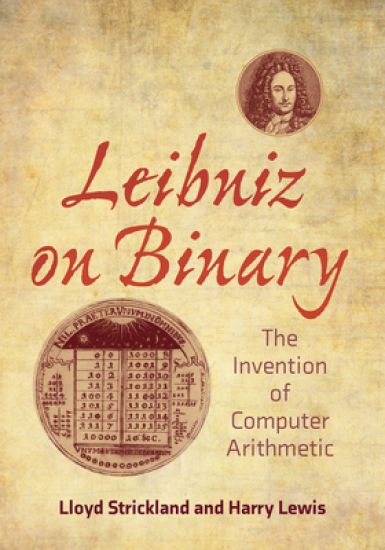
Leibniz on Binary

Leibniz on Binary

Lloyd Strickland; Harry R. Lewis

MIT PRESS LTD
2022
nidottu
The first collection of Leibniz's key writings on the binary system, newly translated, with many previously unpublished in any language. The polymath Gottfried Wilhelm Leibniz (1646-1716) is known for his independent invention of the calculus in 1675. Another major--although less studied--mathematical contribution by Leibniz is his invention of binary arithmetic, the representational basis for today's digital computing. This book offers the first collection of Leibniz's most important writings on the binary system, all newly translated by the authors with many previously unpublished in any language. Taken together, these thirty-two texts tell the story of binary as Leibniz conceived it, from his first youthful writings on the subject to the mature development and publication of the binary system. As befits a scholarly edition, Strickland and Lewis have not only returned to Leibniz's original manuscripts in preparing their translations, but also provided full critical apparatus. In addition to extensive annotations, each text is accompanied by a detailed introductory "headnote" that explains the context and content. Additional mathematical commentaries offer readers deep dives into Leibniz's mathematical thinking. The texts are prefaced by a lengthy and detailed introductory essay, in which Strickland and Lewis trace Leibniz's development of binary, place it in its historical context, and chart its posthumous influence, most notably on shaping our own computer age.
Proofs of God in Early Modern Europe

Proofs of God in Early Modern Europe

Lloyd Strickland

Baylor University Press
2018
nidottu
Proofs of God in Early Modern Europe offers a fascinating window into early modern efforts to prove God's existence. Assembled here are twenty-two key texts, many translated into English for the first time, which illustrate the variety of arguments that philosophers of the seventeenth and eighteenth centuries offered for God. These selections feature traditional proofs - such as various ontological, cosmological, and design arguments - but also introduce more exotic proofs, such as the argument from eternal truths, the argument from universal aseity, and the argument ex consensu gentium. Drawn from the work of eighteen philosophers, this book includes both canonical figures (such as Descartes, Spinoza, Newton, Leibniz, Locke, and Berkeley) and noncanonical thinkers (such as Norris, Fontenelle, Voltaire, Wolff, Du Ch?ótelet, and Maupertuis) and noncanonical thinkers (such as Norris, Fontenelle, Voltaire, Wolff, Du Chótelet, and Maupertuis).Lloyd Strickland provides fresh translations of all selections not originally written in English and updates the spelling and grammar of those that were. Each selection is prefaced by a lengthy headnote, giving a biographical account of its author, an analysis of the main argument(s), and important details about the historical context. Strickland's introductory essay provides further context, focusing on the various reasons that led so many thinkers of early modernity to develop proofs of God's existence.Proofs of God is perfect for both students and scholars of early modern philosophy and philosophy of religion.
The Philosophical Writings of Prémontval

The Philosophical Writings of Prémontval

Lloyd Strickland

Lexington Books
2018
sidottu
This volume contains the key philosophical writings of maverick Enlightenment philosopher André-Pierre Le Guay de Prémontval (1716-1764). Prémontval was a prolific member of the Berlin Academy of Sciences, and in his career as academic he wrote a series of essays and books on a range of core philosophical topics, such as necessity and contingency, free will, sufficient reason, personal identity, the nature of the mind and its relationship with the body, optimism, and the existence of God. Prémontval’s philosophy, shaped by his opposition to key philosophers such as Descartes, Leibniz, and Wolff, is notable for a number of original and often provocative positions on key philosophical issues of the time, which he supported by inventive critiques and a raft of novel arguments. In addition to developing a highly original proof for the existence of God based on the principles of atheism, Prémontval argued that all possible beings exist, and do so necessarily and therefore eternally; he insisted that the universe unfolded through an interplay of chance and necessity, its direction influenced by God but not under God’s direct control; and he considered free will a curse and the main impediment to the realization of the only aim fitting for God, which was to make all beings happy and holy as quickly as possible. His writings are notable for anticipating modern developments such as open theism, process theology, and animal theodicy. In this volume, Lloyd Strickland makes Prémontval’s key philosophical writings available in English for the first time. In making these translations, Strickland—a well-respected translator of Leibniz’s work—has consulted the original manuscripts to ensure the greatest accuracy, and as befits a scholarly edition, the texts are meticulously documented with copious annotations. Accompanying the texts is a substantial and informative introduction.
Leibniz's Monadology

Leibniz's Monadology

Lloyd Strickland

Edinburgh University Press
2014
nidottu
This is a fresh translation and in-depth commentary of Leibniz's seminal text, the Monadology. Written in 1714, the Monadology is widely considered to be the classic statement of Leibniz's mature philosophy. In the space of 90 numbered paragraphs, totalling little more than 6000 words, Leibniz outlines - and argues for - the core features of his philosophical system. Although rightly regarded as a masterpiece, it is also a very condensed work that generations of students have struggled to understand. Lloyd Strickland presents a new translation of the Monadology accompanied by an in-depth, section-by-section commentary that explains in detail not just what Leibniz is saying in the text but also why he says it. The sharp focus on the various arguments and other justifications Leibniz puts forward makes a deeper and more sympathetic understanding of his doctrines possible. This is a new translation of Leibniz's seminal text, by a well-known translator of Leibniz's works. It is a complete, in-depth, section-by-section commentary of the text, bringing to light Leibniz's arguments, principles and assumptions. It includes a detailed introduction, a schema of the text, glossary of terms, supplementary texts, questions for further study and suggestions for further reading to help you gain a solid understanding of the text.
Leibniz's Monadology

Leibniz's Monadology

Lloyd Strickland

Edinburgh University Press
2014
sidottu
Lloyd Strickland presents a new translation of the 'Monadology', alongside key parts of the 'Theodicy', and an in-depth, section-by-section commentary that explains in detail not just what Leibniz is saying in the text but also why he says it. The sharp focus on the various arguments and other justifications Leibniz puts forward makes possible a deeper and more sympathetic understanding of his doctrines. Written in 1714, the 'Monadology' is widely considered to be the classic statement of Leibniz's mature philosophy. In the space of 90 numbered paragraphs, totalling little more than 6000 words, Leibniz outlines and argues for the core features of his philosophical system. Although rightly regarded as a masterpiece, it is also a very condensed work that generations of students have struggled to understand.
Leibniz and the Two Sophies – The Philosophical Correspondence

Leibniz and the Two Sophies – The Philosophical Correspondence

Gottfried Wilhe Leibniz; Sophie Electress Of Ha; Queen Sophie Ch Of Prussia; Lloyd Strickland

University of Toronto Press
2011
nidottu
In his introduction, Lloyd Strickland proposes that Sophie, Electress of Hanover, and her daughter, Queen Sophie Charlotte of Prussia, found consolation in the idea of divine justice. Too long themselves unfairly dismissed as philosophical lightweights, proper justice may now be given to their views through this edition of their private correspondences with Leibniz. Appearing for the first time in English translation, the philosophical selections cover topics from the nature of substance to universal salvation and evidence the independence of the women’s thought as they defend materialism and challenge Leibniz’s conviction that God created the best possible world. The edition also boasts copious and highly informative editorial notes. It is a most welcome addition to The Other Voice in Early Modern Europe: Toronto series.
Leibniz Re-interpreted

Leibniz Re-interpreted

Lloyd Strickland

Continuum International Publishing Group Ltd.
2006
sidottu
"Leibniz Re-interpreted" tackles head on the central idea in Leibniz's philosophy, namely that we live in the best of all possible worlds. Strickland argues that Leibniz's theory has been consistently misunderstood by previous commentators. In the process Strickland provides both an elucidation and reinterpretation of a number of concepts central to Leibniz's work, such as "richness", "simplicity", "harmony" and "incompossibility", and shows where previous attempts to explain these concepts have failed. Thus the book provides an unignorable reinterpretation of many of the core themes of Leibniz's philosophy. This clear and concise study is tightly focussed and assumes no prior acquaintance with Leibniz or optimism. It thus serves as an ideal entry point into Leibniz's philosophy.