Kirjojen hintavertailu. Mukana 12 595 353 kirjaa ja 12 kauppaa.

Kirjailija

Longbing Cao

Kirjat ja teokset yhdessä paikassa: 8 kirjaa, julkaisuja vuosilta 2010-2025, suosituimpien joukossa Domain Driven Data Mining. Vertaile teosten hintoja ja tarkista saatavuus suomalaisista kirjakaupoista.

8 kirjaa

Kirjojen julkaisuhaarukka 2010-2025.

Global COVID-19 Research and Modeling

Global COVID-19 Research and Modeling

Longbing Cao

SPRINGER VERLAG, SINGAPORE
2025
nidottu
This book provides answers to fundamental and challenging questions regarding the global response to COVID-19. It creates a historical record of COVID-19 research conducted over the four years of the pandemic, with a focus on how researchers have responded, quantified, and modeled COVID-19 problems. Since mid-2021, we have diligently monitored and analyzed global scientific efforts in tackling COVID-19. Our comprehensive global endeavor involves collecting, processing, analyzing, and discovering COVID-19 related scientific literature in English since January 2020. This provides insights into how scientists across disciplines and almost every country and regions have fought against COVID-19. Additionally, we explore the quantification of COVID-19 problems and impacts through mathematics, AI, machine learning, data science, epidemiology, and domain knowledge. The book reports findings on publication quantities, impacts, collaborations, and correlations with the economy and infectionsglobally, regionally, and country-wide. These results represent the first and only holistic and systematic studies aimed at scientifically understanding, quantifying, and containing the pandemic. We hope this comprehensive analysis will contribute to better preparedness, response, and management of future emergencies and inspire further research in infectious diseases. The book also serves as a valuable resource for research policy, funding management authorities, researchers, policy makers, and funding bodies involved in infectious disease management, public health, and emergency resilience.
Global COVID-19 Research and Modeling

Global COVID-19 Research and Modeling

Longbing Cao

SPRINGER VERLAG, SINGAPORE
2024
sidottu
This book provides answers to fundamental and challenging questions regarding the global response to COVID-19. It creates a historical record of COVID-19 research conducted over the four years of the pandemic, with a focus on how researchers have responded, quantified, and modeled COVID-19 problems. Since mid-2021, we have diligently monitored and analyzed global scientific efforts in tackling COVID-19. Our comprehensive global endeavor involves collecting, processing, analyzing, and discovering COVID-19 related scientific literature in English since January 2020. This provides insights into how scientists across disciplines and almost every country and regions have fought against COVID-19. Additionally, we explore the quantification of COVID-19 problems and impacts through mathematics, AI, machine learning, data science, epidemiology, and domain knowledge. The book reports findings on publication quantities, impacts, collaborations, and correlations with the economy and infectionsglobally, regionally, and country-wide. These results represent the first and only holistic and systematic studies aimed at scientifically understanding, quantifying, and containing the pandemic. We hope this comprehensive analysis will contribute to better preparedness, response, and management of future emergencies and inspire further research in infectious diseases. The book also serves as a valuable resource for research policy, funding management authorities, researchers, policy makers, and funding bodies involved in infectious disease management, public health, and emergency resilience.
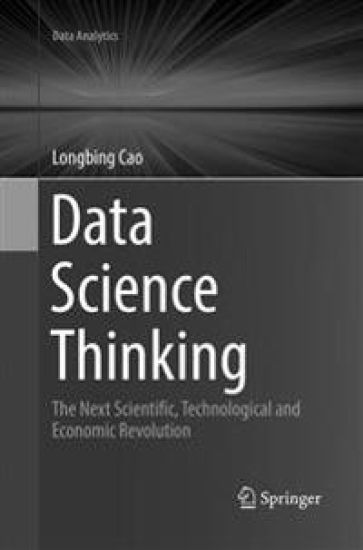
Data Science Thinking

Data Science Thinking

Longbing Cao

Springer Nature Switzerland AG
2019
nidottu
This book explores answers to the fundamental questions driving the research, innovation and practices of the latest revolution in scientific, technological and economic development: how does data science transform existing science, technology, industry, economy, profession and education? How does one remain competitive in the data science field? What is responsible for shaping the mindset and skillset of data scientists? Data Science Thinking paints a comprehensive picture of data science as a new scientific paradigm from the scientific evolution perspective, as data science thinking from the scientific-thinking perspective, as a trans-disciplinary science from the disciplinary perspective, and as a new profession and economy from the business perspective.
Data Science Thinking

Data Science Thinking

Longbing Cao

Springer International Publishing AG
2018
sidottu
This book explores answers to the fundamental questions driving the research, innovation and practices of the latest revolution in scientific, technological and economic development: how does data science transform existing science, technology, industry, economy, profession and education? How does one remain competitive in the data science field? What is responsible for shaping the mindset and skillset of data scientists? Data Science Thinking paints a comprehensive picture of data science as a new scientific paradigm from the scientific evolution perspective, as data science thinking from the scientific-thinking perspective, as a trans-disciplinary science from the disciplinary perspective, and as a new profession and economy from the business perspective.
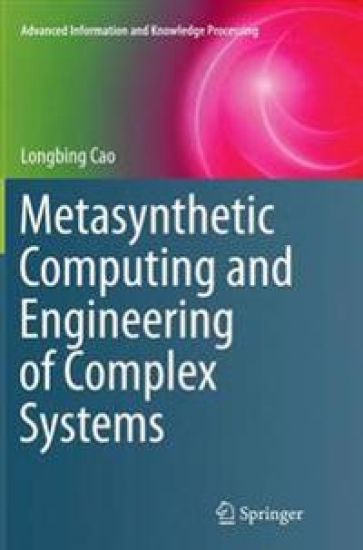
Metasynthetic Computing and Engineering of Complex Systems
Provides a comprehensive overview and introduction to the concepts, methodologies, analysis, design and applications of metasynthetic computing and engineering. The author: • Presents an overview of complex systems, especially open complex giant systems such as the Internet, complex behavioural and social problems, and actionable knowledge discovery and delivery in the big data era. • Discusses ubiquitous intelligence in complex systems, including human intelligence, domain intelligence, social intelligence, network intelligence, data intelligence and machine intelligence, and their synergy through metasynthetic engineering. • Explains the concept and methodology of human-centred, human-machine-cooperated qualitative-to-quantitative metasynthesis for understanding and managing open complex giant systems, and its computing approach: metasynthetic computing. • Introduces techniques and tools for analysing and designing problem-solving systems for open complex problems and systems. Metasynthetic Computing and Engineering uses the systematology methodology in addressing system complexities in open complex giant systems, for which it may not only be effective to apply reductionism or holism. The book aims to encourage and inspire discussions, design, implementation and reflection of effective methodologies and tools for computing and engineering open complex systems and problems. Researchers, research students and practitioners in complex systems, artificial intelligence, data science, computer science, and even system science, cognitive science, behaviour science, and social science, will find this book invaluable.
Metasynthetic Computing and Engineering of Complex Systems
Provides a comprehensive overview and introduction to the concepts, methodologies, analysis, design and applications of metasynthetic computing and engineering. The author: • Presents an overview of complex systems, especially open complex giant systems such as the Internet, complex behavioural and social problems, and actionable knowledge discovery and delivery in the big data era. • Discusses ubiquitous intelligence in complex systems, including human intelligence, domain intelligence, social intelligence, network intelligence, data intelligence and machine intelligence, and their synergy through metasynthetic engineering. • Explains the concept and methodology of human-centred, human-machine-cooperated qualitative-to-quantitative metasynthesis for understanding and managing open complex giant systems, and its computing approach: metasynthetic computing. • Introduces techniques and tools for analysing and designing problem-solving systems for open complex problems and systems. Metasynthetic Computing and Engineering uses the systematology methodology in addressing system complexities in open complex giant systems, for which it may not only be effective to apply reductionism or holism. The book aims to encourage and inspire discussions, design, implementation and reflection of effective methodologies and tools for computing and engineering open complex systems and problems. Researchers, research students and practitioners in complex systems, artificial intelligence, data science, computer science, and even system science, cognitive science, behaviour science, and social science, will find this book invaluable.
Domain Driven Data Mining

Domain Driven Data Mining

Longbing Cao; Philip S. Yu; Chengqi Zhang; Yanchang Zhao

Springer-Verlag New York Inc.
2014
nidottu
Data mining has emerged as one of the most active areas in information and c- munication technologies(ICT). With the boomingof the global economy,and ub- uitouscomputingandnetworkingacrosseverysectorand business,data andits deep analysis becomes a particularly important issue for enhancing the soft power of an organization, its production systems, decision-making and performance. The last ten years have seen ever-increasingapplications of data mining in business, gove- ment, social networks and the like. However, a crucial problem that prevents data mining from playing a strategic decision-support role in ICT is its usually limited decision-support power in the real world. Typical concerns include its actionability, workability, transferability, and the trustworthy, dependable, repeatable, operable and explainable capabilities of data mining algorithms, tools and outputs. This monograph, Domain Driven Data Mining, is motivated by the real-world challenges to and complexities of the current KDD methodologies and techniques, which are critical issues faced by data mining, as well as the ?ndings, thoughts and lessons learned in conducting several large-scale real-world data mining bu- ness applications. The aim and objective of domain driven data mining is to study effective and ef?cient methodologies, techniques, tools, and applications that can discover and deliver actionable knowledge that can be passed on to business people for direct decision-making and action-taking.
Domain Driven Data Mining

Domain Driven Data Mining

Longbing Cao; Philip S. Yu; Chengqi Zhang; Yanchang Zhao

Springer-Verlag New York Inc.
2010
sidottu
Data mining has emerged as one of the most active areas in information and c- munication technologies(ICT). With the boomingof the global economy,and ub- uitouscomputingandnetworkingacrosseverysectorand business,data andits deep analysis becomes a particularly important issue for enhancing the soft power of an organization, its production systems, decision-making and performance. The last ten years have seen ever-increasingapplications of data mining in business, gove- ment, social networks and the like. However, a crucial problem that prevents data mining from playing a strategic decision-support role in ICT is its usually limited decision-support power in the real world. Typical concerns include its actionability, workability, transferability, and the trustworthy, dependable, repeatable, operable and explainable capabilities of data mining algorithms, tools and outputs. This monograph, Domain Driven Data Mining, is motivated by the real-world challenges to and complexities of the current KDD methodologies and techniques, which are critical issues faced by data mining, as well as the ?ndings, thoughts and lessons learned in conducting several large-scale real-world data mining bu- ness applications. The aim and objective of domain driven data mining is to study effective and ef?cient methodologies, techniques, tools, and applications that can discover and deliver actionable knowledge that can be passed on to business people for direct decision-making and action-taking.