Kirjojen hintavertailu. Mukana 12 390 323 kirjaa ja 12 kauppaa.

Kirjailija

Louis P. Pojman

Kirjat ja teokset yhdessä paikassa: 10 kirjaa, julkaisuja vuosilta 1997-2026, suosituimpien joukossa Religious Belief and the Will. Vertaile teosten hintoja ja tarkista saatavuus suomalaisista kirjakaupoista.

10 kirjaa

Kirjojen julkaisuhaarukka 1997-2026.

Religious Belief and the Will

Religious Belief and the Will

Louis P. Pojman

TAYLOR FRANCIS LTD
2026
nidottu
Can we ever achieve belief by a direct act of will? If it will help us to be happier, should we make ourselves believe propositions which the evidence alone does not warrant? These are the sort of questions which Professor Pojman examines in Religious Belief and the Will (originally published in 1986). He deals with a constellation of problems related to believing and willing to believe; his main concern is with religious faith and belief, though his analysis is also of interest to epistemology and ethics. Pojman asks what is so important about believing propositions in the first place, and why religious creeds have made propositional belief a necessary condition for salvation. He considers whether one can be rational and still use the will to believe what the evidence alone does not warrant. He also discusses whether faith and belief are generically related or distinct attitudes. This is the first full-length treatise on religious belief that approaches the subject from the viewpoint of volitional activity (i.e., related to the will). It presents a rethinking of the way the will interacts with belief, a relationship often misconstrued in works of philosophy and theology. Pojman believes that the will is central to religious commitment, and that by understanding the relationship between the attitude of belief and the activity of willing, we are enabled to get fresh insight into the classical problem of religious belief and the will.
Religious Belief and the Will

Religious Belief and the Will

Louis P. Pojman

TAYLOR FRANCIS LTD
2024
sidottu
Can we ever achieve belief by a direct act of will? If it will help us to be happier, should we make ourselves believe propositions which the evidence alone does not warrant? These are the sort of questions which Professor Pojman examines in Religious Belief and the Will (originally published in 1986). He deals with a constellation of problems related to believing and willing to believe; his main concern is with religious faith and belief, though his analysis is also of interest to epistemology and ethics.Pojman asks what is so important about believing propositions in the first place, and why religious creeds have made propositional belief a necessary condition for salvation. He considers whether one can be rational and still use the will to believe what the evidence alone does not warrant. He also discusses whether faith and belief are generically related or distinct attitudes.This is the first full-length treatise on religious belief that approaches the subject from the viewpoint of volitional activity (i.e., related to the will). It presents a rethinking of the way the will interacts with belief, a relationship often misconstrued in works of philosophy and theology. Pojman believes that the will is central to religious commitment, and that by understanding the relationship between the attitude of belief and the activity of willing, we are enabled to get fresh insight into the classical problem of religious belief and the will.
The Moral Life

The Moral Life

Lewis Vaughn; Louis P. Pojman

Oxford University Press Inc
2022
nidottu
Ideal for introductory ethics courses, The Moral Life: An Introductory Reader in Ethics and Literature brings together a comprehensive collection of classical and contemporary readings on ethical theory and contemporary moral issues. The first two-thirds of the book comprises readings on historical and contemporary ethical theory; the final third is devoted to readings on a variety of contemporary moral issues. Integrating literature with philosophy in an innovative way, this anthology leverages literary works to enliven and make concrete the ethical theories and applied issues it covers.
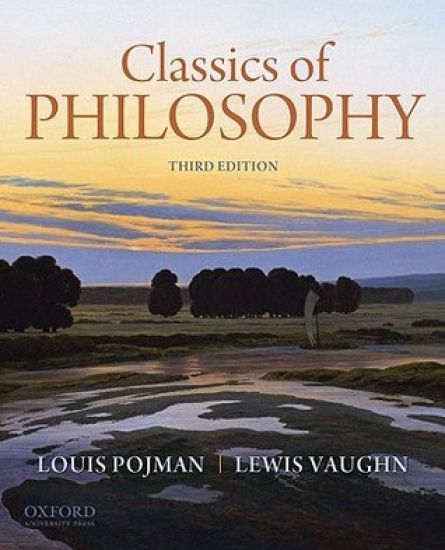
Classics of Philosophy

Classics of Philosophy

Louis P. Pojman; Lewis Vaughn

Oxford University Press Inc
2010
nidottu
Incorporating the insights of new coeditor Lewis Vaughn, Classics of Philosophy, Third Edition, is the most comprehensive anthology of writings in Western philosophy in print. Spanning 2,500 years of thought, it is ideal for introduction to philosophy and history of philosophy courses. It features more than seventy selections by forty philosophers—along with fragments from the Pre-Socratics—offering students and instructors an extensive and economical collection of the major works of the Western tradition. This volume contains the most important writings from Thales to Rawls; twenty of these are complete works, while the others are judiciously abridged so that little of value to the student is lost. A lucid introduction, including a brief biographical sketch, accompanies each of the featured philosophers. NEW TO THE THIRD EDITION: * Selections from philosophers who were not included in the previous edition—Maimonides (Guide for the Perplexed) and Schopenhauer (The World as Will and Representation)—along with Kant's Critique of Pure Reason * Expanded readings: Aristotle's Posterior Analytics, On the Soul, Metaphysics, and Nicomachean Ethics; Berkeley's Of the Principles of Human Knowledge; and Hume's Treatise on Human Nature * Review questions for each chapter and illustrated portraits of many philosophers * A Companion Website at www.oup.com/us/pojman featuring resources for students (self-quizzes, flash cards, chapter review questions, a timeline, and helpful web links) and instructors (brief reading summaries, essay questions, test questions, and PowerPoint-based lecture slides) Classics of Philosophy, Third Edition, provides students with an extensive view of the major stages of growth in Western philosophy—including its birth with the Pre-Socratics and its contemporary developments—in an accessible format and at an affordable price.
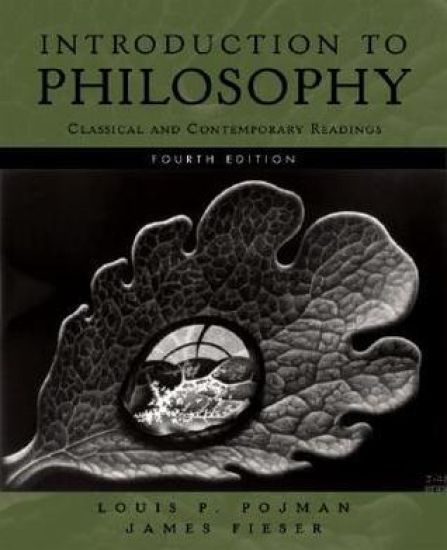
Introduction to Philosophy

Introduction to Philosophy

Louis P. Pojman; James Fieser

Oxford University Press Inc
2007
nidottu
Introduction to Philosophy is a topically-organized introductory anthology. Presenting differing arguments on each issue, its 84 selections represent some of WEstern philosophy's leading contributions across five major areas: theory of knowledge, philosophy of religion, philosophy of mind, free will and determinism, and moral philosophy. Louis P. Pojman and new co-editor James Fieser introduce each of these areas, their subsections, and each of the readings, providing background information and summarizing key themes. Beginning with the opening section - "What is Philosophy" - they present a compelling sampling of classical material while also highlightng some of philosophy's most influential contemporary work. Now in its fourth edition, the book features Questions for Further Reflection, Suggestions for Further Reading, a glossary, two appendices, and nine new selections.
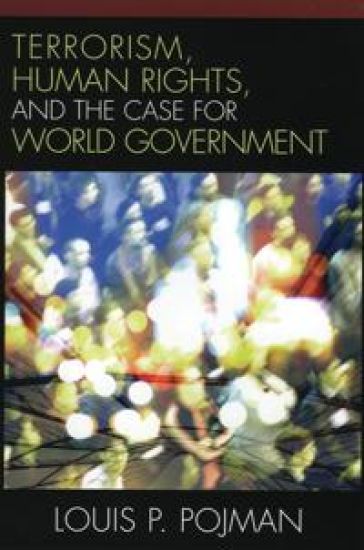
Terrorism, Human Rights, and the Case for World Government

Terrorism, Human Rights, and the Case for World Government

Louis P. Pojman

Rowman Littlefield Publishers
2006
sidottu
One of the nation's leading military ethicists, Louis P. Pojman argues that globalism and cosmopolitanism motivate the need for greater international cooperation based on enforceable international law. The best way to realize the promises of globalism and cogent moral arguments for cosmopolitanism, Pojman contends, is through the establishment of a World Government. In very readable prose, Pojman begins with a description of the growing menace of non-state terrorism on people everywhere, and distinguishes 'old-style' from 'new-style' terrorism. In Chapter 2, he examines the virtues and vices of nationalism, comparing them to the promises and problems of cosmopolitanism. Pojman ultimately argues that enforceable international law which will promote peace and curtail terrorism requires that we endorse a form of 'soft nationalism.' This form of nationalism is ultimately compatible with a limited, republican form of world government. Chapter 3 addresses universal human rights, arguing against the notion that they are an ethnocentric product of Western culture, and providing an overall justification of human rights as correlative to moral duties. Pojman concludes on a hopeful note, characterizing his proposal for a World Government as an effective counter-measure, albeit ambitious and controversial, to terrorism and its causes.
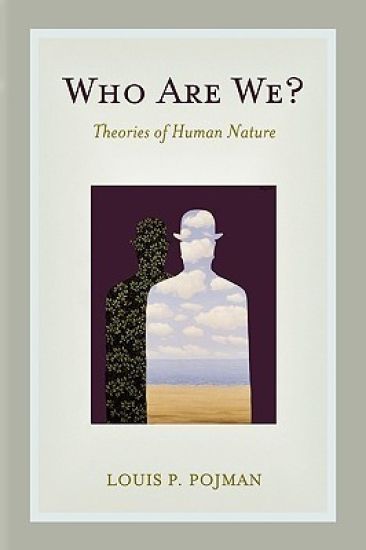
Who Are We?

Who Are We?

Louis P. Pojman

Oxford University Press Inc
2005
nidottu
Since the dawn of human history, people have exhibited wildly contradictory qualities: good and evil, love and hate, strength and weakness, kindness and cruelty, aggressiveness and pacifism, generosity and greed, courage and cowardice. Experiencing a sense of eternity in our hearts--but at the same time confined to temporal and spatial constraints--we seek to understand ourselves, both individually and as a species. What is our nature? What is this enigma that we call human? Who are we? In Who Are We?, esteemed author Louis P. Pojman seeks to find answers to these questions by exploring major theories in Western philosophy and religion, along with several traditions in Eastern thought. The most comprehensive work of its kind, the volume opens with chapters on the Hebrew/Christian view of human nature and the contrasting classical Greek theories, outlining a dichotomy between faith and reason that loosely frames the rest of the book. Following chapters cover the medieval view, Hindu and Buddhist perspectives, conservative and liberal theories, Kant's Copernican revolution, Schopenhauer's transcendental idealism, and Karl Marx's theory. Freud's psychoanalytic view, the existentialist perspective, the Darwinian view, and scientific-materialism are also discussed. Pojman concludes with a discussion of the question of free will, ultimately asserting that each one of us must decide for ourselves who and what we are, and, based on that answer, how we shall live.
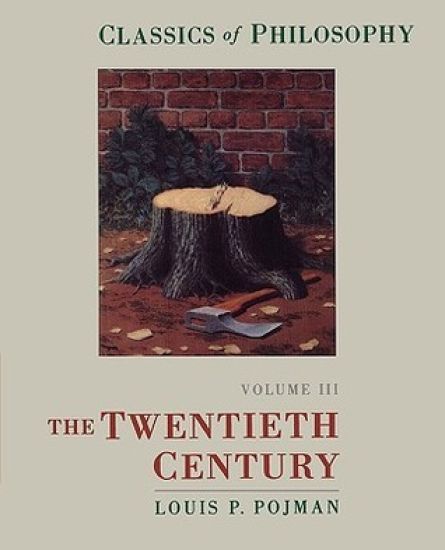
Classics of Philosophy: Volume III: The Twentieth Century

Classics of Philosophy: Volume III: The Twentieth Century

Louis P. Pojman

Oxford University Press Inc
2000
nidottu
This is Volume 3 of the most comprehensive anthology of writings in Western philosophy in print. It assembles the classic essays of Western philosophy of the twentieth century which have given shape and value to its character and structure. From logical Positivism, American Pragmatism, and Ordinary Language Philosophy to Continental Philosophy, the selections have been chosen because they are creative, controversial, and typically fascinating. Fifty four selections of thirty nine authors are included, featuring the work of McTaggart, Moore, Russell, Wittgenstein, Carnap. Quine, Ayer, Kipke, Harrison, Gettier, Goldman, Strawson, Ryle, Dennett, Davidson, Putnam, Nagel, Serle, Nozick, Rawls, Hussert, Heidegger, Sartre, Foucault, Derrida, Rourty, and Habermas. Also featured are seminal works in the philosophy of mind, free will/determinism, the debate over religious truth, and political and moral philosophy while the emphasis of the earlier volumes on epistemological and metaphysical issues continues. This is a collection which students and intelligent lay people can use without needing advanced technical ability in logic or semantics. The volume opens with a general essay by the editor on philosophy in the twentieth century; a biographical sketch accompanies each author; and each selection includes by an abstract and short bibliography.
Kierkegaard's Philosophy of Religion

Kierkegaard's Philosophy of Religion

Louis P. Pojman

International Scholars Publications,U.S.
1999
sidottu
The plan of this study is founded on a hypothesis that there is an overall argument in the Climacus writings (and reflected and supported in Kierkegaard's private papers and other writings): 1) There are two opposing ways to approach the truth: the objective and the subjective ways, 2) The objective way fails, 3) Hence the only appropriate way to the truth is the subjective way, 4) Christianity is the subjective way of life that meets all conditions for the highest subjectivity, 5) Hence Christianity is the appropriate way to reach the truth. The present work is sympathetically critical - always appreciative of Kierkegaard's genius but not always endorsing his arguments.
The Death Penalty

The Death Penalty

Jeffrey Reiman; Louis P. Pojman

Rowman Littlefield
1997
nidottu
Two distinguished social and political philosophers take opposing positions in this highly engaging work. Louis P. Pojman justifies the practice of execution by appealing to the principle of retribution: we deserve to be rewarded and punished according to the virtue or viciousness of our actions. He asserts that the death penalty does deter some potential murderers and that we risk the lives of innocent people who might otherwise live if we refuse to execute those deserving that punishment. Jeffrey Reiman argues that although the death penalty is a just punishment for murder, we are not morally obliged to execute murderers. Since we lack conclusive evidence that executing murderers is an effective deterrent and because we can foster the advance of civilization by demonstrating our intolerance for cruelty in our unwillingness to kill those who kill others, Reiman concludes that it is good in principle to avoid the death penalty, and bad in practice to impose it.