Kirjojen hintavertailu. Mukana 12 459 402 kirjaa ja 12 kauppaa.

Kirjailija

Love Ekenberg

Kirjat ja teokset yhdessä paikassa: 8 kirjaa, julkaisuja vuosilta 2011-2023, suosituimpien joukossa Deliberation, Representation, Equity. Vertaile teosten hintoja ja tarkista saatavuus suomalaisista kirjakaupoista.

8 kirjaa

Kirjojen julkaisuhaarukka 2011-2023.

Real-Life Decision-Making

Real-Life Decision-Making

Mats Danielson; Love Ekenberg

TAYLOR FRANCIS LTD
2023
sidottu
Have you ever experienced a decision situation that was hard to come to grips with? Did you ever feel a need to improve your decision-making skills? Is this something where you feel that you have not learned enough practical and useful methods? In that case, you are not alone! Even though decision-making is both considered and actually is a very important skill in modern work-life as well as in private life, these skills are not to any reasonable extent taught in schools at any level. No wonder many people do indeed feel the need to improve but have a hard time finding out how. This book is an attempt to remedy this shortcoming of our educational systems and possibly also of our common, partly intuition-based, decision culture. Intuition is not at all bad, quite the contrary, but it has to co-exist with rationality. We will show you how.Methods for decision-making should be of prime concern to any individual or organisation, even if the decision processes are not always explicitly or even consciously formulated. All kinds of organisations, as well as individuals, must continuously make decisions of the most varied nature in order to prosper and attain their objectives. A large part of the time spent in any organisation, not least at management levels, is spent gathering, processing, and compiling information for the purpose of making decisions supported by that information. The same interest has hitherto not been shown for individual decision-making, even though large gains would also be obtained at a personal level if important personal decisions were better deliberated. This book aims at changing that and thus attends to both categories of decision-makers.This book will take you through a journey starting with some history of decision-making and analysis and then go through easy-to-learn ways of structuring decision information and methods for analysing the decision situations, beginning with simple decision situations and then moving on to progressively harder ones, but never losing sight of the overarching goal that the reader should be able to follow the progression and being able to carry out similar decision analyses in real-life situations.The Open Access version of this book, available at www.taylorfrancis.com, has been made available under a Creative Commons Attribution-Non Commercial-No Derivatives 4.0 license.
Real-Life Decision-Making

Real-Life Decision-Making

Mats Danielson; Love Ekenberg

TAYLOR FRANCIS LTD
2023
nidottu
Have you ever experienced a decision situation that was hard to come to grips with? Did you ever feel a need to improve your decision-making skills? Is this something where you feel that you have not learned enough practical and useful methods? In that case, you are not alone! Even though decision-making is both considered and actually is a very important skill in modern work-life as well as in private life, these skills are not to any reasonable extent taught in schools at any level. No wonder many people do indeed feel the need to improve but have a hard time finding out how. This book is an attempt to remedy this shortcoming of our educational systems and possibly also of our common, partly intuition-based, decision culture. Intuition is not at all bad, quite the contrary, but it has to co-exist with rationality. We will show you how.Methods for decision-making should be of prime concern to any individual or organisation, even if the decision processes are not always explicitly or even consciously formulated. All kinds of organisations, as well as individuals, must continuously make decisions of the most varied nature in order to prosper and attain their objectives. A large part of the time spent in any organisation, not least at management levels, is spent gathering, processing, and compiling information for the purpose of making decisions supported by that information. The same interest has hitherto not been shown for individual decision-making, even though large gains would also be obtained at a personal level if important personal decisions were better deliberated. This book aims at changing that and thus attends to both categories of decision-makers.This book will take you through a journey starting with some history of decision-making and analysis and then go through easy-to-learn ways of structuring decision information and methods for analysing the decision situations, beginning with simple decision situations and then moving on to progressively harder ones, but never losing sight of the overarching goal that the reader should be able to follow the progression and being able to carry out similar decision analyses in real-life situations.The Open Access version of this book, available at www.taylorfrancis.com, has been made available under a Creative Commons Attribution-Non Commercial-No Derivatives 4.0 license.
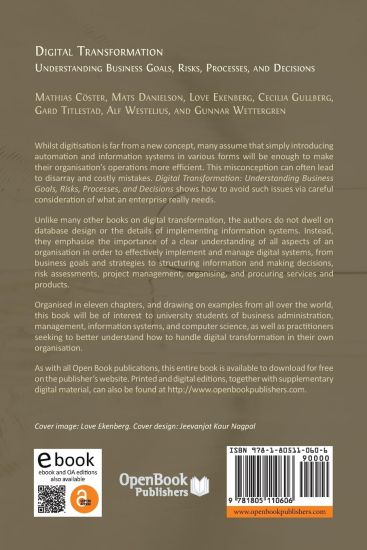
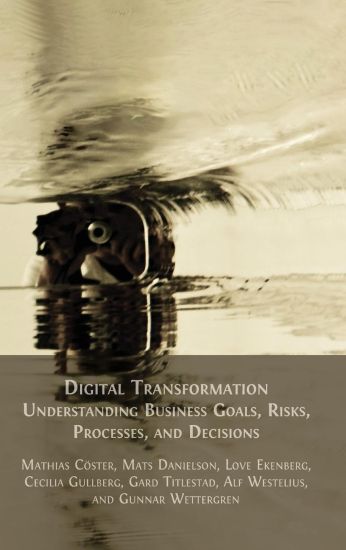
Digital Transformation: Understanding Business Goals, Risks, Processes, and Decisions

Digital Transformation: Understanding Business Goals, Risks, Processes, and Decisions

Mathias Cöster; Mats Danielson; Love Ekenberg

Open Book Publishers
2023
nidottu
Whilst digitisation is far from a new concept, many assume that simply introducing automation and information systems in various forms will be enough to make their organisation's operations more efficient. This misconception can often lead to disarray and costly mistakes. Digital Transformation: Understanding Business Goals, Risks, Processes, and Decisions shows how to avoid such issues via careful consideration of what an enterprise really needs. Unlike many other books on digital transformation, the authors do not dwell on database design or the details of implementing information systems. Instead, they emphasise the importance of a clear understanding of all aspects of an organisation in order to effectively implement and manage digital systems, from business goals and strategies to structuring information and making decisions, risk assessments, project management, organising, and procuring services and products. Organised in eleven chapters, and drawing on examples from all over the world, this book will be of interest to university students of business administration, management, information systems, and computer science, as well as practitioners seeking to better understand how to handle digital transformation in their own organisation.
Digital Transformation: Understanding Business Goals, Risks, Processes, and Decisions

Digital Transformation: Understanding Business Goals, Risks, Processes, and Decisions

Mathias Cöster; Mats Danielson; Love Ekenberg

Open Book Publishers
2023
sidottu
Whilst digitisation is far from a new concept, many assume that simply introducing automation and information systems in various forms will be enough to make their organisation's operations more efficient. This misconception can often lead to disarray and costly mistakes. Digital Transformation: Understanding Business Goals, Risks, Processes, and Decisions shows how to avoid such issues via careful consideration of what an enterprise really needs. Unlike many other books on digital transformation, the authors do not dwell on database design or the details of implementing information systems. Instead, they emphasise the importance of a clear understanding of all aspects of an organisation in order to effectively implement and manage digital systems, from business goals and strategies to structuring information and making decisions, risk assessments, project management, organising, and procuring services and products. Organised in eleven chapters, and drawing on examples from all over the world, this book will be of interest to university students of business administration, management, information systems, and computer science, as well as practitioners seeking to better understand how to handle digital transformation in their own organisation.
Organisering och digitalisering : att skapa värde i det 21:a århundradet

Organisering och digitalisering : att skapa värde i det 21:a århundradet

Mathias Cöster; Love Ekenberg; Cecilia Gullberg; Alf Westelius; Gunnar Wettergren

Liber
2017
nidottu
Digitaliseringen gör att förändringar sker allt snabbare. Förändringarna innebär stora möjligheter men lika stora risker. För att kunna utnyttja möjligheterna måste vi anpassa oss. Och vi måste göra det medvetet.Förändringarna ger organisationer bättre förutsättningar än någonsin för att lyckas, men för att lyckas behöver man förstå och utnyttja dem. Vissa klarar det, andra inte. Att digitalisera framgångsrikt är inte enkelt.Den här boken visar hur organisationer skapar värde i en digitaliserad verklighet. Boken går igenom digitalisering med utgångspunkt i vad en organisation egentligen är och vad den behöver. Den spänner över mål, affärsmodeller, strategier, organisering, beslut och projekt. Tyngdpunkten ligger på hur man strukturerar för att få effektivare beslutshantering och mer framgångsrika projektgenomföranden. Eftersom beslut och project är grundpelare för att kunna använda digitaliseringen.Boken lämpar sig särskilt väl för kurser i företagsekonomi, industriell ekonomi och data- och systemvetenskap. Men den vänder sig till alla som vill förstå hur organisationer ska hantera och dra nytta av digitaliseringen.Om författarnaFörfattarna har under många år arbetat som forskare, universitetslärare och konsulter inom olika aspekter av verksamhetsutveckling och förändringsarbete inom mängder av områden.
Deliberation, Representation, Equity

Deliberation, Representation, Equity

Love Ekenberg

Open Book Publishers
2017
sidottu
What can we learn about the development of public interaction in e-democracy from a drama delivered by mobile headphones to an audience standing around a shopping center in a Stockholm suburb? In democratic societies there is widespread acknowledgment of the need to incorporate citizens' input in decision-making processes in more or less structured ways. But participatory decision making is balancing on the borders of inclusion, structure, precision and accuracy. To simply enable more participation will not yield enhanced democracy, and there is a clear need for more elaborated elicitation and decision analytical tools. This rigorous and thought-provoking volume draws on a stimulating variety of international case studies, from flood risk management in the Red River Delta of Vietnam, to the consideration of alternatives to gold mining in Roșia Montană in Transylvania, to the application of multi-criteria decision analysis in evaluating the impact of e-learning opportunities at Uganda's Makerere University. Editors Love Ekenberg (senior research scholar, International Institute for Applied Systems Analysis IIASA], Laxenburg, professor of Computer and Systems Sciences, Stockholm University), Karin Hansson (artist and research fellow, Department of Computer and Systems Sciences, Stockholm University), Mats Danielson (vice president and professor of Computer and Systems Sciences, Stockholm University, affiliate researcher, IIASA) and G ran Cars (professor of Societal Planning and Environment, Royal Institute of Technology, Stockholm) draw innovative collaborations between mathematics, social science, and the arts. They develop new problem formulations and solutions, with the aim of carrying decisions from agenda setting and problem awareness through to feasible courses of action by setting objectives, alternative generation, consequence assessments, and trade-off clarifications. As a result, this book is important new reading for decision makers in government, public administration and urban planning, as well as students and researchers in the fields of participatory democracy, urban planning, social policy, communication design, participatory art, decision theory, risk analysis and computer and systems sciences.
Transcending Business Intelligence

Transcending Business Intelligence

Kjell Borking; Mats Danielson; Guy Davies; Love Ekenberg

Sine Metu Productions
2011
nidottu
How on Earth did this happen? The question is not infrequent, but more to the point, it?s unnecessary. It arises because in many cases people haven?t thought things through beforehand. Yes, sometimes people can be unlucky, but far from every time that things go awry; bad luck is never so consistent ? by definition. Thinking things through properly beforehand might seem a fairly obvious requirement for making a good decision, but startlingly often, even critical decisions are made without any in depth analysis. Well, there may have been some background data lying around somewhere, but not much is done with it. Though it's easy to blame authoritarian leadership or the like, poor decision making is far more usually due to not really knowing what to do with the available information, whether it's sufficient and what else needs to be known There?s nothing weird or idiotic about today?s decision makers, but there often is about the tools and methods available to them. It would be more accurate to say that many decision makers have been lead astray regarding their remit and capacity, but fortunately with structured decision processes they can be guided back on track far more easily than had they been as dim- witted as some of their decisions would indicate.Businesses introduce various BI solutions both timely and untimely, but what most of them don't have is any kind of methodology by which to deal with decisions. With no processes, knowledge, techniques or tools, they soon come to grief. Happily this is fairly easy to remedy.Decision processes and decision methods can be greatly improved. In this book we simply explain how to go about it.