Kirjojen hintavertailu. Mukana 12 657 676 kirjaa ja 12 kauppaa.

Kirjailija

Luc Herman

Kirjat ja teokset yhdessä paikassa: 5 kirjaa, julkaisuja vuosilta 2013-2026, suosituimpien joukossa Becoming Pynchon: Genetic Narratology and V.. Vertaile teosten hintoja ja tarkista saatavuus suomalaisista kirjakaupoista.

5 kirjaa

Kirjojen julkaisuhaarukka 2013-2026.

Becoming Pynchon: Genetic Narratology and V.

Becoming Pynchon: Genetic Narratology and V.

Luc Herman; John M. Krafft

OHIO STATE UNIVERSITY PRESS
2026
nidottu
The 1963 publication of Thomas Pynchon's V. changed the landscape of American fiction. Becoming Pynchon: Genetic Narratology and V. offers a detailed examination of the dramatic transformations that took place as Pynchon's foundational novel went from typescript to published work. Luc Herman and John M. Krafft develop and deploy a rich theory of genetic narratology to examine the performance of genre in the novel. Pushing back against the current dominance of cognitive narratology, they discuss focalization, character construction, and evocation of consciousness as clues to Pynchon's developing narratology of historical fiction. Their theoretical interventions offer an important and timely corrective to the field of narratology with a method that brings the author back into the analytical frame. Herman and Krafft use as their guide the typescript of V. that surfaced in 2001, when it was acquired by the Harry Ransom Humanities Research Center, as well as Pynchon's editorial correspondence with Corlies Smith, his first editor at J. B. Lippincott. Becoming Pynchon assembles a comprehensive and unequaled picture of Pynchon's writing process that will appeal both to Pynchonians and to postmodernism scholars more broadly.
Becoming Pynchon

Becoming Pynchon

Luc Herman

OHIO STATE UNIVERSITY PRESS
2023
sidottu
The 1963 publication of Thomas Pynchon's V. changed the landscape of American fiction. Becoming Pynchon: Genetic Narratology and V. offers a detailed examination of the dramatic transformations that took place as Pynchon's foundational novel went from typescript to published work. Luc Herman and John M. Krafft develop and deploy a rich theory of genetic narratology to examine the performance of genre in the novel. Pushing back against the current dominance of cognitive narratology, they discuss focalization, character construction, and evocation of consciousness as clues to Pynchon's developing narratology of historical fiction. Their theoretical interventions offer an important and timely corrective to the field of narratology with a method that brings the author back into the analytical frame. Herman and Krafft use as their guide the typescript of V. that surfaced in 2001, when it was acquired by the Harry Ransom Humanities Research Center, as well as Pynchon's editorial correspondence with Corlies Smith, his first editor at J. B. Lippincott. Becoming Pynchon assembles a comprehensive and unequaled picture of Pynchon's writing process that will appeal both to Pynchonians and to postmodernism scholars more broadly.
Handbook of Narrative Analysis

Handbook of Narrative Analysis

Luc Herman; Bart Vervaeck

University of Nebraska Press
2019
pokkari
Stories are everywhere, from fiction across media to politics and personal identity. Handbook of Narrative Analysis sorts out both traditional and recent narrative theories, providing the necessary skills to interpret any story. In addition to discussing classical theorists, such as Gérard Genette, Mieke Bal, and Seymour Chatman, Handbook of Narrative Analysis presents precursors (such as E. M. Forster), related theorists (Franz Stanzel, Dorrit Cohn), and a large variety of postclassical critics. Among the latter particular attention is paid to rhetorical, cognitive, and cultural approaches; intermediality; storyworlds; gender theory; and natural and unnatural narratology. Not content to consider theory as an end in itself, Luc Herman and Bart Vervaeck use two short stories and a graphic narrative by contemporary authors as touchstones to illustrate each approach to narrative. In doing so they illuminate the practical implications of theoretical preferences and the ideological leanings underlying them. Marginal glosses guide the reader through discussions of theoretical issues, and an extensive bibliography points readers to the most current publications in the field. Written in an accessible style, this handbook combines a comprehensive treatment of its subject with a user-friendly format appropriate for specialists and nonspecialists alike.Handbook of Narrative Analysis is the go-to book for understanding and interpreting narrative. This new edition revises and extends the first edition to describe and apply the last fifteen years of cutting-edge scholarship in the field of narrative theory.
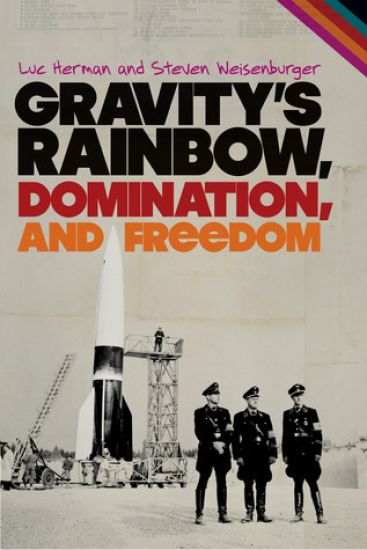
Gravity's Rainbow, Domination, and Freedom

Gravity's Rainbow, Domination, and Freedom

Luc Herman; Steven Weisenburger

University of Georgia Press
2013
pokkari
When published in 1973, Gravity’s Rainbow expanded our sense of what the novel could be. Pynchon’s extensive references to modern science, history, and culture challenged any reader, while his prose bent the rules for narrative art and his satirical practices taunted U.S. obscenity and pornography statutes. His writing thus enacts freedom even as the book’s great theme is domination: humanity’s diminished “chances for freedom” in a global military-industrial system birthed and set on its feet in World War II. Its symbol: the V-2 rocket.“Gravity’s Rainbow,” Domination, and Freedom broadly situates Pynchon’s novel in “long sixties” history, revealing a fiction deeply of and about its time. Herman and Weisenburger put the novel’s abiding questions about freedom in context with sixties struggles against war, restricted speech rights, ethno-racial oppression, environmental degradation, and subtle new means of social and psychological control. They show the text’s close indebtedness to critiques of domination by key postwar thinkers such as Erich Fromm, Herbert Marcuse, and Hannah Arendt. They detail equally powerful ways that sixties countercultural practices—free-speech resistance played out in courts, campuses, city streets, and raucously satirical underground presswork—provide a clearer bearing on Pynchon’s own satirical practices and their implicit criticisms.If the System has jacketed humanity in a total domination, may not a solitary individual still assert freedom? Or has the System captured all—even supposedly immune elites—in an irremediable dominion? Reading Pynchon’s main characters and storylines, this study realizes a darker Gravity’s Rainbow than critics have been willing to see.
Gravity's Rainbow, Domination, and Freedom

Gravity's Rainbow, Domination, and Freedom

Luc Herman; Steven Weisenburger

University of Georgia Press
2013
sidottu
When published in 1973, Gravity’s Rainbow expanded our sense of what the novel could be. Pynchon’s extensive references to modern science, history, and culture challenged any reader, while his prose bent the rules for narrative art and his satirical practices taunted U.S. obscenity and pornography statutes. His writing thus enacts freedom even as the book’s great theme is domination: humanity’s diminished “chances for freedom” in a global military-industrial system birthed and set on its feet in World War II. Its symbol: the V-2 rocket.“Gravity’s Rainbow,” Domination, and Freedom broadly situates Pynchon’s novel in “long sixties” history, revealing a fiction deeply of and about its time. Herman and Weisenburger put the novel’s abiding questions about freedom in context with sixties struggles against war, restricted speech rights, ethno-racial oppression, environmental degradation, and subtle new means of social and psychological control. They show the text’s close indebtedness to critiques of domination by key postwar thinkers such as Erich Fromm, Herbert Marcuse, and Hannah Arendt. They detail equally powerful ways that sixties countercultural practices—free-speech resistance played out in courts, campuses, city streets, and raucously satirical underground presswork—provide a clearer bearing on Pynchon’s own satirical practices and their implicit criticisms.If the System has jacketed humanity in a total domination, may not a solitary individual still assert freedom? Or has the System captured all—even supposedly immune elites—in an irremediable dominion? Reading Pynchon’s main characters and storylines, this study realizes a darker Gravity’s Rainbow than critics have been willing to see.