Kirjojen hintavertailu. Mukana 12 595 353 kirjaa ja 12 kauppaa.

Kirjailija

Luca Lambertini

Kirjat ja teokset yhdessä paikassa: 10 kirjaa, julkaisuja vuosilta 2006-2020, suosituimpien joukossa The Economics of Innovation. Vertaile teosten hintoja ja tarkista saatavuus suomalaisista kirjakaupoista.

10 kirjaa

Kirjojen julkaisuhaarukka 2006-2020.

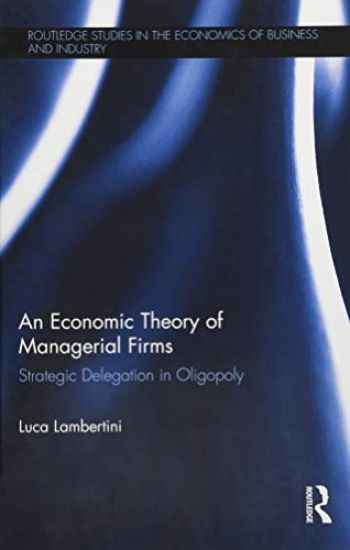
An Economic Theory of Managerial Firms
The separation between ownership and control has become common practice over the last century, in most medium and large firms across the world. Throughout the twentieth century, the theory of the firm and the theory of industrial organization developed parallel and complementary views on managerial firms. This book offers a comprehensive exposition of this debate.In its survey of strategic delegation in oligopoly games, An Economic Theory of Managerial Firms is able to offer a reinterpretation of a range of standard results in the light of the fact that the control of firms is generally not in the hand of its owners. The theoretical models are supported by a wealth of real-world examples, in order to provide a study of strategic delegation that is far more in-depth than has previously been found in the literature on industrial organization. In this volume, analysis is extended in several directions to cover applications concerning the role of: managerial firms in mixed market; collusion and mergers; divisionalization and vertical relations; technical progress; product differentiation; international trade; environmental issues; and the intertemporal growth of firms.This book is of great interest to those who study industrial economics, organizational studies and industrial studies.
Differential Games in Industrial Economics

Differential Games in Industrial Economics

Luca Lambertini

Cambridge University Press
2018
sidottu
Game theory has revolutionised our understanding of industrial organisation and the traditional theory of the firm. Despite these advances, industrial economists have tended to rely on a restricted set of tools from game theory, focusing on static and repeated games to analyse firm structure and behaviour. Luca Lambertini, a leading expert on the application of differential game theory to economics, argues that many dynamic phenomena in industrial organisation (such as monopoly, oligopoly, advertising, R&D races) can be better understood and analysed through the use of differential games. After illustrating the basic elements of the theory, Lambertini guides the reader through the main models, spanning from optimal control problems describing the behaviour of a monopolist through to oligopoly games in which firms' strategies include prices, quantities and investments. This approach will be of great value to students and researchers in economics and those interested in advanced applications of game theory.
Differential Games in Industrial Economics

Differential Games in Industrial Economics

Luca Lambertini

Cambridge University Press
2018
pokkari
Game theory has revolutionised our understanding of industrial organisation and the traditional theory of the firm. Despite these advances, industrial economists have tended to rely on a restricted set of tools from game theory, focusing on static and repeated games to analyse firm structure and behaviour. Luca Lambertini, a leading expert on the application of differential game theory to economics, argues that many dynamic phenomena in industrial organisation (such as monopoly, oligopoly, advertising, R&D races) can be better understood and analysed through the use of differential games. After illustrating the basic elements of the theory, Lambertini guides the reader through the main models, spanning from optimal control problems describing the behaviour of a monopolist through to oligopoly games in which firms' strategies include prices, quantities and investments. This approach will be of great value to students and researchers in economics and those interested in advanced applications of game theory.
An Economic Theory of Managerial Firms
The separation between ownership and control has become common practice over the last century, in most medium and large firms across the world. Throughout the twentieth century, the theory of the firm and the theory of industrial organization developed parallel and complementary views on managerial firms. This book offers a comprehensive exposition of this debate.In its survey of strategic delegation in oligopoly games, An Economic Theory of Managerial Firms is able to offer a reinterpretation of a range of standard results in the light of the fact that the control of firms is generally not in the hand of its owners. The theoretical models are supported by a wealth of real-world examples, in order to provide a study of strategic delegation that is far more in-depth than has previously been found in the literature on industrial organization. In this volume, analysis is extended in several directions to cover applications concerning the role of: managerial firms in mixed market; collusion and mergers; divisionalization and vertical relations; technical progress; product differentiation; international trade; environmental issues; and the intertemporal growth of firms.This book is of great interest to those who study industrial economics, organizational studies and industrial studies.
Oligopoly, the Environment and Natural Resources
Industrial production and consumption patterns rely heavily on the intensive use of both renewable and non-renewable resources and the consequences for the environment can be serious. Following a long period of time where the profit incentives of firms have prevailed over preservation of the environment and the world’s natural resources, a new consensus has emerged concerning the need to regulate firm behaviour, aimed at ensuring the sustainability of the economic system in the long run.This book offers an exhaustive overview of current economic debate about these topics, taking modern oligopoly theory as a benchmark. The first part of the book covers static models dealing with incentives for green research and development, Pigovian taxation, cartels, environmental quality and international trade, as well as the role of corporate social responsibility, public firms and consumer environmental awareness as endogenous regulatory instruments. Then, the author moves on to examine the role of time while drawing from optimal control and differential game theory. This opens the way to the discussion of fair discount rates to ensure the welfare of future generations, as well as the long run sustainability of production and consumption patterns.
Oligopoly, the Environment and Natural Resources
Industrial production and consumption patterns rely heavily on the intensive use of both renewable and non-renewable resources and the consequences for the environment can be serious. Following a long period of time where the profit incentives of firms have prevailed over preservation of the environment and the world’s natural resources, a new consensus has emerged concerning the need to regulate firm behaviour, aimed at ensuring the sustainability of the economic system in the long run.This book offers an exhaustive overview of current economic debate about these topics, taking modern oligopoly theory as a benchmark. The first part of the book covers static models dealing with incentives for green research and development, Pigovian taxation, cartels, environmental quality and international trade, as well as the role of corporate social responsibility, public firms and consumer environmental awareness as endogenous regulatory instruments. Then, the author moves on to examine the role of time while drawing from optimal control and differential game theory. This opens the way to the discussion of fair discount rates to ensure the welfare of future generations, as well as the long run sustainability of production and consumption patterns.
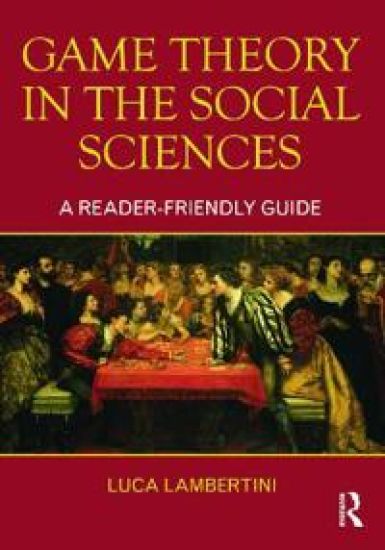
Game Theory in the Social Sciences

Game Theory in the Social Sciences

Luca Lambertini

Routledge
2011
sidottu
Individuals, firms, governments and nations behave strategically, for good and bad. Over the last few decades, game theory has been constructed and progressively refined to become the major tool used by social scientists to understand, predict and regulate strategic interaction among agents who often have conflicting interests. In the surprisingly anodyne jargon of the theory, they ‘play games’. This book offers an introduction to the basic tools of game theory and an overview of a number of applications to real-world cases, covering the areas of economics, politics and international relations. Each chapter is accompanied by some suggestions about further reading.
Game Theory in the Social Sciences

Game Theory in the Social Sciences

Luca Lambertini

Routledge
2011
nidottu
Individuals, firms, governments and nations behave strategically, for good and bad. Over the last few decades, game theory has been constructed and progressively refined to become the major tool used by social scientists to understand, predict and regulate strategic interaction among agents who often have conflicting interests. In the surprisingly anodyne jargon of the theory, they ‘play games’. This book offers an introduction to the basic tools of game theory and an overview of a number of applications to real-world cases, covering the areas of economics, politics and international relations. Each chapter is accompanied by some suggestions about further reading.
The Economics of Innovation

The Economics of Innovation

Roberto Cellini; Luca Lambertini

Elsevier Science Ltd
2008
sidottu
The book is a collection of original research papers by a number of industrial organization economists active in the field of Research and Development theory and policy. The contributions gathered here cover several relevant topics in this area; namely patent policy, the effects of market structure and the internal organization of the firm on R&D incentives and technical progress, R&D cooperation and technological spillovers, innovation and the entry process. Comprehensive views of the acquired knowledge of these topics are presented together with new insights on these issues, including policy insights wherever appropriate. The book is intended for professional researchers in industrial organization, antitrust officers, plus graduate students (at both Master and PhD level).
The Economics of Vertically Differentiated Markets

The Economics of Vertically Differentiated Markets

Luca Lambertini

Edward Elgar Publishing Ltd
2006
sidottu
This original new book offers a comprehensive and engaging perspective on the theory of vertical differentiation. It enables the reader to grasp the key concepts and effects that product quality has both on firms' behaviour and market structure, and the ways in which this relationship has evolved.With contributions from prominent figures in the field, the book investigates a number of important topics, such as the choice of the optimal product range, profit sharing, the existence of equilibrium in duopoly games, positional effects attached to status goods, international trade, collusion, advertising and the dynamics of capital accumulation for quality improvement and product innovation. Using both static and dynamic approaches, these aspects are assessed in relation to the manifold issues of regulation, competition policy and trade policy.Product differentiation and its influence on consumer behaviour and the performance of firms is a core topic in the existing literature in the fields of industrial organization, international trade and economic growth. This book will be an essential read for researchers, students and professional scholars working in these areas, especially those with an interest in antitrust regulation.