Kirjojen hintavertailu. Mukana 12 595 353 kirjaa ja 12 kauppaa.

Kirjailija

Ludger Woessmann

Kirjat ja teokset yhdessä paikassa: 6 kirjaa, julkaisuja vuosilta 2009-2023, suosituimpien joukossa Universal basic skills. Vertaile teosten hintoja ja tarkista saatavuus suomalaisista kirjakaupoista.

6 kirjaa

Kirjojen julkaisuhaarukka 2009-2023.

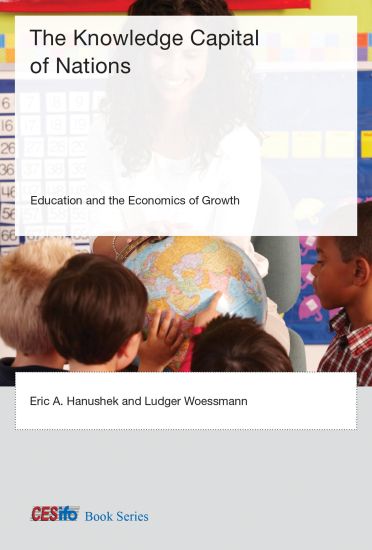
The Knowledge Capital of Nations

The Knowledge Capital of Nations

Eric A. Hanushek; Ludger Woessmann

MIT PRESS LTD
2023
pokkari
A rigorous, pathbreaking analysis demonstrating that a country's prosperity is directly related in the long run to the skills of its population. In this book Eric Hanushek and Ludger Woessmann make a simple, central claim, developed with rigorous theoretical and empirical support: knowledge is the key to a country's development. Of course, every country acknowledges the importance of developing human capital, but Hanushek and Woessmann argue that message has become distorted, with politicians and researchers concentrating not on valued skills but on proxies for them. The common focus is on school attainment, although time in school provides a very misleading picture of how skills enter into development. Hanushek and Woessmann contend that the cognitive skills of the population--which they term the "knowledge capital" of a nation--are essential to long-run prosperity. Hanushek and Woessmann subject their hypotheses about the relationship between cognitive skills (as consistently measured by international student assessments) and economic growth to a series of tests, including alternate specifications, different subsets of countries, and econometric analysis of causal interpretations. They find that their main results are remarkably robust, and equally applicable to developing and developed countries. They demonstrate, for example, that the "Latin American growth puzzle" and the "East Asian miracle" can be explained by these regions' knowledge capital. Turning to the policy implications of their argument, they call for an education system that develops effective accountability, promotes choice and competition, and provides direct rewards for good performance.
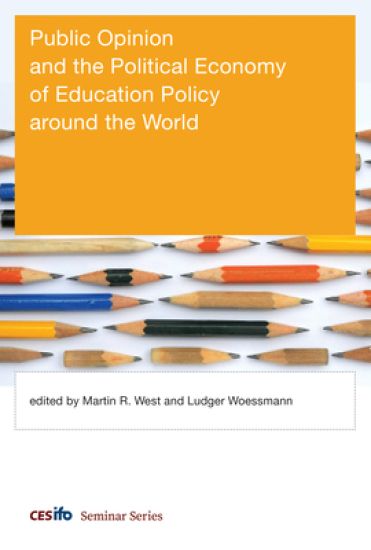
Public Opinion and the Political Economy of Education Policy around the World
Comparative analyses of the influence of public opinion on education policy in developed countries.Although research has suggested a variety of changes to education policy that have the potential to improve educational outcomes, politicians are often reluctant to implement such evidence-based reforms. Public opinion and pressure by interest groups would seem to have a greater role in shaping education policy than insights drawn from empirical data. The construction of a comparative political economy of education that seeks to explain policy differences among nations is long overdue. This book offers the first comparative inventory and analysis of public opinion and education in developed countries, drawing on data primarily from Europe and the United States.
New Directions in the Economics of Higher Education

New Directions in the Economics of Higher Education

Ludger Woessmann; Eric Bettinger

Edward Elgar Publishing Ltd
2020
sidottu
New Directions in the Economics of Higher Education provides an overview of the vibrant and growing field of the economics of higher education. The text assesses the full breadth of the topic, including the returns to higher education, college attendance and completion, higher education financing, educational production, and the market for higher education. This comprehensive literature review puts the collected papers into the perspective of developments in the wider literature on the economics of higher education over the past decade.
Endangering Prosperity

Endangering Prosperity

Eric A. Hanushek; Paul E. Peterson; Ludger Woessmann

Brookings Institution
2013
nidottu
"The relative deficiencies of U.S. public schools are a serious concern to parents and policymakers. But they should be of concern to all Americans, as a globalizing world introduces new competition for talent, markets, capital, and opportunity. In Endangering Prosperity, a trio of experts on international education policy compares the performance of American schools against that of other nations. The net result is a mixed but largely disappointing picture that clearly shows where improvement is most needed. The authors' objective is not to explain the deep causes of past failures but to document how dramatically the U.S. school system has failed its students and its citizens. It is a wake-up call for structural reform. To move forward to a different and better future requires that we understand just how serious a situation America faces today.For example, the authors consider the Programme for International Student Assessment (PISA), an international mathematics examination. America is stuck in the middle of average scores, barely beating out European countries whose national economies are in the red zone. U.S. performance as measured against stronger economies is even weaker—in total, 32 nations outperformed the United States. The authors also delve into comparative reading scores. A mere 31 percent of U.S. students in the class of 2011 could perform at the ""proficient"" level as measured by the National Assessment of Educational Progress (NAEP) program, compared with South Korea's result of 47 percent. And while some observers may downplay the significance of cross-globe comparisons, they should note that Canadian students are dramatically outpacing their U.S. counterparts as well.Clearly something is wrong with this picture, and this book clearly explicates the costs of inaction. The time for incremental tweaking the system is long past—wider, deeper, and more courageous steps are needed, as this book amply demonstrates with accessible prose, supported with hard data that simply cannot be ignored."
School Accountability, Autonomy and Choice Around the World

School Accountability, Autonomy and Choice Around the World

Ludger Woessmann; Elke Luedemann; Gabriela Schuetz; Martin R. West

Edward Elgar Publishing Ltd
2009
sidottu
Accountability, autonomy and choice are now the watchwords of education reformers around the globe. This book presents new evidence from the Programme for International Student Assessment (PISA) test on whether students perform better in school systems with such institutional measures in place. It also provides a theoretical framework for considering these reforms and summarizes previous international evidence. The results confirm that various policies promoting accountability, autonomy and choice are strongly associated with higher achievement for students from both disadvantaged and advantaged backgrounds. In particular, choice through public funding for private schools is associated with both higher performance overall and higher equality of opportunity.Providing detailed and rich facets of different forms of accountability, autonomy and choice, this book is unique in its empirically based and internationally oriented treatment of this up-to-date policy topic. It will be of great interest to academics, policy-makers and practitioners, as well as students in education policy and in the economics of education.