Kirjojen hintavertailu. Mukana 12 595 353 kirjaa ja 12 kauppaa.

Kirjailija

Luigi Fortuna

Kirjat ja teokset yhdessä paikassa: 25 kirjaa, julkaisuja vuosilta 1992-2025, suosituimpien joukossa Nonlinear Noninteger Order Circuits & Systems - An Introduction. Vertaile teosten hintoja ja tarkista saatavuus suomalaisista kirjakaupoista.

25 kirjaa

Kirjojen julkaisuhaarukka 1992-2025.

Essentials of Automatic Control with MATLAB in 20 Lessons

Essentials of Automatic Control with MATLAB in 20 Lessons

Luigi Fortuna; Mattia Frasca; Arturo Buscarino

TAYLOR FRANCIS LTD
2025
sidottu
This book is designed to explain the fundamental principles of automatic control through 20 lessons, each incorporating worked examples and MATLAB®-based exercises to help readers effectively understand and apply the proposed methods. It offers a concise and accessible resource for learning automatic control, blending simplicity with clarity. Drawing on decades of teaching experience, the authors aim to provide an approachable introduction to the core concepts of the discipline, encouraging further exploration through independent study.Integrates MATLAB® within a 20-lesson frameworkEnhances learning by supporting both theoretical understanding and practical problem-solvingPromotes critical thinking and problem-solving skills, essential competencies in today's AI-driven world.Focuses on classical topics related to Single-Input Single-Output (SISO) linear continuous-time systemsProvides introductory material on topics such as Multiple-Input Multiple-Output (MIMO) and discrete-time systems, serving as a bridge to more advanced studies.By establishing a strong foundation in these areas, the book prepares readers to tackle complex challenges in modern automatic control and excel in future academic and professional endeavors. Primarily intended for undergraduate engineering students, the book is also suitable for a wider audience. As automatic control is a foundational subject across numerous academic programs, this resource equips readers with essential analytical tools and introduces key problems, fostering deeper insights into the subject.
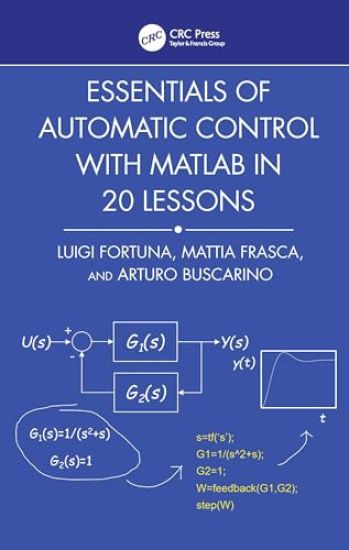
Essentials of Automatic Control with MATLAB in 20 Lessons

Essentials of Automatic Control with MATLAB in 20 Lessons

Luigi Fortuna; Mattia Frasca; Arturo Buscarino

TAYLOR FRANCIS LTD
2025
nidottu
This book is designed to explain the fundamental principles of automatic control through 20 lessons, each incorporating worked examples and MATLAB®-based exercises to help readers effectively understand and apply the proposed methods. It offers a concise and accessible resource for learning automatic control, blending simplicity with clarity. Drawing on decades of teaching experience, the authors aim to provide an approachable introduction to the core concepts of the discipline, encouraging further exploration through independent study.Integrates MATLAB® within a 20-lesson frameworkEnhances learning by supporting both theoretical understanding and practical problem-solvingPromotes critical thinking and problem-solving skills, essential competencies in today's AI-driven world.Focuses on classical topics related to Single-Input Single-Output (SISO) linear continuous-time systemsProvides introductory material on topics such as Multiple-Input Multiple-Output (MIMO) and discrete-time systems, serving as a bridge to more advanced studies.By establishing a strong foundation in these areas, the book prepares readers to tackle complex challenges in modern automatic control and excel in future academic and professional endeavors. Primarily intended for undergraduate engineering students, the book is also suitable for a wider audience. As automatic control is a foundational subject across numerous academic programs, this resource equips readers with essential analytical tools and introduces key problems, fostering deeper insights into the subject.
Nonlinear Resonance From Circuits To Systems

Nonlinear Resonance From Circuits To Systems

Luigi Fortuna; Arturo Buscarino

WORLD SCIENTIFIC PUBLISHING CO PTE LTD
2025
sidottu
This book is a specific monograph on nonlinear resonance in circuits and systems. The topic falls within the wider area of research that the authors have been developing during the last several years, which includes strange attractors and bifurcations in nonlinear circuits and control systems. Particularly, this monograph discusses the active use of jump resonance circuits, outlining the concept of multi jump and multiple hysteresis jump resonance with the aim of designing electronic circuits, either analog or digital, capable of sensing frequency drifts.The organization is optimized for the reader's quick acquisition of theoretical knowledge which can immediately be applied to carry out practical experiments on nonlinear circuits. The first few chapters present main concepts of jump resonance and the recent advances on nonlinear resonance. Then, the relevance of jump resonance is analyzed in the case of the Chua's circuit and presented in the discrete-time domain. The multi-jump resonance phenomenon is also studied, offering the real possibility of designing multi-jump resonance responses for multi-drift frequency detection. Some chapters focus on the presentation of practical devices, including digital solutions.This monograph is a suitable reading for both theorists and practitioners in nonlinear electronic circuits, especially those interested in how nonlinear resonance can be useful to design advanced circuits and systems.
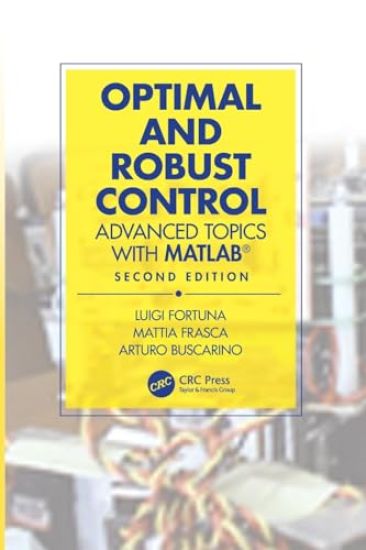
Optimal and Robust Control

Optimal and Robust Control

Luigi Fortuna; Mattia Frasca; Arturo Buscarino

TAYLOR FRANCIS LTD
2024
nidottu
There are many books on advanced control for specialists, but not many present these topics for non-specialists. Assuming only a basic knowledge of automatic control and signals and systems, this second edition of Optimal and Robust Control offers a straightforward, self-contained handbook of advanced topics and tools in automatic control.The book deals with advanced automatic control techniques, paying particular attention to robustness-the ability to guarantee stability in the presence of uncertainty. It explains advanced techniques for handling uncertainty and optimizing the control loop. It also details analytical strategies for obtaining reduced order models. The authors then propose using the Linear Matrix Inequality (LMI) technique as a unifying tool to solve many types of advanced control problems. Topics covered in the book include, LQR and H8 approaches Kalman and singular value decomposition Open-loop balancing and reduced order models Closed-loop balancing Positive-real systems, bounded-real systems, and imaginary-negative systems Criteria for stability control Time-delay systemsThis easy-to-read text presents the essential theoretical background and provides numerous examples and MATLAB® exercises to help the reader efficiently acquire new skills. Written for electrical, electronic, computer science, space, and automation engineers interested in automatic control, this book can also be used for self-study of for a one-semester course in robust control.This fully renewed second edition of the book also includes new fundamental topics such as Lyapunov functions for stability, variational calculus, formulation in terms of optimization problems of matrix algebraic equations, negative-imaginary systems, and time-delay systems.
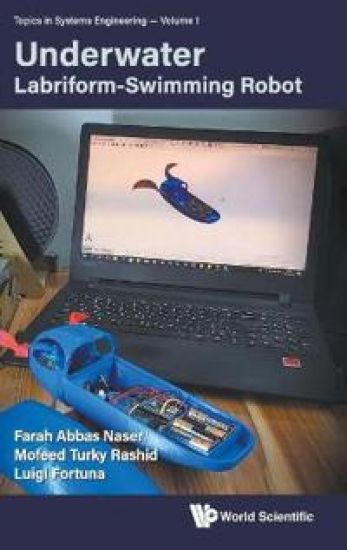
Underwater Labriform-swimming Robot

Underwater Labriform-swimming Robot

Farah Abbas Naser; Mofeed Turky Rashid; Luigi Fortuna

World Scientific Publishing Co Pte Ltd
2021
sidottu
This book provides a simplified description of how to design an underwater swimming robot, inspired by the mechanism of the Labriform mode of fish. This style of swimming depends on the pectoral fins only as a main locomotor for movement. A unique model with fins having a concave shape allows the highest thrust force to be achieved during the power period and the lowest drag force during the recovery period, especially if the velocity values between the powering and recovery periods are manipulated.Besides the ability to swim quickly, the proposed model was also inspired by a method of maneuvering based on the principle of differential drive for two-wheel mobile robot, achieving the minimum turning radius by controlling the speed of the rowing fins.Also, by applying the technique of the diving model used by gliders, the robot achieves underwater gliding by changing the center of the body's mass. Thus, the robot obtains the ability to dive and float in a manner similar to the Sawtooth wave.All the mentioned tasks were conducted via laboratory experiments and proven to be both effective and efficient.
Optimal and Robust Control

Optimal and Robust Control

Luigi Fortuna; Mattia Frasca; Arturo Buscarino

TAYLOR FRANCIS LTD
2021
sidottu
There are many books on advanced control for specialists, but not many present these topics for non-specialists. Assuming only a basic knowledge of automatic control and signals and systems, this second edition of Optimal and Robust Control offers a straightforward, self-contained handbook of advanced topics and tools in automatic control.The book deals with advanced automatic control techniques, paying particular attention to robustness-the ability to guarantee stability in the presence of uncertainty. It explains advanced techniques for handling uncertainty and optimizing the control loop. It also details analytical strategies for obtaining reduced order models. The authors then propose using the Linear Matrix Inequality (LMI) technique as a unifying tool to solve many types of advanced control problems. Topics covered in the book include, LQR and H8 approaches Kalman and singular value decomposition Open-loop balancing and reduced order models Closed-loop balancing Positive-real systems, bounded-real systems, and imaginary-negative systems Criteria for stability control Time-delay systemsThis easy-to-read text presents the essential theoretical background and provides numerous examples and MATLAB® exercises to help the reader efficiently acquire new skills. Written for electrical, electronic, computer science, space, and automation engineers interested in automatic control, this book can also be used for self-study of for a one-semester course in robust control.This fully renewed second edition of the book also includes new fundamental topics such as Lyapunov functions for stability, variational calculus, formulation in terms of optimization problems of matrix algebraic equations, negative-imaginary systems, and time-delay systems.
Essentials of Nonlinear Circuit Dynamics with MATLAB® and Laboratory Experiments

Essentials of Nonlinear Circuit Dynamics with MATLAB® and Laboratory Experiments

Arturo Buscarino; Luigi Fortuna; Mattia Frasca

CRC Press
2021
nidottu
This book deals with nonlinear dynamics of electronic circuits, which could be used in robot control, secure communications, sensors and synchronized networks. The genesis of the content is related to a course on complex adaptive systems that has been held at the University of Catania since 2005. The efforts are devoted in order to emulate with nonlinear electronic circuits nonlinear dynamics. Step-by-step methods show the essential concepts of complex systems by using the Varela diagrams and accompanying MATLAB® exercises to reinforce new information. Special attention has been devoted to chaotic systems and networks of chaotic circuits by exploring the fundamentals, such as synchronization and control. The aim of the book is to give to readers a comprehensive view of the main concepts of nonlinear dynamics to help them better understand complex systems and their control through the use of electronics devices.
500 Years After Leonardo Da Vinci Machines: Towards Innovation And Control

500 Years After Leonardo Da Vinci Machines: Towards Innovation And Control

Maide Bucolo; Arturo Buscarino; Carlo Famoso; Luigi Fortuna; Salvina Gagliano

World Scientific Publishing Co Pte Ltd
2020
nidottu
The book focuses on the role of the Leonardo da Vinci projects and inventions, specifically the interdisciplinarity of his studies that represents perhaps the first example of the paradigm of complex systems engineering. The projects are characterized within a modern conception of his thinking, looking at the main motivations behind his machines. The book also proposes a set of experimental realizations of the models made mainly in wood, using the actual concept of automatic control and microcontroller technology emphasizing that the Leonardo machines can be seen in agreement with modern current technology.The remote control of each machine is considered and the behavior of each monitored. Machines are revisited based on the transmission principle that adopts microcontrollers and bluetooth devices, studying the equipment behind the actuation of the systems. Thus, the paradigm of each machine is maintained unaltered while the latest technologies show the relevance of such inventions in the modern era. The study also stimulated more applications and future projects that can start from the original Leonardo projects and then proceed to the next centuries, providing readers simple and efficient ideas to innovate his projects using modern low-cost microcontrollers.
500 Years After Leonardo Da Vinci Machines: Towards Innovation And Control

500 Years After Leonardo Da Vinci Machines: Towards Innovation And Control

Maide Bucolo; Arturo Buscarino; Carlo Famoso; Luigi Fortuna; Salvina Gagliano

World Scientific Publishing Co Pte Ltd
2020
sidottu
The book focuses on the role of the Leonardo da Vinci projects and inventions, specifically the interdisciplinarity of his studies that represents perhaps the first example of the paradigm of complex systems engineering. The projects are characterized within a modern conception of his thinking, looking at the main motivations behind his machines. The book also proposes a set of experimental realizations of the models made mainly in wood, using the actual concept of automatic control and microcontroller technology emphasizing that the Leonardo machines can be seen in agreement with modern current technology.The remote control of each machine is considered and the behavior of each monitored. Machines are revisited based on the transmission principle that adopts microcontrollers and bluetooth devices, studying the equipment behind the actuation of the systems. Thus, the paradigm of each machine is maintained unaltered while the latest technologies show the relevance of such inventions in the modern era. The study also stimulated more applications and future projects that can start from the original Leonardo projects and then proceed to the next centuries, providing readers simple and efficient ideas to innovate his projects using modern low-cost microcontrollers.
Synchronization in Networks of Nonlinear Circuits

Synchronization in Networks of Nonlinear Circuits

Mattia Frasca; Lucia Valentina Gambuzza; Arturo Buscarino; Luigi Fortuna

Springer International Publishing AG
2018
nidottu
This book addresses synchronization in networks of coupled systems. It illustrates the main aspects of the phenomenon through concise theoretical results and code, allowing readers to reproduce them and encouraging readers to pursue their own experimentation. The book begins by introducing the mathematical representation of nonlinear circuits and the code for their simulation. This is followed by a brief account of the concept of the complex network, which describes the main aspects of complex networks and the main model types, with a particular focus on the code used to study and reproduce the models. The focus then shifts to the process through which independent nonlinear circuits that follow different trajectories without coupling share some properties of their motion: synchronization. The authors present the main techniques for studying synchronization in complex networks, including the major measures, the stability properties and control techniques. The book then moves on to advanced topics in synchronization of complex networks by examining forms of synchronization in which not all the units share the same trajectory, namely chimera states, clustering synchronization, and relay and remote synchronization. Simple codes for experimentation with these topics and control methods are also provided. In closing, the book addresses the problem of synchronization in time-varying networks.
Control Of Imperfect Nonlinear Electromechanical Large Scale Systems: From Dynamics To Hardware Implementation

Control Of Imperfect Nonlinear Electromechanical Large Scale Systems: From Dynamics To Hardware Implementation

Luigi Fortuna; Arturo Buscarino; Mattia Frasca; Carlo Famoso

World Scientific Publishing Co Pte Ltd
2017
sidottu
This book focuses on a class of uncertain systems that are called imperfect, and shows how much systems can regularly work if an appropriate control strategy is adopted. Along with some practical well studied examples, a formalization of the models for imperfect system is considered and a control strategy is proposed. Experimental case studies on electromechanical systems are also included.New concepts, experimental innovative circuits and laboratory details allow the reader to implement at low cost the outlined strategy. Emergent topics in nonlinear device realization are emphasized with the aim to allow researchers and students to perform experiments with large scale electromechanical systems. Moreover, the possibility of using imperfections and noise to generate nonlinear strange behavior is discussed.
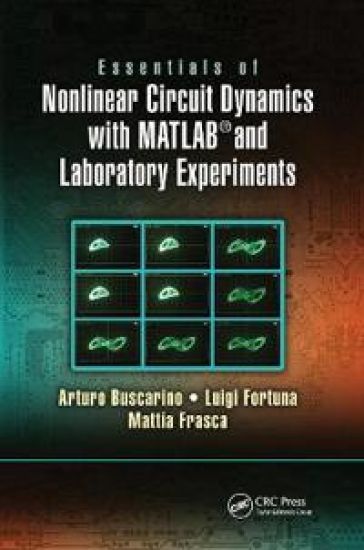
Essentials of Nonlinear Circuit Dynamics with MATLAB® and Laboratory Experiments

Essentials of Nonlinear Circuit Dynamics with MATLAB® and Laboratory Experiments

Arturo Buscarino; Luigi Fortuna; Mattia Frasca

CRC Press
2017
sidottu
This book deals with nonlinear dynamics of electronic circuits, which could be used in robot control, secure communications, sensors and synchronized networks. The genesis of the content is related to a course on complex adaptive systems that has been held at the University of Catania since 2005. The efforts are devoted in order to emulate with nonlinear electronic circuits nonlinear dynamics. Step-by-step methods show the essential concepts of complex systems by using the Varela diagrams and accompanying MATLAB® exercises to reinforce new information. Special attention has been devoted to chaotic systems and networks of chaotic circuits by exploring the fundamentals, such as synchronization and control. The aim of the book is to give to readers a comprehensive view of the main concepts of nonlinear dynamics to help them better understand complex systems and their control through the use of electronics devices.
Nonlinear Modeling of Solar Radiation and Wind Speed Time Series

Nonlinear Modeling of Solar Radiation and Wind Speed Time Series

Luigi Fortuna; Giuseppe Nunnari; Silvia Nunnari

Springer International Publishing AG
2016
nidottu
This brief is a clear, concise description of the main techniques of time series analysis —stationary, autocorrelation, mutual information, fractal and multifractal analysis, chaos analysis, etc.— as they are applied to the influence of wind speed and solar radiation on the production of electrical energy from these renewable sources. The problem of implementing prediction models is addressed by using the embedding-phase-space approach: a powerful technique for the modeling of complex systems. Readers are also guided in applying the main machine learning techniques for classification of the patterns hidden in their time series and so will be able to perform statistical analyses that are not possible by using conventional techniques. The conceptual exposition avoids unnecessary mathematical details and focuses on concrete examples in order to ensure a better understanding of the proposed techniques. Results are well-illustrated by figures and tables.
A Concise Guide to Chaotic Electronic Circuits

A Concise Guide to Chaotic Electronic Circuits

Arturo Buscarino; Luigi Fortuna; Mattia Frasca; Gregorio Sciuto

Springer International Publishing AG
2014
nidottu
This brief provides a source of instruction from which students can be taught about the practicalities of designing and using chaotic circuits. The text provides information on suitable materials, circuit design and schemes for design realization. Readers are then shown how to reproduce experiments on chaos and to design new ones. The text guides the reader easily from the basic idea of chaos to the laboratory test providing an experimental basis that can be developed for such applications as secure communications.This brief provides introductory information on sample chaotic circuits, includes coverage of their development, and the “gallery” section provides information on a wide range of circuits. Concise Guide to Chaotic Electronic Circuits will be useful to anyone running a laboratory class involving chaotic circuits and to students wishing to learn about them.
Cellular Neural Networks

Cellular Neural Networks

Gabriele Manganaro; Paolo Arena; Luigi Fortuna

Springer-Verlag Berlin and Heidelberg GmbH Co. K
2011
nidottu
The field of cellular neural networks (CNNs) is of growing importance in non­ linear circuits and systems and it is maturing to the point of becoming a new area of study in general nonlinear theory. CNNs emerged through two semi­ nal papers co-authored by Professor Leon O. Chua back in 1988. Since then, the attention that CNNs have attracted in the scientific community has been vast. For instance, there are international workshops dedicated to CNNs and their applications, special issues published in both the International Journal of Circuit Theory and in the IEEE Transactions on Circuits and Systems, and there are also Associate Editors appointed in the latter journal especially for the CNN field. All of this bears witness the importance that CNNs are gaining within the scientific community. Without doubt this book is a primer in the field. Its extensive coverage provides the reader with a very comprehensive view of aspects involved in the theory and applications of cellular neural networks. The authors have done an excellent job merging basic CNN theory, synchronization, spatio­ temporal phenomena and hardware implementation into eight exquisitely written chapters. Each chapter is thoroughly illustrated with examples and case studies. The result is a book that is not only excellent as a professional reference but also very appealing as a textbook. My view is that students as well professional engineers will find this volume extremely useful.
Soft Sensors for Monitoring and Control of Industrial Processes

Soft Sensors for Monitoring and Control of Industrial Processes

Luigi Fortuna; Salvatore Graziani; Alessandro Rizzo; Maria Gabriella Xibilia

Springer London Ltd
2010
nidottu
focussed on the key steps in soft sensor design: data selection; model structure selection and model validation, respectively. Extensions to the basic steps of soft sensor design, namely soft sensor performance enhancement and the modifications needed to facilitate different industrial process applications follow in Chapter 7 and 8, respectively. Widening the applications range and role of soft sensors to fault detection and sensor validation configurations is dealt with in Chapter 9. A great strength of Soft Sensors for Monitoring and Control of Industrial Processes is the use, throughout the text, of a set of industrial case studies to demonstrate the successes and drawbacks of the different methods used to create soft sensor models. A number of different methods may be used in each separate step of the soft sensor design process and the industrial case studies are often used to provide explicit comparisons of the performance of these methods. The industrial control and process engineer will find these comparison exercises invaluable illustrations of the sort of results that might be found in industrial applications. The monograph also highlights the importance of using knowledge from industrial experts and from the existing industrial process literature. This is an important aspect of industrial control that is not very widely acknowledged or taught in control courses. Most industrial processes have already generated a significant experimental knowledge base and the control engineer should develop ways of tapping into this valuable resource when designing industrial control schemes.
Fractional Order Systems: Modeling And Control Applications

Fractional Order Systems: Modeling And Control Applications

Riccardo Caponetto; Giovanni Dongola; Luigi Fortuna; Ivo Petras

World Scientific Publishing Co Pte Ltd
2010
sidottu
This book aims to propose the implementation and application of Fractional Order Systems (FOS). It is well known that FOS can be utilized in control applications and systems modeling, and their effectiveness has been proven in many theoretical works and simulation routines. A further and mandatory step for FOS real world utilization is their hardware implementation and applications on real systems modeling. With this viewpoint, introductory chapters are included on the definition of stability region of Fractional Order PID Controller and Chaotic FOS, followed by the practical implementation based on Microcontroller, Field Programmable Gate Array, Field Programmable Analog Array and Switched Capacitor. Another section is dedicated to FO modeling of Ionic Polymeric Metal Composite (IPMC). This new material will have applications in robotics, aerospace and biomedicine.
Chua's Circuit Implementations: Yesterday, Today And Tomorrow

Chua's Circuit Implementations: Yesterday, Today And Tomorrow

Luigi Fortuna; Mattia Frasca; Maria Gabriella Xibilia

World Scientific Publishing Co Pte Ltd
2009
sidottu
Since the birth of the Chua circuit in 1983, a considerable number of fruitful, fascinating and relevant research topics have arisen. In honor of the 25th anniversary of the invention of Chua's circuit, this book presents the 25 years of research on the implementation of Chua's circuit, and also discusses future directions and emerging applications of recent results.The purpose of the book is to provide researchers, PhD students, and undergraduate students a research monograph containing both fundamentals on the topics and advanced results that have been recently obtained. With about 60 illustrations included in the book, it also shows the detailed schematics of several different implementations that can be easily reproduced with a low-cost experimental setup and PC-based measurement instrumentation.
Advanced Topics On Cellular Self-organizing Nets And Chaotic Nonlinear Dynamics To Model And Control Complex Systems

Advanced Topics On Cellular Self-organizing Nets And Chaotic Nonlinear Dynamics To Model And Control Complex Systems

Riccardo Caponetto; Luigi Fortuna; Mattia Frasca

World Scientific Publishing Co Pte Ltd
2008
sidottu
This book focuses on the research topics investigated during the three-year research project funded by the Italian Ministero dell'Istruzione, dell'Università e della Ricerca (MIUR: Ministry of Education, University and Research) under the FIRB project RBNE01CW3M. With the aim of introducing newer perspectives of the research on complexity, the final results of the project are presented after a general introduction to the subject. The book is intended to provide researchers, PhD students, and people involved in research projects in companies with the basic fundamentals of complex systems and the advanced project results recently obtained.
Soft Sensors for Monitoring and Control of Industrial Processes

Soft Sensors for Monitoring and Control of Industrial Processes

Luigi Fortuna; Salvatore Graziani; Alessandro Rizzo; Maria Gabriella Xibilia

Springer London Ltd
2006
sidottu
focussed on the key steps in soft sensor design: data selection; model structure selection and model validation, respectively. Extensions to the basic steps of soft sensor design, namely soft sensor performance enhancement and the modifications needed to facilitate different industrial process applications follow in Chapter 7 and 8, respectively. Widening the applications range and role of soft sensors to fault detection and sensor validation configurations is dealt with in Chapter 9. A great strength of Soft Sensors for Monitoring and Control of Industrial Processes is the use, throughout the text, of a set of industrial case studies to demonstrate the successes and drawbacks of the different methods used to create soft sensor models. A number of different methods may be used in each separate step of the soft sensor design process and the industrial case studies are often used to provide explicit comparisons of the performance of these methods. The industrial control and process engineer will find these comparison exercises invaluable illustrations of the sort of results that might be found in industrial applications. The monograph also highlights the importance of using knowledge from industrial experts and from the existing industrial process literature. This is an important aspect of industrial control that is not very widely acknowledged or taught in control courses. Most industrial processes have already generated a significant experimental knowledge base and the control engineer should develop ways of tapping into this valuable resource when designing industrial control schemes.