Kirjojen hintavertailu. Mukana 12 294 472 kirjaa ja 12 kauppaa.

Kirjailija

Luiz Antônio de Lima Junior

Kirjat ja teokset yhdessä paikassa: 3 kirjaa, julkaisuja vuosilta 2022-2026, suosituimpien joukossa Workbook for Macroeconomic Theory. Vertaile teosten hintoja ja tarkista saatavuus suomalaisista kirjakaupoista.

3 kirjaa

Kirjojen julkaisuhaarukka 2022-2026.

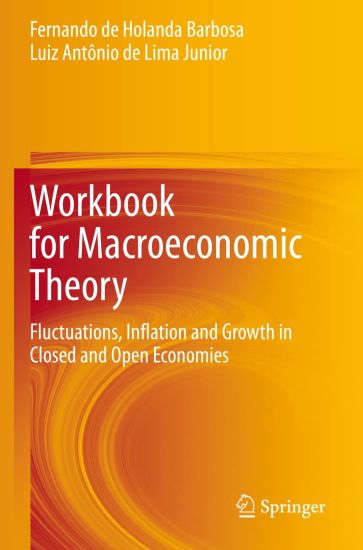
Workbook for Macroeconomic Theory

Workbook for Macroeconomic Theory

Fernando de Holanda Barbosa; Luiz Antônio de Lima Junior

Springer Nature Switzerland AG
2022
nidottu
This workbook presents the answers to the exercises in Macroeconomic Theory, Fluctuations, Inflation and Growth in Closed and Open Economies by Fernando de Holanda Barbosa (2018). Altogether, there are 172 exercises in eleven chapters and three appendices. The organization of this workbook follows the organization of the main text. The first part deals with flexible price models, including the representative agent model, the overlapping generations model, and the Solow growth model. The second part covers sticky price models; both Keynesian and Neoclassical. The third part presents exercises on the government budget constraint and monetary theory issues. There are two types of exercises in this workbook. The first type provides the student with material to practice for a full understanding the subjects presented in the text. The second type covers topics that are not dealt with in the main text, but are included for the sake of completeness. These exercises are marked with an asterisk and can be solved using the tools presented in the corresponding textbook chapter or appendix.
Workbook for Macroeconomic Theory

Workbook for Macroeconomic Theory

Fernando de Holanda Barbosa; Luiz Antônio de Lima Junior

Springer International Publishing AG
2025
sidottu
This book presents the answers to the exercises in Macroeconomic Theory, Fluctuations, Inflation and Growth in Closed and Open Economies, 2nd Edition, by Fernando de Holanda Barbosa (Cham, Switzerland: Springer, 2024), hereafter referred as Macro Theory. Altogether, there are 170 exercises in eleven chapters and three appendices. Many of these exercises are based on, or inspired in, the literature listed in the bibliography of Macro Theory, although the sources are not documented. The goal of a good number of exercises is to help the student to develop the skills necessary to obtain the model’s empirically testable predictions. You should try to solve each exercise by yourself but do not be upset if you cannot. Some exercises are very hard and take time to work out. However, to learn, you should persevere and try again and again. We hope that this workbook will help you in the learning process of macroeconomic theory. The most important change in this second edition is Part IV, which presents an abridged survey of the empirical evidence on macroeconomic models. This part has four chapters. Chapter 12 takes care of growth. Chapter 13 analyzes the main characteristics of business cycles. Chapter 14 presents the empirical evidence on Keynesian models, and Chapter 15 deals with several issues related to the budget constraint, such as chronic inflation, the pathologies of hyperinflation, public debt crises, external debt crises and the fiscal theory of the price level.