Kirjojen hintavertailu. Mukana 12 595 353 kirjaa ja 12 kauppaa.
Kirjailija
Luke Eric Lassiter
Kirjat ja teokset yhdessä paikassa: 9 kirjaa, julkaisuja vuosilta 2002-2023, suosituimpien joukossa Invitation to Anthropology. Vertaile teosten hintoja ja tarkista saatavuus suomalaisista kirjakaupoista.
Born within and against the violence of European colonial conquest, anthropology has aspired to understand the diversity of human experience in ethical and transformative ways. The New Invitation to Anthropology is a fresh and accessible text that takes students to the heart of the discipline and reveals the ongoing relevance of anthropology today. The New Invitation to Anthropology, Fifth Edition has an intimate touch that invites students in and helps them understand the historical roots of anthropology and its connection to recent social and political issues. Part I covers the history of the discipline, the emergence of the concept of culture, and ethnographic field methods in relation to European imperialism and discourses on race. Part II illustrates how the concept of culture shaped specific domains of anthropological study, including ecological adaptation, social class, gender, family, marriage, religion, and medicine.As a timely and engaging “non-textbook,” The New Invitation to Anthropology explores anthropological perspectives on real-world problems, helping students think like anthropologists and become better citizens of the world.New To This EditionSignificantly revised Chapter 1, “The Origins of North American Anthropology,” demonstrates how modern anthropology emerged out of 19th century theories of race and social evolutionism and develops critical understandings of modern forms of racism New sections on social class and globalization in Chapter 4 offer insights into the complexities of modern global problems like climate changeNew elaborations of intersectionality in Chapter 5, “Sex, Gender, and Inequality” reinforces discussions of gender-based inequalityChapter 7 on religious experience now incorporates healing and medicine to expand a framework of studying belief and experience

Doing Ethnography Today explores the methodologies and theories behind contemporary, collaborative ethnography and provides an opportunity to cultivate experience with included exercises. • Presents ethnography as creative and artful rather than analytical or technical • Emphasises the collaborative nature of ethnography • Structured exercises cultivate practical experience • Includes a discussion on indexing and interpreting project materials • Provides guidance on interview questions and selecting appropriate field equipment
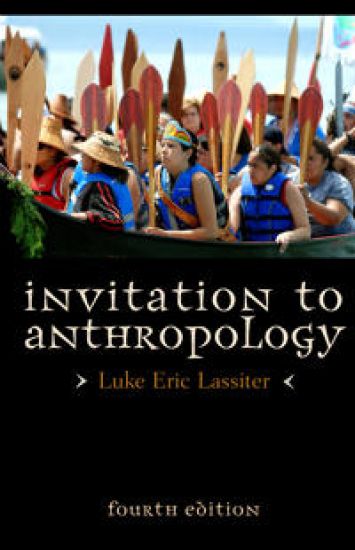
In this concise introduction to cultural anthropology, now in its 4th edition, Lassiter takes a fresh and accessible approach to stimulating student interest in the human experience. He uses timely and engaging examples to showcase the ongoing relevance of anthropology today. He also explores how the anthropological perspective can be applied to real-world problems on the local, regional, and global scale. The 4th edition features updates and clarifications throughout the text, including expanded discussion of evolution, language, fieldwork, gender identities, and belief systems. New “Anthropology Here and Now” sidebars encourage readers to delve deeper into particular subjects and to connect with current and ongoing conversations among working anthropologists. Taken as a whole, the book serves as an ideal text for introductory undergraduate courses.
Collaboration between ethnographers and subjects has long been a product of the close, intimate relationships that define ethnographic research. But increasingly collaboration is no longer viewed as merely a consequence of fieldwork; instead collaboration now preconditions and shapes research design as well as its dissemination. As a result, ethnographic subjects are shifting from being informants to being consultants. The emergence of collaborative ethnography highlights this relationship between consultant and ethnographer, moving it to center stage as a calculated part not only of fieldwork but also of the writing process itself. "The Chicago Guide to Collaborative Ethnography" presents a historical, theoretical, and practice-oriented road map for this shift from incidental collaboration to a more conscious and explicit collaborative strategy. Luke Eric Lassiter charts the history of collaborative ethnography from its earliest implementation to its contemporary emergence in fields such as feminism, humanistic anthropology, and critical ethnography. On this historical and theoretical base, Lassiter outlines concrete steps for achieving a more deliberate and overt collaborative practice throughout the processes of fieldwork and writing. As a participatory action situated in the ethical commitments between ethnographers and consultants and focused on the co-construction of texts, collaborative ethnography, argues Lassiter, is among the most powerful ways to press ethnographic fieldwork and writing into the service of an applied and public scholarship. A comprehensive and highly accessible handbook for ethnographers of all stripes, "The Chicago Guide to Collaborative Ethnography" will become a fixture in the development of a critical practice of anthropology, invaluable to undergraduates, graduate students, and faculty alike.
Prompted by the overt omission of Muncie's black community from the famous community study by Robert S. Lynd and Helen Merrell Lynd, Middletown: A Study in Modern American Culture, the authors initiated this project to reveal the unrecorded historical and contemporary life of Middletown, a well-known pseudonym for the Midwestern city of Muncie, Indiana. As a collaboration of community and campus, this book recounts the early efforts of Hurley Goodall to develop a community history and archive that told the story of the African American community, and rectify the representation of small town America as exclusively white. The authors designed and implemented a collaborative ethnographic field project that involved intensive interviews, research, and writing between community organizations, local experts, ethnographers, and teams of college students. This book is a unique model for collaborative research, easily accessible to students. It will be a valuable resource for instructors in anthropology, creative writing, sociology, community research, and African American studies.
In this highly original and moving volume, an anthropologist, a historian, and a Native singer come together to reveal the personal and cultural power of Christian faith among the Kiowas of southwestern Oklahoma and to show how Christian members of the Kiowa community have creatively embraced hymns and made them their own. Kiowas practice a unique expression of Christianity, a blending that began with the arrival of missionaries on the Kiowa-Comanche-Apache Reservation in the 1870s. In these pages, historian Clyde Ellis offers a compelling look at the way in which many Kiowas became Christian over the past century and have woven that faith into their identity. The personal and cultural significance of traditional songs and their close connection to the power of hymns is then illuminated by anthropologist Luke Eric Lassiter. Like traditional Kiowa songs, Christian hymns help restore and minister to the community; they also can be highly individualistic since many are composed and shared by church members themselves at different times in their lives. In the final section of the book Kiowa singer Ralph Kotay tells of the personal meaning and value of the hymns and of the Christian faith in general.This remarkable, sensitive book makes an important contribution to our understanding of the complexity of Native lives today and offers a subtle yet penetrating look at the legacy of Christianity among Native peoples.