Kirjojen hintavertailu. Mukana 12 290 406 kirjaa ja 12 kauppaa.
Kirjailija
Lyle J Morris
Kirjat ja teokset yhdessä paikassa: 11 kirjaa, julkaisuja vuosilta 2014-2024, suosituimpien joukossa Report on the Arctic Capabilities of the U.S. Armed Forces. Vertaile teosten hintoja ja tarkista saatavuus suomalaisista kirjakaupoista.
Abbie Tingstad; Scott Savitz; Benjamin J Sacks; Yuliya Shokh; Irina a Chindea; Scott R Stephenson; Michael T Wilson; James G Kallimani; Kristin Van Abel; Stephanie Pezard; Isabelle Winston; Inez Khan; Dan Abel; Clay McKinney; Yvonne K Crane; Katheryn Giglio; Sherrill Lingel; Lyle J Morris
This report summarizes the findings of research on U.S. and other armed forces' capabilities in the Arctic, the extent to which non-U.S. entities are operating where U.S. forces cannot, and how those operations might affect U.S. national interests. The authors found that the United States is lacking in capacity and, to a lesser extent, capability and that this creates risk for U.S. security.
Bryan Frederick; Kristen Gunness; Gabrielle Tarini; Andrew Stravers; Michael J Mazarr; Emily Ellinger; Jonah Blank; Shawn Cochran; Jeffrey W Hornung; Lyle J Morris; Jordan Ernstsen; Lydia Grek; Howard Wang; Lev Navarre Chao
Ensuring military access to the territory of allies and partners in the Indo-Pacific in the event of a future conflict with China is a critical concern for U.S. policymakers. By looking at five specific allies and partners, the authors explore how states are likely to approach access requests, what factors influence such decisions, and what peacetime policy levers the United States might have to increase the likelihood of access in conflict.
Michael J Mazarr; Nathan Beauchamp-Mustafaga; Jonah Blank; Samuel Charap; Michael S Chase; Beth Grill; Derek Grossman; Dara Massicot; Jennifer D P Moroney; Lyle J Morris; Alexander Noyes; Stephanie Pezard; Ashley L Rhoades; Alice Shih; Mark Stalczynski; Melissa Shostak; David E Thaler; Dori Walker
In this study, RAND researchers examined the current role of security cooperation efforts as a tool in the emerging strategic competition among the United States, Russia, and China. In particular, they sought to identify how, where, and to what degree the three major competitors?plus Australia, Japan, India, and several countries in Europe?are using security cooperation.
Michael J Mazarr; Jonah Blank; Samuel Charap; Benjamin N Harris; Timothy R Heath; Niklas Helwig; Jeffrey W Hornung; Lyle J Morris; Ashley L Rhoades; Ariane M Tabatabai; Sean M Zeigler
The U.S. National Security Strategy focuses on the expectation of a new era of growing international competition that the United States is expected to confront. The authors examine the nature of the emerging era, assess the perspectives of 16 countries (beginning with the primary challengers to the U.S.-led order), and evaluate various characteristics for each.
Eric Heginbotham; Michael S. Chase; Jacob L. Heim; Bonny Lin; Mark R. Cozad; Lyle J. Morris; Christopher P. Twomey; Forrest E. Morgan; Michael Nixon; Cristina L. Garafola; Samuel K. Berkowitz
China's approach to nuclear deterrence has been broadly consistent since its first test in 1964, but it has recently accelerated nuclear force modernization. China's strategic environment is likely to grow more complex, and nuclear constituencies are gaining a larger bureaucratic voice. Beijing is unlikely to change official nuclear policies but will probably increase emphasis on nuclear deterrence and may adjust the definition of key concepts.
Eric Heginbotham; Michael Nixon; Forrest E. Morgan; Jacob L. Heim; Jeff Hagen; Sheng Li; Jeffrey Engstrom; Martin C. Libicki; Paul DeLuca; David A. Shlapak; David R. Frelinger; Burgess Laird; Kyle Brady; Lyle J. Morris
A RAND study analyzed Chinese and U.S. military capabilities in two scenarios (Taiwan and the Spratly Islands) from 1996 to 2017, finding that trends in most, but not all, areas run strongly against the United States. While U.S. aggregate power remains greater than China s, distance and geography affect outcomes. China is capable of challenging U.S. military dominance on its immediate periphery and its reach is likely to grow in the years ahead."
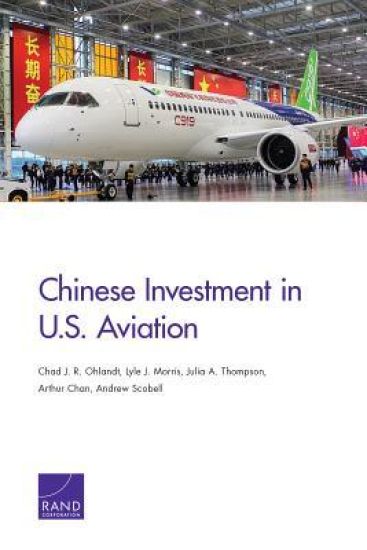
This report assesses Chinese investment in U.S. aviation from 2005 to 2016. It provides context in China's demand for aviation products and aviation industrial policies, while assessing technology transfers and impact on U.S. competitiveness. Chinese investment in U.S. aviation over the past decade has primarily involved lower-technology general aviation manufacturers that do not affect U.S. competitiveness.
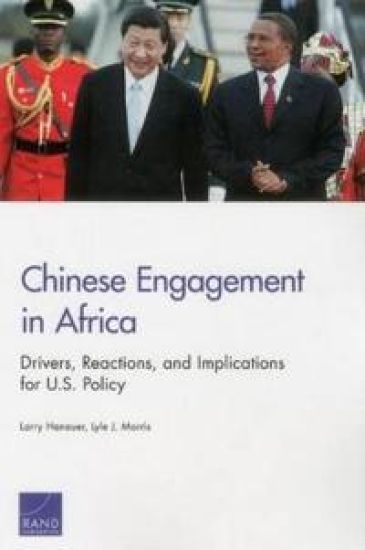
Examines Chinese engagement with African nations, focusing on (1) Chinese and African objectives in the political and economic spheres and how they work to achieve them, (2) African perceptions of Chinese engagement, (3) how China has adjusted its policies to accommodate African views, and (4) whether the United States and China are competing for influence, access, and resources in Africa and how they might cooperate in the region.