Kirjojen hintavertailu. Mukana 12 595 353 kirjaa ja 12 kauppaa.

Kirjailija

M. Brinton Lykes

Kirjat ja teokset yhdessä paikassa: 5 kirjaa, julkaisuja vuosilta 1996-2019, suosituimpien joukossa Myths About the Powerless. Vertaile teosten hintoja ja tarkista saatavuus suomalaisista kirjakaupoista.

5 kirjaa

Kirjojen julkaisuhaarukka 1996-2019.

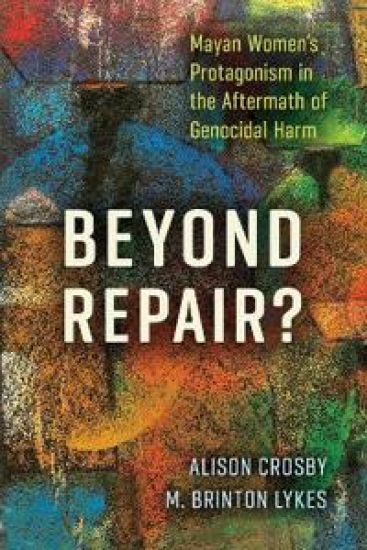
Beyond Repair?

Beyond Repair?

Alison Crosby; M. Brinton Lykes

Rutgers University Press
2019
sidottu
Winner of the 2021 Raphael Lemkin Book Award from the Institute for the Study of Genocide?Honorable Mention, 2020 CALACS Book Prize?Beyond Repair? explores Mayan women’s agency in the search for redress for harm suffered during the genocidal violence perpetrated by the Guatemalan state in the early 1980s at the height of the thirty-six-year armed conflict. The book draws on eight years of feminist participatory action research conducted with fifty-four Q’eqchi’, Kaqchikel, Chuj, and Mam women who are seeking truth, justice, and reparation for the violence they experienced during the war, and the women’s rights activists, lawyers, psychologists, Mayan rights activists, and researchers who have accompanied them as intermediaries for over a decade. Alison Crosby and M. Brinton Lykes use the concept of “protagonism” to deconstruct dominant psychological discursive constructions of women as “victims,” “survivors,” “selves,” “individuals,” and/or “subjects.” They argue that at different moments Mayan women have been actively engaged as protagonists in constructivist and discursive performances through which they have narrated new, mobile meanings of “Mayan woman,” repositioning themselves at the interstices of multiple communities and in their pursuit of redress for harm suffered.
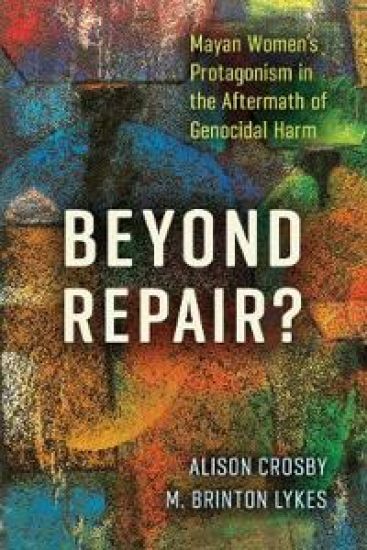
Beyond Repair?

Beyond Repair?

Alison Crosby; M. Brinton Lykes

Rutgers University Press
2019
nidottu
Winner of the 2021 Raphael Lemkin Book Award from the Institute for the Study of Genocide?Honorable Mention, 2020 CALACS Book Prize?Beyond Repair? explores Mayan women’s agency in the search for redress for harm suffered during the genocidal violence perpetrated by the Guatemalan state in the early 1980s at the height of the thirty-six-year armed conflict. The book draws on eight years of feminist participatory action research conducted with fifty-four Q’eqchi’, Kaqchikel, Chuj, and Mam women who are seeking truth, justice, and reparation for the violence they experienced during the war, and the women’s rights activists, lawyers, psychologists, Mayan rights activists, and researchers who have accompanied them as intermediaries for over a decade. Alison Crosby and M. Brinton Lykes use the concept of “protagonism” to deconstruct dominant psychological discursive constructions of women as “victims,” “survivors,” “selves,” “individuals,” and/or “subjects.” They argue that at different moments Mayan women have been actively engaged as protagonists in constructivist and discursive performances through which they have narrated new, mobile meanings of “Mayan woman,” repositioning themselves at the interstices of multiple communities and in their pursuit of redress for harm suffered.
Humanitarian Aid Work

Humanitarian Aid Work

Carlos Martín Beristain; M. Brinton Lykes

University of Pennsylvania Press
2008
pokkari
"Drawing on over a decade of field experiences in Latin America as well as a burgeoning literature about the psychological and social effects of war and disasters, MartÍn Beristain developed this volume at the interface of theory and practice as one response to these complex social and political realities. Humanitarian Aid Work offers an excellent introduction to those seeking to respond to the complex social, political, cultural, and linguistic diversities within any humanitarian crisis."-from the Foreword Throughout the world, there is a rising need for humanitarian aid. Enormous resources are being devoted to it; more organizations carry out cooperative projects; and emergency actions have grown to unprecedented levels. However, such expansion has not always meant that relief has been more adequately provided to victims, nor has it always had positive effects in reconstructing the social fabric. This book helps us to understand how people respond to traumatic experiences in extraordinary circumstances and to appreciate the social and cultural context in which these responses occur. Carlos MartÍn Beristain offers a psychosocial approach that advocates a cultural sensitivity for humanitarian action and the work of collaboration, assistance, and accompaniment. He suggests alternative ideas for social reconstruction in such areas as prevention, care of victims, collective memory, respect for human rights, and help to the helpers. Humanitarian Aid Work offers a constructive approach to the problems of groups affected by violence, catastrophe, or emergency situations. It is intended as a critical manual for aid workers. Academic research in psychology and the social sciences-as well as the author's experience in Central and South America-has been summarized to yield clear, action-oriented guidance. Research results from Europe, Africa, and Asia are also incorporated.