

Kirjailija
M. Joseph Sirgy
Kirjat ja teokset yhdessä paikassa: 26 kirjaa, julkaisuja vuosilta 1986-2026, suosituimpien joukossa Community Quality-of-Life Indicators. Vertaile teosten hintoja ja tarkista saatavuus suomalaisista kirjakaupoista.
Mukana myös kirjoitusasut: M Joseph Sirgy
26 kirjaa
Kirjojen julkaisuhaarukka 1986-2026.

Real Estate Marketing: Strategy, Selling, Negotiations, Management, and Ethics, Second Edition is specifically designed to educate real estate students with the art and science of the real estate marketing profession. The book is divided into five major parts. Part 1 focuses on strategy issues related to real estate development firms. Concepts discussed include strategic analysis, target marketing, and the four elements of the marketing mix: property planning, site selection, pricing of properties, and promotion of properties. Part 2 focuses on the real estate agent and the business of buying and selling in the context of real estate brokerage firms. Part 3 focuses on negotiation concepts and applications. Part 4 focuses on human resource management issues such as recruiting and training real estate agents, issues related to performance evaluation, motivation, and compensation, as well as issues related to leadership. Finally, Part 5 focuses on legal and ethical issues in the real estate industry. Students will learn how to address difficult situations and legal/ethical dilemmas by understanding and applying a variety of legal/ethical tests. This fully updated new edition will also include expanded coverage of real estate marketing across English-speaking countries through case studies, as well as focus on the use of AI and technology in real estate marketing. The ideal textbook for undergraduate and graduate-level classes in real estate marketing, this book will be of interest to real estate students and professionals.

Real Estate Marketing: Strategy, Selling, Negotiations, Management, and Ethics, Second Edition is specifically designed to educate real estate students with the art and science of the real estate marketing profession. The book is divided into five major parts. Part 1 focuses on strategy issues related to real estate development firms. Concepts discussed include strategic analysis, target marketing, and the four elements of the marketing mix: property planning, site selection, pricing of properties, and promotion of properties. Part 2 focuses on the real estate agent and the business of buying and selling in the context of real estate brokerage firms. Part 3 focuses on negotiation concepts and applications. Part 4 focuses on human resource management issues such as recruiting and training real estate agents, issues related to performance evaluation, motivation, and compensation, as well as issues related to leadership. Finally, Part 5 focuses on legal and ethical issues in the real estate industry. Students will learn how to address difficult situations and legal/ethical dilemmas by understanding and applying a variety of legal/ethical tests. This fully updated new edition will also include expanded coverage of real estate marketing across English-speaking countries through case studies, as well as focus on the use of AI and technology in real estate marketing. The ideal textbook for undergraduate and graduate-level classes in real estate marketing, this book will be of interest to real estate students and professionals.

Happiness in the Marketplace
Dong-Jin Lee; M. Joseph Sirgy
Springer Nature Switzerland AG
2025
sidottu

Organizational Strategies for Work-Life Balance
Dong-Jin Lee; M. Joseph Sirgy
Springer International Publishing AG
2025
nidottu
This book provides a systematic review of the research literature related to the effectiveness of organizational policies and programs on work-life balance (WLB). It discusses policies and practices related to workload management, flextime, flexplace, alternative job arrangements, and family care. Based on the evidence, the authors make specific recommendations to organizational executives and HR directors to design and implement work-life balance policies and programs to maximize their effectiveness and help employees achieve their optimal level of work-life balance. Specifically, the authors discuss how to: (1) identify employees with greater need for WLB programs, (2) evaluate environmental circumstances for WLB programs (3) design effective WLB policies and programs, (3) facilitate effective implementation of WLB policies and programs, (4) provide management support for WLB policies and programs, and (5) evaluate performance of WLB policies and programs. Written lucidly by experts in the field and with many case studies and examples, this book appeals to a wide range of academic and professional readers.

Organizational Strategies for Work-Life Balance
Dong-Jin Lee; M. Joseph Sirgy
Springer International Publishing AG
2024
sidottu
This book provides a systematic review of the research literature related to the effectiveness of organizational policies and programs on work-life balance (WLB). It discusses policies and practices related to workload management, flextime, flexplace, alternative job arrangements, and family care. Based on the evidence, the authors make specific recommendations to organizational executives and HR directors to design and implement work-life balance policies and programs to maximize their effectiveness and help employees achieve their optimal level of work-life balance. Specifically, the authors discuss how to: (1) identify employees with greater need for WLB programs, (2) evaluate environmental circumstances for WLB programs (3) design effective WLB policies and programs, (3) facilitate effective implementation of WLB policies and programs, (4) provide management support for WLB policies and programs, and (5) evaluate performance of WLB policies and programs. Written lucidly by experts in the field and with many case studies and examples, this book appeals to a wide range of academic and professional readers.
Community Quality-of-Life Indicators
M. Joseph Sirgy
Springer International Publishing AG
2023
nidottu
This training book is designed to help professionals enhance their knowledge of community quality-of-life indicators, and to develop viable community projects. Chapter 1 describes the theoretical concepts that guide the formulation of community indicator projects. Chapter 2 creates a sample community indicator project as a template of the entire process. Chapter 3 describes the planning process: how to identify sponsors, secure funding, develop an organizational structure, select a quality-of-life model, select indicators, and so on. Chapter 4 focuses on data collection. Finally, Chapter 5 describes efforts related to dissemination and promotion of community indicators projects. Written by a stalwart in the field of quality-of-life research, this book provides the tools of sound community project planning for quality-of-life researchers, social workers, social marketers, community research organizations, and policy-makers.

Based on a thorough review of the research on work-life balance, Sirgy and Lee identify a set of personal interventions that selected employees commonly use to increase their work-life balance and life satisfaction. Personal interventions of work-life balance involve five behavior-based strategies and four cognition-based strategies. The behavior-based strategies are engaging in multiple roles and domains, increasing role enrichment, engaging in behavior-based compensation, managing role conflict, and creating role balance. The cognition-based strategies are segmenting roles and domains, integrating roles and domains, engaging in value-based compensation, and applying whole-life perspective in decision-making. This volume provides HR managers and HR consultants with pedagogical material designed to help them develop in-house workshops, seminars, and curricula for their employees to improve their work-life balance by using the personal interventions described in the book.

Based on a thorough review of the research on work-life balance, Sirgy and Lee identify a set of personal interventions that selected employees commonly use to increase their work-life balance and life satisfaction. Personal interventions of work-life balance involve five behavior-based strategies and four cognition-based strategies. The behavior-based strategies are engaging in multiple roles and domains, increasing role enrichment, engaging in behavior-based compensation, managing role conflict, and creating role balance. The cognition-based strategies are segmenting roles and domains, integrating roles and domains, engaging in value-based compensation, and applying whole-life perspective in decision-making. This volume provides HR managers and HR consultants with pedagogical material designed to help them develop in-house workshops, seminars, and curricula for their employees to improve their work-life balance by using the personal interventions described in the book.
Community Quality-of-Life Indicators
M. Joseph Sirgy
Springer International Publishing AG
2022
sidottu
This training book is designed to help professionals enhance their knowledge of community quality-of-life indicators, and to develop viable community projects. Chapter 1 describes the theoretical concepts that guide the formulation of community indicator projects. Chapter 2 creates a sample community indicator project as a template of the entire process. Chapter 3 describes the planning process: how to identify sponsors, secure funding, develop an organizational structure, select a quality-of-life model, select indicators, and so on. Chapter 4 focuses on data collection. Finally, Chapter 5 describes efforts related to dissemination and promotion of community indicators projects. Written by a stalwart in the field of quality-of-life research, this book provides the tools of sound community project planning for quality-of-life researchers, social workers, social marketers, community research organizations, and policy-makers.

The third, thoroughly revised and enhanced edition of this bestselling book analyses and discusses the most up-to-date research on the psychology of quality of life. The book is divided into six parts. The introductory part lays the philosophical and academic foundation of much of the research on wellbeing and positive mental health, showing the beneficial effects of happy people at work, health, and to society at large. Part 2 (effects of objective reality) describes how sociocultural factors, income factors, other demographic factors, and biological and health conditions affect wellbeing and positive mental health. Part 3 focuses on subjective reality and discusses how individuals process information from their objective environment, and how they manipulate this information that affects wellbeing and positive mental health. Part 4 focuses on the psychology of quality of life specific to life domains, while Part 5 reviews the research on special populations: children, women, the elderly, but also the disabled, drug addicts, prostitutes, emergency personnel, immigrants, teachers, and caregivers. The final part of the book focuses on theories and models of wellbeing and positive mental health that integrate and unify disparate concepts and programs of research. The book addresses the importance of the psychology of quality of life in the context of public policy and calls for a broadening of the approach in happiness research to incorporate other aspects of quality of life at the group, community, and societal levels. It is of topical interest to academics, students and researchers of quality of life, well-being research, happiness studies, psychotherapy, and social policy.

The balanced life is a state of equally moderate-to-high levels of satisfaction in important and multiple life domains that contribute to overall life satisfaction. This book strives to improve the reader's understanding of what the balanced life is, and how it can be both achieved and maintained. Its primary goal is therefore to identify the major principles of life balance, and to introduce a comprehensive construct of the balanced life reflective of these principles. It discusses how life balance substantially contributes to subjective well-being – defined as life satisfaction, a preponderance of positive over negative feelings, and absence of ill-being – and explores strategies to attain life balance. It argues that achieving life balance, through manipulating one's thoughts and taking concrete action, will lead to increased personal happiness. Aimed at professional, academic, and lay audiences, this book is grounded in scientific studies related to work-life balance and the balanced life.

The balanced life is a state of equally moderate-to-high levels of satisfaction in important and multiple life domains that contribute to overall life satisfaction. This book strives to improve the reader's understanding of what the balanced life is, and how it can be both achieved and maintained. Its primary goal is therefore to identify the major principles of life balance, and to introduce a comprehensive construct of the balanced life reflective of these principles. It discusses how life balance substantially contributes to subjective well-being – defined as life satisfaction, a preponderance of positive over negative feelings, and absence of ill-being – and explores strategies to attain life balance. It argues that achieving life balance, through manipulating one's thoughts and taking concrete action, will lead to increased personal happiness. Aimed at professional, academic, and lay audiences, this book is grounded in scientific studies related to work-life balance and the balanced life.
The book provides a new theory of well-being designed to integrate many disparate concepts of well-being, such as subjective well-being, personal happiness, mental well-being, emotional well-being, psychological well-being, hedonic well-being, social well-being, life satisfaction, domain satisfaction, and eudaimonia. It lays the foundation for a new a theory of mental well-being based on a hierarchical perspective of positive mental health and guided by the concept of positive balance.Written by a well-known expert in the field, this book addresses the issue of positive balance related to physiological, emotional, cognitive, meta-cognitive, developmental and social-ecological levels of an individual and analyses the factors at each level that contribute to an individual’s positive mental health experience. It discusses in detail the effects of neurochemicals such as dopamine, serotonin, or cortisol; positive and negative affect; satisfaction in salient and multiple life domains vis-à-vis dissatisfaction in life domains; positive versus negative evaluations about one’s life using certain standards of comparison; positive psychological traits of personal growth and intrinsic motivation, etc. vis-à-vis negative traits like pessimism and impulsiveness; and perceived social resources like social contribution and social actualization vis-à-vis perceived constraints like exclusion and ostracism. This original work is of interest to students, researchers and practitioners of quality of life and wellbeing studies, positive psychology, developmental psychology and mental health..

The third, thoroughly revised and enhanced edition of this bestselling book analyses and discusses the most up-to-date research on the psychology of quality of life. The book is divided into six parts. The introductory part lays the philosophical and academic foundation of much of the research on wellbeing and positive mental health, showing the beneficial effects of happy people at work, health, and to society at large. Part 2 (effects of objective reality) describes how sociocultural factors, income factors, other demographic factors, and biological and health conditions affect wellbeing and positive mental health. Part 3 focuses on subjective reality and discusses how individuals process information from their objective environment, and how they manipulate this information that affects wellbeing and positive mental health. Part 4 focuses on the psychology of quality of life specific to life domains, while Part 5 reviews the research on special populations: children, women, the elderly, but also the disabled, drug addicts, prostitutes, emergency personnel, immigrants, teachers, and caregivers. The final part of the book focuses on theories and models of wellbeing and positive mental health that integrate and unify disparate concepts and programs of research. The book addresses the importance of the psychology of quality of life in the context of public policy and calls for a broadening of the approach in happiness research to incorporate other aspects of quality of life at the group, community, and societal levels. It is of topical interest to academics, students and researchers of quality of life, well-being research, happiness studies, psychotherapy, and social policy.
The book provides a new theory of well-being designed to integrate many disparate concepts of well-being, such as subjective well-being, personal happiness, mental well-being, emotional well-being, psychological well-being, hedonic well-being, social well-being, life satisfaction, domain satisfaction, and eudaimonia. It lays the foundation for a new a theory of mental well-being based on a hierarchical perspective of positive mental health and guided by the concept of positive balance.Written by a well-known expert in the field, this book addresses the issue of positive balance related to physiological, emotional, cognitive, meta-cognitive, developmental and social-ecological levels of an individual and analyses the factors at each level that contribute to an individual’s positive mental health experience. It discusses in detail the effects of neurochemicals such as dopamine, serotonin, or cortisol; positive and negative affect; satisfaction in salient and multiple life domains vis-à-vis dissatisfaction in life domains; positive versus negative evaluations about one’s life using certain standards of comparison; positive psychological traits of personal growth and intrinsic motivation, etc. vis-à-vis negative traits like pessimism and impulsiveness; and perceived social resources like social contribution and social actualization vis-à-vis perceived constraints like exclusion and ostracism. This original work is of interest to students, researchers and practitioners of quality of life and wellbeing studies, positive psychology, developmental psychology and mental health..

Combatting Jihadist Terrorism through Nation-Building
M. Joseph Sirgy; Richard J. Estes; El-Sayed El-Aswad; Don R. Rahtz
Springer Nature Switzerland AG
2019
sidottu
This book focuses on the drivers of Jihadist terrorism and explains how a better understanding of these drivers can lead to more effective counterterrorism policies all over the world. It builds on results of the extensive body of quality of life studies to document the historical, geo-political, economic, religious, cultural and media drivers of Jihadist terrorism. Guided by a major theme this book shows that the significant gains we have made in combatting Jihadist terrorism are not enough, but that we need to embrace a much broader and comprehensive view of the antecedents and the sustaining enablers of this threat to help guide any sustainable efforts. It proposes interventions designed to effectively treat the causes of this insidious disease. This book is of great interest to new media, policy makers concerned about national security as well as people and academic scholars whose research interest involves conflict and conflict resolution, religious studies, terrorism and counterterrorism, Islamic history, and Islamic geo-politics.

Media and research tend to focus on social problems in today's world - from terrorism and natural disasters to environmental degradation, conflict and economic decline. Yet many countries are also placing the promotion of well-being central at the heart of their social agenda. So what can we say about human progress and the development of civilization? This book considers the brighter side of our world today by exploring the ways in which wellbeing is on an upward swing globally. Systematically considering indicators of human well-being in terms of economics, health and education, alongside subjective notions of wellbeing, the book draws together research and data from around the world. It uses the United Nations Development Programme's Human Development Index as an underlying framework from which to examine the ways in which wellbeing has improved since WWII. Analysing leading scholarship and empirical work allows the authors to determine policy recommendations for how we might continue to build a better world of human wellbeing.

Media and research tend to focus on social problems in today's world - from terrorism and natural disasters to environmental degradation, conflict and economic decline. Yet many countries are also placing the promotion of well-being central at the heart of their social agenda. So what can we say about human progress and the development of civilization? This book considers the brighter side of our world today by exploring the ways in which wellbeing is on an upward swing globally. Systematically considering indicators of human well-being in terms of economics, health and education, alongside subjective notions of wellbeing, the book draws together research and data from around the world. It uses the United Nations Development Programme's Human Development Index as an underlying framework from which to examine the ways in which wellbeing has improved since WWII. Analysing leading scholarship and empirical work aloows the authors to determine policy recommendations for how we might continue to build a better world of human wellbeing.
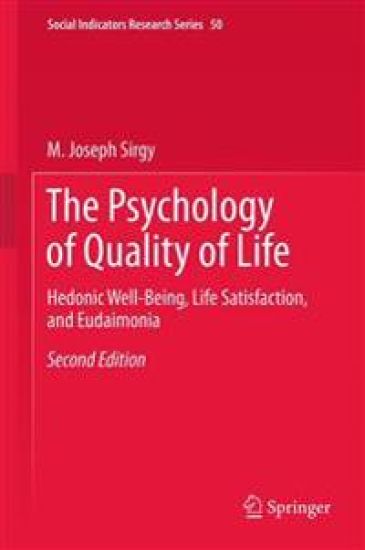
The second edition will be an update and further elaboration of the literature related to subjective well-being, happiness, and life satisfaction. It will have a new substantial section that focuses on reviewing much of the literature of subjective well-being within specific life domains (social life, material life, leisure life, work life, community life, spiritual life, family life, health life, sex life, travel life, etc.) In the 1st edition the research in these various life domains was discussed only briefly. The second edition will maintain the same organizational structure of the first edition; that is, Part 1 will focus on introduction (definitions and distinctions; examples of measures of subjective well-being, happiness, and life satisfaction; and motives underlying subjective well-being). Part 2 will focus on psychological strategies that are allow people to optimize subjective well-being by engaging in psychological processes related to the relationship between and among life domains (e.g., social life, family life, love life, spiritual life, community life, financial life, etc.) This part will contain four chapters related to these various “inter-domain” processes: bottom-up spillover, top-down spillover, horizontal spillover, and compensation. Part 3 of the book will focus on “intra-domain” psychological strategies designed to optimize subjective well-being. These include re-evaluation based on personal history, re-evaluation based on self-concept, re-evaluation based on social comparison, goal selection, goal implementation and attainment, and re-appraisal. Part 4 of the book will focus on balance processes—how people attempt to create balance in their lives using psychological processes within specific life domains (intra-domain strategies) and processes that relate one domain to another (inter-domain strategies).