Kirjojen hintavertailu. Mukana 12 595 353 kirjaa ja 12 kauppaa.

Kirjailija

M. Rashad Islam

Kirjat ja teokset yhdessä paikassa: 9 kirjaa, julkaisuja vuosilta 2020-2026, suosituimpien joukossa Engineering Dynamics. Vertaile teosten hintoja ja tarkista saatavuus suomalaisista kirjakaupoista.

Mukana myös kirjoitusasut: M Rashad Islam

9 kirjaa

Kirjojen julkaisuhaarukka 2020-2026.

Engineering Dynamics

Engineering Dynamics

M Rashad Islam; A K M Monayem H Mazumder; Mahbub Ahmed

TAYLOR FRANCIS LTD
2024
nidottu
This textbook is intended for the first course of engineering dynamics for undergraduate students. Engineering dynamics is a rigorous topic that typically involves the intensive use of vector mathematics and calculus. This book, however, uses plain language with less vector mathematics and calculus to introduce these topics of mathematics to students with a high school physics background. Numerous practical examples are provided with their step-by-step worked out solutions, as well as case studies to reflect the interests of new engineering and applied engineering students. The topics covered in the Fundamentals of Engineering (FE) examination are presented throughout the text. It also includes roadway dynamics to incorporate engineering dynamics and transportation engineering for civil engineering.Features:Discusses theory using easy-to-understand language with less vector mathematics and calculusIncludes practical case studies and numerous realistic step-by-step solved examplesIncludes exercise problems for students’ practiceProvides numerous sample examples related to the Fundamentals of Engineering (FE) examIncludes a solutions manual and PowerPoint slides for adopting instructorsEngineering Dynamics: Fundamentals and Applications serves as a useful resource for students across several engineering degree programs, such as civil, mechanical, aerospace, automotive, chemical, and electrical engineering. It is also appropriate for engineering technology and applied science students as well.
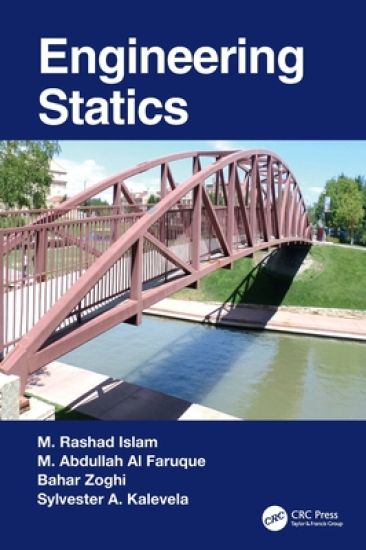
Engineering Statics

Engineering Statics

M. Rashad Islam; M. Abdullah Al Faruque; Bahar Zoghi; Sylvester A. Kalevela

TAYLOR FRANCIS LTD
2024
nidottu
Engineering Statics presents the cutting-edge topics in engineering statics, focusing on practical applications knowledge, with numerous real-world examples, practice problems, and case studies throughout. It covers theory concisely and uses plain language and coverage that can be completed in a one-semester course. It also covers the related concepts required to take the Fundamentals of Engineering (FE) exam.Features: Written in plain language, with numerous realistic step-by-step examples. Covers topics required to understand and prepare for the Fundamentals of Engineering (FE) exam. Includes practical case studies, concise theory and numerous solved practice problems.Engineering Statics is suitable for undergraduate students in civil and mechanical engineering courses, as well as those in Engineering Technology and Applied courses. This book includes material suitable for first and second-year undergraduate courses, as well as more senior students.The authors believe that this text will be very helpful for students to succeed in their degree programs and professional careers.
Engineering Dynamics

Engineering Dynamics

M Rashad Islam; A K M Monayem H Mazumder; Mahbub Ahmed

TAYLOR FRANCIS LTD
2022
sidottu
This textbook is intended for the first course of engineering dynamics for undergraduate students. Engineering dynamics is a rigorous topic that typically involves the intensive use of vector mathematics and calculus. This book, however, uses plain language with less vector mathematics and calculus to introduce these topics of mathematics to students with a high school physics background. Numerous practical examples are provided with their step-by-step worked out solutions, as well as case studies to reflect the interests of new engineering and applied engineering students. The topics covered in the Fundamentals of Engineering (FE) examination are presented throughout the text. It also includes roadway dynamics to incorporate engineering dynamics and transportation engineering for civil engineering.Features:Discusses theory using easy-to-understand language with less vector mathematics and calculusIncludes practical case studies and numerous realistic step-by-step solved examplesIncludes exercise problems for students’ practiceProvides numerous sample examples related to the Fundamentals of Engineering (FE) examIncludes a solutions manual and PowerPoint slides for adopting instructorsEngineering Dynamics: Fundamentals and Applications serves as a useful resource for students across several engineering degree programs, such as civil, mechanical, aerospace, automotive, chemical, and electrical engineering. It is also appropriate for engineering technology and applied science students as well.
Engineering Statics

Engineering Statics

M. Rashad Islam; M. Abdullah Al Faruque; Bahar Zoghi; Sylvester A. Kalevela

CRC Press
2020
sidottu
Engineering Statics presents the cutting-edge topics in engineering statics, focusing on practical applications knowledge, with numerous real-world examples, practice problems, and case studies throughout. It covers theory concisely and uses plain language and coverage that can be completed in a one-semester course. It also covers the related concepts required to take the Fundamentals of Engineering (FE) exam.Features: Written in plain language, with numerous realistic step-by-step examples. Covers topics required to understand and prepare for the Fundamentals of Engineering (FE) exam. Includes practical case studies, concise theory and numerous solved practice problems.Engineering Statics is suitable for undergraduate students in civil and mechanical engineering courses, as well as those in Engineering Technology and Applied courses. This book includes material suitable for first and second-year undergraduate courses, as well as more senior students.The authors believe that this text will be very helpful for students to succeed in their degree programs and professional careers.
Statics and Strength of Materials for Construction, Engineering Technology, and Architecture
Statics and Strength of Materials for Construction, Engineering Technology, and Architecture: Theory, Analysis, and Application provides students and industry professionals with the necessary statics and strength of materials background for more innovative approaches to particular fields of engineering technology, construction engineering and management, civil engineering, and architectural technology. It presents an introduction to statics, a review of algebra and trigonometry, concepts of vectors, a classification of building structural systems, an overview of advanced topics in statics and strength of materials, and frameworks of real-world application projects. This book contains 19 chapters and discusses several topics related to statics and strength of materials, such as coplanar force systems; the equilibrium of particle and rigid bodies; design loads; beam and frame reactions; trusses; arches, cables, and pulleys; space force systems; centroid of areas; moment of inertia; friction; properties of materials; axial deformation; bending and shear stress; torsional stress; combined loading; stress transformation; deflection; and stress in columns. Each chapter includes an Instructor’s Solution Manual and Guide with instructional materials and comprehensive explanations of the related practice problems, critical thinking exercises, and application projects.
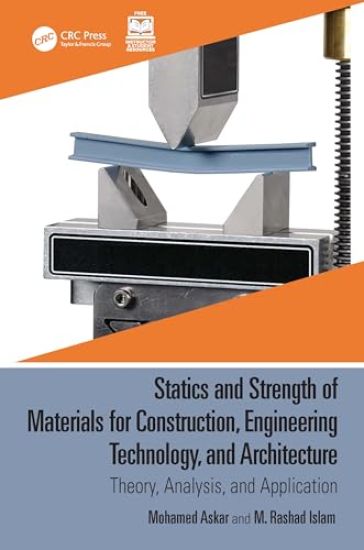
Statics and Strength of Materials for Construction, Engineering Technology, and Architecture
Statics and Strength of Materials for Construction, Engineering Technology, and Architecture: Theory, Analysis, and Application provides students and industry professionals with the necessary statics and strength of materials background for more innovative approaches to particular fields of engineering technology, construction engineering and management, civil engineering, and architectural technology. It presents an introduction to statics, a review of algebra and trigonometry, concepts of vectors, a classification of building structural systems, an overview of advanced topics in statics and strength of materials, and frameworks of real-world application projects.This book contains 19 chapters and discusses several topics related to statics and strength of materials, such as coplanar force systems; the equilibrium of particle and rigid bodies; design loads; beam and frame reactions; trusses; arches, cables, and pulleys; space force systems; centroid of areas; moment of inertia; friction; properties of materials; axial deformation; bending and shear stress; torsional stress; combined loading; stress transformation; deflection; and stress in columns.Each chapter includes an Instructor’s Solution Manual and Guide with instructional materials and comprehensive explanations of the related practice problems, critical thinking exercises, and application projects.
Construction Safety: Health, Practices and OSHA

Construction Safety: Health, Practices and OSHA

M. Rashad Islam

McGraw-Hill Education
2021
sidottu
A comprehensive overview of all aspects of construction safety, including standards and regulations, for major infrastructure and construction projects of all types.Construction Safety: Health, Practices, and OSHA covers key elements of construction safety across all types of construction. In-depth coverage includes safety principles, precautions necessary with the use of specific materials, protections for various types of construction, detailed explanations of Activity Hazard Analyses (AHA) and Job Hazard Analysis (JHA), and compliance with OSHA regulations.The book contains theoretical materials and detailed explanations with photos, tables, diagrams and sketches. At the end of each chapter there are multiple choice and fill-in-the-blanks questions typical of those found in various national exams and OSHA construction safety training exam as well as practice problems and critical-thinking questions.Coverage includes:Personal Protective and Life Saving EquipmentActivity Hazard Analysis (AHA) and Job Hazard Analysis (JHA).Toxic and Hazardous SubstancesConcrete, Masonry, Steel, and Wood ConstructionUnderground Construction, Caissons, Cofferdams, and Compressed AirBlasting and firesElectric Power Transmission and DistributionMechanized Equipment, Scaffold, Materials Handling and TransportationPromoting Safety and Preventing Violence
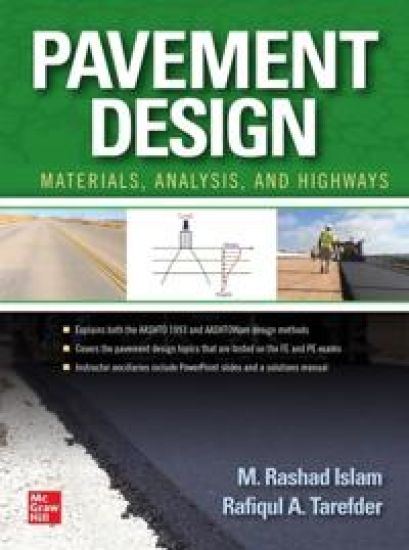
Pavement Design: Materials, Analysis, and Highways

Pavement Design: Materials, Analysis, and Highways

M. Rashad Islam; Rafiqul Tarefder

McGraw-Hill Education
2020
nidottu
Master the principles, analysis, and design in pavement engineeringThis student-friendly textbook offers comprehensive coverage of pavement design and highways. Written by two seasoned civil engineering educators, the book contains precise explanations of traditional and computerized mechanistic design methods along with detailed examples of real-world pavement and highway projects. Pavement Design: Materials, Analysis, and Highways shows, step by step, how to apply the latest, software-based AASHTOWare Pavement Mechanistic-Empirical Design method. Each design topic is covered in separate, modular chapters, enabling you to tailor a course of study. Fundamentals of Engineering (FE) sample questions are also provided in each chapter.Coverage includes:Stress-strain in pavementSoils, aggregates, asphalt, and portland cement concreteTraffic analysis for pavement designDistresses and distress-prediction models in flexible and rigid pavementFlexible and rigid pavement design by AASHTO 1993 and AASHTOWareOverlay and drainage designSustainable and rehabilitation pavement design, pavement management, and recyclingGeometric design of highways
Civil Engineering Materials

Civil Engineering Materials

M. Rashad Islam

CRC Press
2020
sidottu
Civil Engineering Materials: Introduction and Laboratory Testing discusses the properties, characterization procedures, and analysis techniques of primary civil engineering materials. It presents the latest design considerations and uses of engineering materials as well as theories for fully understanding them through numerous worked mathematical examples. The book also includes important laboratory tests which are clearly described in a step-by-step manner and further illustrated by high-quality figures. Also, analysis equations and their applications are presented with appropriate examples and relevant practice problems, including Fundamentals of Engineering (FE) styled questions as well those found on the American Concrete Institute (ACI) Concrete Field Testing Technician - Grade I certification exam.Features: Includes numerous worked examples to illustrate the theories presented Presents Fundamentals of Engineering (FE) examination sample questions in each chapter Reviews the ACI Concrete Field Testing Technician - Grade I certification exam Utilizes the latest laboratory testing standards and practices Includes additional resources for instructors teaching related coursesThis book is intended for students in civil engineering, construction engineering, civil engineering technology, construction management engineering technology, and construction management programs.