Kirjojen hintavertailu. Mukana 12 595 353 kirjaa ja 12 kauppaa.

Kirjailija

M.Rebecca Kilburn

Kirjat ja teokset yhdessä paikassa: 6 kirjaa, julkaisuja vuosilta 1998-2021, suosituimpien joukossa Does Four Equal Five?. Vertaile teosten hintoja ja tarkista saatavuus suomalaisista kirjakaupoista.

Mukana myös kirjoitusasut: M Rebecca Kilburn

6 kirjaa

Kirjojen julkaisuhaarukka 1998-2021.

Does Four Equal Five?

Does Four Equal Five?

M Rebecca Kilburn; Andrea Phillips; Celia J Gomez; Louis T Mariano; Christopher Joseph Doss; Wendy M Troxel; Emily Morton; Kevin Estes

RAND
2021
nidottu
The authors provide information on the implementation and outcomes of the four-day school week using quantitative and qualitative data from a variety of sources. The authors add to the literature by providing the richest qualitative data on the four-day-school week to date, analyzing the broadest set of outcomes for a variety of stakeholders, and using the most up-to-date data available.
Investing in Our Children

Investing in Our Children

Lynn A. Karoly; Peter W Greenwood; Susan S. Everingham; Jill Hoube; M.Rebecca Kilburn

RAND
1998
pokkari
The authors find that well-targeted early intervention programs for at-risk children, such as nurse home visits to first-time mothers and high-quality pre-school education, can yield substantial advantages to participants in terms of emotional and cognitive development, education, economic well-being and health.
Investing Early

Investing Early

Jill S Cannon; M Rebecca Kilburn; Lynn A Karoly

RAND
2017
nidottu
This report examines evaluations of early childhood programs that meet criteria for scientific rigor and synthesizes their results to better understand program outcomes, costs, and benefits. It focuses on programs serving children or parents of children from the prenatal period to age 5. The programs reviewed use approaches alone or in combination that include early care and education, home visiting, parent education, and government transfers.
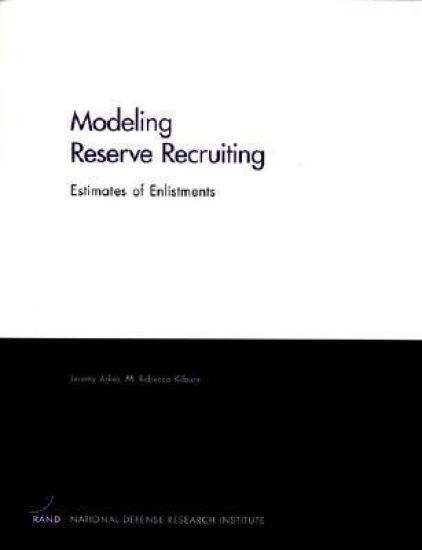
Modeling Reserve Recruiting

Modeling Reserve Recruiting

Jeremy Arkes; M.Rebecca Kilburn

RAND
2005
pokkari
Given that reserve components are increasingly being called upon to provide support across the entire spectrum of military operations, the authors examine reserve recruting and the likely challenges facing the reserve components. The policy variables the authors included in the models had sizeable and significant effects on both active duty and reserve recruiting. The authors also modeled the effects of economic and demographic variables.
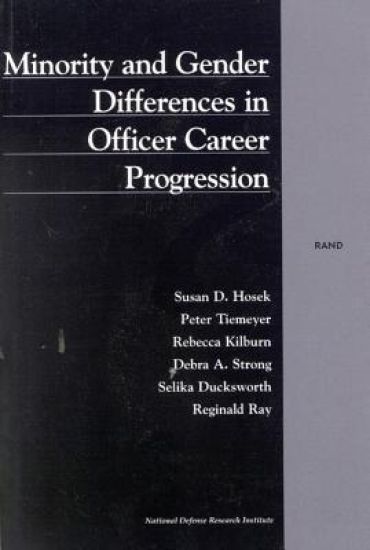
Minority and Gender Differences in Officer Career Progression

Minority and Gender Differences in Officer Career Progression

Peter Tiemeyer; Susan D. Hosek; M.Rebecca Kilburn; Debra A. Strong

RAND
2001
pokkari
Since the military draft ended in 1975, newly commissioned officers have included increasing numbers of minorities and women. These officers must be retained and promoted for the senior officer ranks to become as diverse as the junior officer ranks are today. This report examines whether minority and women officers obtain these promotions and choose to continue in their careers at the same rate as other officers. The authors conducted two research efforts: analyzing personnel records and interviewing midcareer officers, personnel managers, and promotion board members individually and in focus groups. Results for minorities other than blacks were limited due to small sample sizes. White women were found to be less likely to reach higher officer ranks than were men, mostly because they chose to leave the military between promotions. Black male and black female officers generally failed promotions in higher proportions than did white males, but were more likely to stay in the military between promotions.The interviews and focus groups revealed different perceptions about careers: Black officers seemed to have greater difficulty forming all-important peer and mentor relationships and overcoming initial expectations of lower performance. Women's careers have been affected by limited occupational opportunities, inconsistent acceptance of their role as military officers, harassment, and family conflicts.
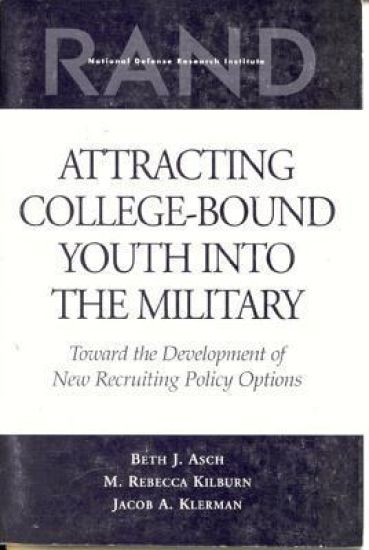
Attracting College-bound Youth into the Military

Attracting College-bound Youth into the Military

Beth J. Asch; M.Rebecca Kilburn; Jacob Alex Klerman

RAND
1999
pokkari
Although the military's need for enlisted personnel has declined by almost one-third since the end of the cold war, the armed services are finding it difficult to meet their recruiting goals. Among ongoing changes in the civilian labor market is a strong demand for skilled labor, which has prompted an increasing number of high quality youth to pursue post-secondary education and subsequent civilian employment. Because of this competition for high quality youth, the Department of Defense may want to explore new options for attracting desirable young people into the armed forces. The military, for example, offers a myriad of options for service members to take college courses while in active service. However, the programs do not in fact generate significant increases in educational attainment during time in service. One popular program, the Montgomery GI Bill, enrolls large numbers of individuals, but the vast majority of service members use their benefits after separating from service. Thus, the military does not receive the benefits of a more educated and productive workforce, unless the individuals subsequently join a reserve component. The authors suggest the Department of Defense should consider nontraditional policy options to enhance recruitment of college-bound youth. Recruiters could target more thoroughly students on two-year college campuses, or dropouts from two- or four-year colleges. Options for obtaining some college before military service could be expanded by allowing high school seniors to first attend college, paid for by the military, and then enlist. Or the student might serve in a reserve component while in college and then enter an active component after college. Alternatively, the military could create an entirely new path for combining college and military service by encouraging enlisted veterans to attend college and then reenlist (at a higher pay grade). The most promising alternatives should be evaluated in a national experiment designed to test their effectiveness and cost-effectiveness, similar to the one that led to the creation of the Army College Fund and the Navy College Fund.