Kirjojen hintavertailu. Mukana 12 390 323 kirjaa ja 12 kauppaa.

Kirjailija

M. Wiley

Kirjat ja teokset yhdessä paikassa: 5 kirjaa, julkaisuja vuosilta 1998-2017, suosituimpien joukossa Indo-Malay Martial Traditions. Vertaile teosten hintoja ja tarkista saatavuus suomalaisista kirjakaupoista.

5 kirjaa

Kirjojen julkaisuhaarukka 1998-2017.

Filipino Martial Art Anthology

Filipino Martial Art Anthology

M. Wiley; S. Dowd; M. Soderholm; P. Hobart; R. Macaraeg; Ken Smith

VIA MEDIA PUBLISHING COMPANY,US
2017
nidottu
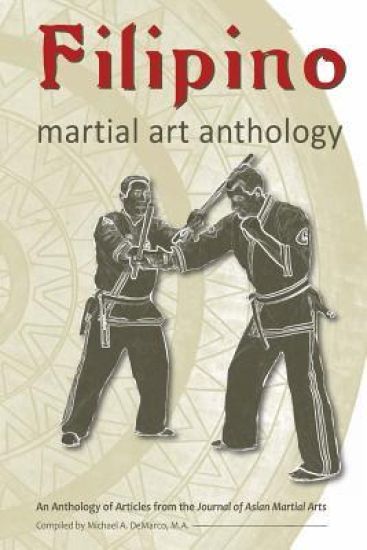
There has been a lack of reliable academic studies regarding Filipino martial arts (FMA) that have uniquely developed in the Philippine archipelago. This anthology assembles pioneering scholarly materials valuable for any interested in the Filipino combatives, as well as chapters specifically on the practice. Mark Wiley stands out as a leading scholar/practitioner of the Filipino arts. This book contains three chapters by him. In the first, he conducted linguistic and historical research to present the developmental background of the ancient Filipino kali and European fencing systems, thus illuminating the evolution of classical eskrima. In chapter two, Wiley attempts to classify Filipino martial arts and explore the ethos of Filipino martial culture by deriving information directly from the contemporary grandmasters who have maintained an oral transmission of information concerning the evolution and development of their respective martial systems. Part of Wiley's research also led him to seek out special repositories of artifacts. Museums collections rarely include much on Southeast Asian weapons. University of Pennsylvania Museum of Archaeology and Anthropology has nearly 1,000 martial artifacts in storerooms from the Philippines, including swords, knives, spears, shields, helmets, and armor discussed in Wiley's third chapter. On a practical side, Steven Dowd presents the art of Carlita La ada who studied martial arts as passed down within his own family in the Philippines. He calls his rendition Kuntaw Lima-Lima, an art whose techniques are reminiscent of Okinawan karate styles, with hints of Chinese gongfu. Presented are the underlying principles, and a sayawan (form) with applications. Majia Soderholm's chapter is about Visayan Corto Kadena Eskrima and some of its concepts and training methods with regard to free-sparring with swords. It is a Filipino martial system encompassing empty-hand and non-bladed and bladed weapons. Peter Hobart presents a wonderful tribute to Remy Presas, the founder of Modern Arnis. This retrospective is comprised of the stories and memories of many of those who knew him. Topics include Presas' theory and practice of arnis, such as importance of flow, and memories of his last seminar. The chapter by Ruel Macaraeg dives into the topic of piracy in the Philippines. His study reconstructs the pirates' martial practices through comparative historical analysis of their weapons, costume, and organization in order to draw conclusions about their relationship to martial cultures in the Philippines and across the region. In the final chapter, Ken Smith discusses a few of his favorite techniques from Modern Arnis. His insights-as well as the information found in the previous chapters-contribute to the academic understanding of Filipino martial traditions as well as the actual practice of kali, escrima, and arnis. We hope you'll enjoy the reading.
Indo-Malay Martial Traditions

Indo-Malay Martial Traditions

Phillip Davies; James Wilson; M. Wiley; K. Pauka

VIA MEDIA PUBLISHING COMPANY,US
2015
nidottu
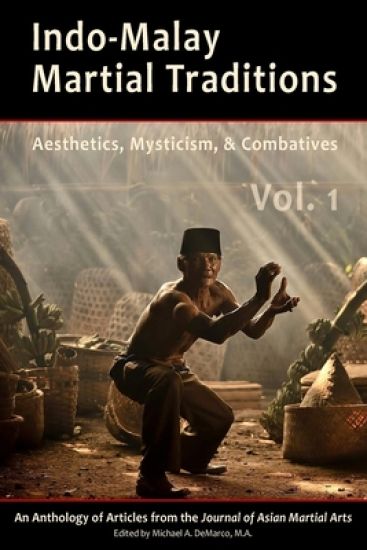
Many Indo-Malay martial arts are kept private, taught in secluded areas away from the public. These are arts of the older tradition, developed when combative knowledge was valued for its use in protecting the sanctity of life. This two-volume anthology brings together a great collection of writings by authors who dove into the deepest realms of Indo-Malay combatives. They offer readers a rare viewing of martial traditions that is usually hidden behind social shrouds of secrecy and a clannish quest to preserve their own martial arts. For the lead chapter in Volume 1, Dr. Philip Davies masterfully details the complex social milieu in the Indo-Malay martial tradition, focusing on the Chinese arts referred to by the ambiguous term of kuntao. His writing underlines the importance of martial arts to specific social groups, and what and how these groups practice these combative forms. As an initiate into the art of Bimi Kakti, Jamese Wilson's chapter illustrates how beliefs and practices intertwine, especially with the animistic roots of Indonesia. The influence makes Javanese silat unique in practice as well as social standing. A main ingredient in Southeast Asian silat styles is kebatinan: "the science of the inner." Mark Wiley's chapter discusses how the blend of ancient animistic beliefs and mystical religions have given a psychological charge to silt's methods as a source of mystic power.Dr. Kirstin Pauka's chapter reports on a rare celebration-the Pauleh Tinggi ceremony. This three-day long event occurs only when the social needs arise and may not occur again for decades. Silat performances by individuals, pairs, and groups are the primary features and go on throughout each day and night. Descriptions of the mental and physical sides of the silat performances offer readers a view of a martial tradition in which combative skills flow from an inner mystical guidance that flows through the movements. The psychic state is embodied both the art as well as social relationships.All who are serious about the history and practice of Indo-Malay fighting arts will enjoy this special anthology, volumes one and two. We are very fortunate to assemble the works of these highly qualified authors. We hope reading will provide information you seek. Although the availability of studying under a true silat mater is nearly impossible, the chapters here will certainly add direction and inspiration for practitioners.
Romantic Migrations

Romantic Migrations

M. Wiley

Palgrave Macmillan
2008
nidottu
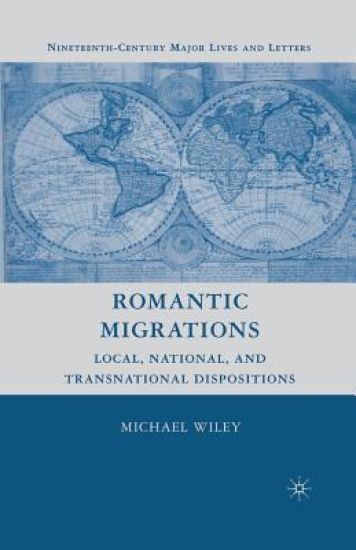
Analyzing real, speculative, and imaginary schemes of migration to and from Britain, this book addresses three interrelated movements: between France and Britain after the French Revolution, between Britain and North America also after the Revolution, and between West Africa and Britain in the years leading to the Revolution.
Romantic Migrations

Romantic Migrations

M. Wiley

Palgrave Macmillan
2008
sidottu
Analyzing real, speculative, and imaginary schemes of migration to and from Britain, this book addresses three interrelated movements: between France and Britain after the French Revolution, between Britain and North America also after the Revolution, and between West Africa and Britain in the years leading to the Revolution.
Romantic Geography

Romantic Geography

M. Wiley

Palgrave Macmillan
1998
sidottu
Grounded in historical sources and informed by recent work in cultural, sociological, geographical and spatial studies, Romantic Geography illuminates the nexus between imaginative literature and geography in William Wordsworth's poetry and prose. It shows that eighteenth-century social and political interest groups contested spaces through maps, geographical commentaries and travel literature; and that by configuring 'utopian' landscapes Wordsworth himself participated in major social and political controversies in post-French Revolutionary England.