Kirjojen hintavertailu. Mukana 12 390 323 kirjaa ja 12 kauppaa.

Kirjailija

M. Zuhair Nashed

Kirjat ja teokset yhdessä paikassa: 6 kirjaa, julkaisuja vuosilta 2018-2023, suosituimpien joukossa Spherical Sampling. Vertaile teosten hintoja ja tarkista saatavuus suomalaisista kirjakaupoista.

6 kirjaa

Kirjojen julkaisuhaarukka 2018-2023.

Recovery Methodologies: Regularization and Sampling

Recovery Methodologies: Regularization and Sampling

Willi Freeden; M. Zuhair Nashed

AMERICAN MATHEMATICAL SOCIETY
2023
nidottu
The goal of this book is to introduce the reader to methodologies in recovery problems for objects, such as functions and signals, from partial or indirect information. The recovery of objects from a set of data demands key solvers of inverse and sampling problems. Until recently, connections between the mathematical areas of inverse problems and sampling were rather tenuous. However, advances in several areas of mathematical research have revealed deep common threads between them, which proves that there is a serious need for a unifying description of the underlying mathematical ideas and concepts. Freeden and Nashed present an integrated approach to resolution methodologies from the perspective of both these areas.Researchers in sampling theory will benefit from learning about inverse problems and regularization methods, while specialists in inverse problems will gain a better understanding of the point of view of sampling concepts. This book requires some basic knowledge of functional analysis, Fourier theory, geometric number theory, constructive approximation, and special function theory. By avoiding extreme technicalities and elaborate proof techniques, it is an accessible resource for students and researchers not only from applied mathematics, but also from all branches of engineering and science.

Inverse Magnetometry

Inverse Magnetometry

Christian Blick; Willi Freeden; M. Zuhair Nashed; Helga Nutz; Michael Schreiner

Springer Nature Switzerland AG
2021
nidottu
This monograph presents the geoscientific context arising in decorrelative geomagnetic exploration. First, an insight into the current state of research is given by reducing magnetometry to mathematically accessible, and thus calculable, decorrelated models. In this way, various questions and problems of magnetometry are made available to a broad scientific audience and the exploration industry. New stimuli are given, and innovative ways of modeling geologic strata by mollifier magnetometric techniques are shown.Potential data sets primarily of terrestrial origin constitute the main data basis in the book. For deep geology, the geomathematical decorrelation methods are designed in such a way that depth information (e.g., in boreholes) may be canonically entered. Overall, this book provides pioneering and ground-breaking innovative mathematical knowledge as a transfer methodology from the “reality space” of magnetometric measurements into the “virtual space” of mathematical-numerical modeling structures and mollifier solutions with novel geological application areas. It pursues a double goal: On the one hand, it represents a geoscientific set of rules for today's geoengineering, interested in the application of innovative modelling and simulation techniques to promising data sets and structures occurring in geomagnetics. On the other hand, the book serves as a collection of current material in Applied Mathematics to offer alternative methodologies in the theory of inverse problems.
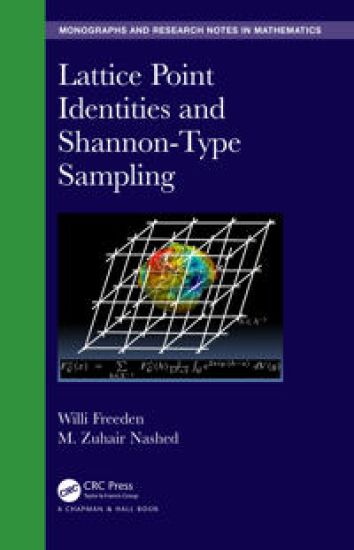
Lattice Point Identities and Shannon-Type Sampling

Lattice Point Identities and Shannon-Type Sampling

Willi Freeden; M. Zuhair Nashed

CRC Press
2019
sidottu
Lattice Point Identities and Shannon-Type Sampling demonstrates that significant roots of many recent facets of Shannon's sampling theorem for multivariate signals rest on basic number-theoretic results. This book leads the reader through a research excursion, beginning from the Gaussian circle problem of the early nineteenth century, via the classical Hardy-Landau lattice point identity and the Hardy conjecture of the first half of the twentieth century, and the Shannon sampling theorem (its variants, generalizations and the fascinating stories about the cardinal series) of the second half of the twentieth century. The authors demonstrate how all these facets have resulted in new multivariate extensions of lattice point identities and Shannon-type sampling procedures of high practical applicability, thereby also providing a general reproducing kernel Hilbert space structure of an associated Paley-Wiener theory over (potato-like) bounded regions (cf. the cover illustration of the geoid), as well as the whole Euclidean space. All in all, the context of this book represents the fruits of cross-fertilization of various subjects, namely elliptic partial differential equations, Fourier inversion theory, constructive approximation involving Euler and Poisson summation formulas, inverse problems reflecting the multivariate antenna problem, and aspects of analytic and geometric number theory. Features: New convergence criteria for alternating series in multi-dimensional analysis Self-contained development of lattice point identities of analytic number theory Innovative lattice point approach to Shannon sampling theory Useful for students of multivariate constructive approximation, and indeed anyone interested in the applicability of signal processing to inverse problems.
An Invitation to Geomathematics

An Invitation to Geomathematics

Willi Freeden; Clemens Heine; M. Zuhair Nashed

Springer Nature Switzerland AG
2019
nidottu
The authors introduce geomathematics as an active research area to a wider audience. Chapter 1 presents an introduction to the Earth as a system to apply scientific methods. Emphasis is laid on transfers from virtual models to reality and vice versa. In the second chapter geomathematics is introduced as a new scientific area which nevertheless has its roots in antiquity. The modern conception of geomathematics is outlined from different points of view and its challenging nature is described as well as its interdisciplinarity. Geomathematics is shown as the bridge between the real world and the virtual world. The complex mathematical tools are shown from a variety of fields necessary to tackle geoscientific problems in the mathematical language. Chapter 3 contains some exemplary applications as novel exploration methods. Particular importance is laid on the change of language when it comes to translate measurements to mathematical models. New solution methods like the multiscale mollifier technique are presented. Further applications discussed are aspects of reflection seismics. Chapter 4 is devoted to the short description of recent activities in geomathematics. The Appendix (Chapter 5) is devoted to the GEM – International Journal on Geomathematics founded ten years ago. Besides a detailed structural analysis of the editorial goals an index of all papers published in former issues is given.
Spherical Sampling

Spherical Sampling

Willi Freeden; M. Zuhair Nashed; Michael Schreiner

Springer Nature Switzerland AG
2019
nidottu
This book presents, in a consistent and unified overview, results and developments in the field of today´s spherical sampling, particularly arising in mathematical geosciences. Although the book often refers to original contributions, the authors made them accessible to (graduate) students and scientists not only from mathematics but also from geosciences and geoengineering. Building a library of topics in spherical sampling theory it shows how advances in this theory lead to new discoveries in mathematical, geodetic, geophysical as well as other scientific branches like neuro-medicine. A must-to-read for everybody working in the area of spherical sampling.
Spherical Sampling

Spherical Sampling

Willi Freeden; M. Zuhair Nashed; Michael Schreiner

Birkhauser Verlag AG
2018
sidottu
This book presents, in a consistent and unified overview, results and developments in the field of today´s spherical sampling, particularly arising in mathematical geosciences. Although the book often refers to original contributions, the authors made them accessible to (graduate) students and scientists not only from mathematics but also from geosciences and geoengineering. Building a library of topics in spherical sampling theory it shows how advances in this theory lead to new discoveries in mathematical, geodetic, geophysical as well as other scientific branches like neuro-medicine. A must-to-read for everybody working in the area of spherical sampling.