Kirjojen hintavertailu. Mukana 12 595 353 kirjaa ja 12 kauppaa.

Kirjailija

Maciej Henneberg

Kirjat ja teokset yhdessä paikassa: 3 kirjaa, julkaisuja vuosilta 2010-2017, suosituimpien joukossa The Hobbit Trap. Vertaile teosten hintoja ja tarkista saatavuus suomalaisista kirjakaupoista.

3 kirjaa

Kirjojen julkaisuhaarukka 2010-2017.

Dynamic Human

Dynamic Human

Arthur Saniotis; Maciej Henneberg

Bentham Science Publishers
2017
nidottu
The natural world can be viewed as a continuously changing complex system comprising variable units that do not conform to any stable plan. Within this framework, human evolution is not the story of the past that created Homo sapiens and then handed this account over to written history. It is the ongoing process that shapes us now and will shape us in the future, body and mind. We must understand it in order to survive and be able to direct it to our advantage. The Dynamic Human presents a general theory of how humans function as a multi-individual system embedded in the natural world. The authors employ a unified approach of systems theory to outline forces that direct ongoing human evolution and produce its outcomes in terms of the past, present and future. Readers will find a perspective on the human place in nature, through a brief account of the past human evolution over 10 million years ago, a discussion of the earliest appearance of humans some 2 million years ago, and a description of the mechanisms of the changes in the gene pool of humans from generation-to-generation. Understanding the forces involved in these mechanisms (physical and mental growth and development) may allow us to understand human evolution better. The Dynamic Human presents a simplified perspective on human evolution for all readers interested in a discourse on the origins, nature and future of human beings.
The Hobbit Trap

The Hobbit Trap

Maciej Henneberg; Robert B Eckhardt; John Schofield

Left Coast Press Inc
2010
sidottu
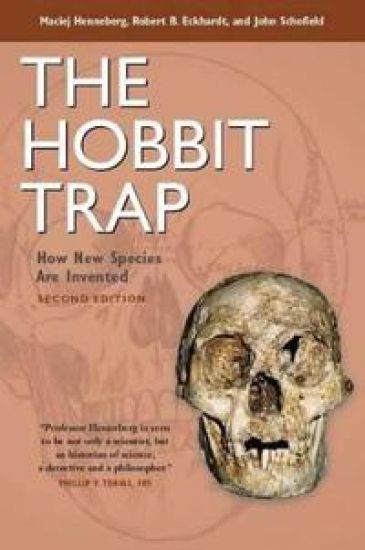
When scientists found the remains of a tiny hominid on an Indonesian in 2004, they claimed they found a totally new species of human ancestor (homo floresiensis), and called it a Hobbit. Film crews rolled in and the little creature took the world by storm, but a group of prominent scientists, including Maciej Henneberg and Robert Eckhardt, smelled a rat. They refuted the data—the size and shape of bones, the inferences about height—and they raised fundamental questions about scientific method, revealing cultural and political pressures that lead to the wide acceptance of unsupported theories. The Hobbit Trap describes how the case against the “new species” theory developed and offers an important critique of the species concept in evolution. In this thoroughly updated second edition, the authors include new data and analysis of the Flores fossils, and expand their important analysis of scientific practice, calling for a new movement to reverse the decline in scientific standards and the rise in scientific politics. This lively and important challenge to conventional wisdom is accessible to the general reader and makes a stimulating addition to courses on the history and philosophy of science, evolution and physical anthropology.
The Hobbit Trap

The Hobbit Trap

Maciej Henneberg; Robert B Eckhardt; John Schofield

Left Coast Press Inc
2010
nidottu
When scientists found the remains of a tiny hominid on an Indonesian in 2004, they claimed they found a totally new species of human ancestor (homo floresiensis), and called it a Hobbit. Film crews rolled in and the little creature took the world by storm, but a group of prominent scientists, including Maciej Henneberg and Robert Eckhardt, smelled a rat. They refuted the data—the size and shape of bones, the inferences about height—and they raised fundamental questions about scientific method, revealing cultural and political pressures that lead to the wide acceptance of unsupported theories. The Hobbit Trap describes how the case against the “new species” theory developed and offers an important critique of the species concept in evolution. In this thoroughly updated second edition, the authors include new data and analysis of the Flores fossils, and expand their important analysis of scientific practice, calling for a new movement to reverse the decline in scientific standards and the rise in scientific politics. This lively and important challenge to conventional wisdom is accessible to the general reader and makes a stimulating addition to courses on the history and philosophy of science, evolution and physical anthropology.