Kirjojen hintavertailu. Mukana 12 595 353 kirjaa ja 12 kauppaa.

Kirjailija

Maciej Lewenstein

Kirjat ja teokset yhdessä paikassa: 7 kirjaa, julkaisuja vuosilta 2012-2025, suosituimpien joukossa Tensor Network Contractions. Vertaile teosten hintoja ja tarkista saatavuus suomalaisista kirjakaupoista.

7 kirjaa

Kirjojen julkaisuhaarukka 2012-2025.

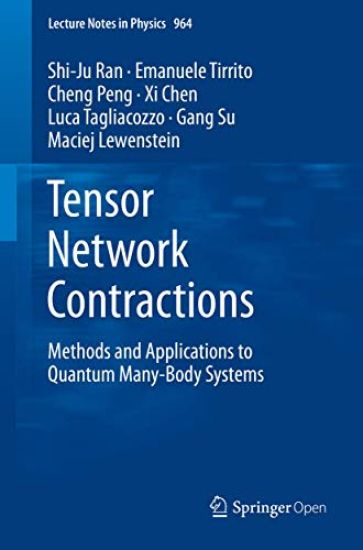
Tensor Network Contractions

Tensor Network Contractions

Shi-Ju Ran; Emanuele Tirrito; Cheng Peng; Xi Chen; Luca Tagliacozzo; Gang Su; Maciej Lewenstein

Springer Nature Switzerland AG
2020
nidottu
Tensor network is a fundamental mathematical tool with a huge range of applications in physics, such as condensed matter physics, statistic physics, high energy physics, and quantum information sciences. This open access book aims to explain the tensor network contraction approaches in a systematic way, from the basic definitions to the important applications. This book is also useful to those who apply tensor networks in areas beyond physics, such as machine learning and the big-data analysis. Tensor network originates from the numerical renormalization group approach proposed by K. G. Wilson in 1975. Through a rapid development in the last two decades, tensor network has become a powerful numerical tool that can efficiently simulate a wide range of scientific problems, with particular success in quantum many-body physics. Varieties of tensor network algorithms have been proposed for different problems. However, the connections among different algorithms are notwell discussed or reviewed. To fill this gap, this book explains the fundamental concepts and basic ideas that connect and/or unify different strategies of the tensor network contraction algorithms. In addition, some of the recent progresses in dealing with tensor decomposition techniques and quantum simulations are also represented in this book to help the readers to better understand tensor network. This open access book is intended for graduated students, but can also be used as a professional book for researchers in the related fields. To understand most of the contents in the book, only basic knowledge of quantum mechanics and linear algebra is required. In order to fully understand some advanced parts, the reader will need to be familiar with notion of condensed matter physics and quantum information, that however are not necessary to understand the main parts of the book. This book is a good source for non-specialists on quantum physics to understand tensor network algorithms and the related mathematics.
Machine Learning in Quantum Sciences

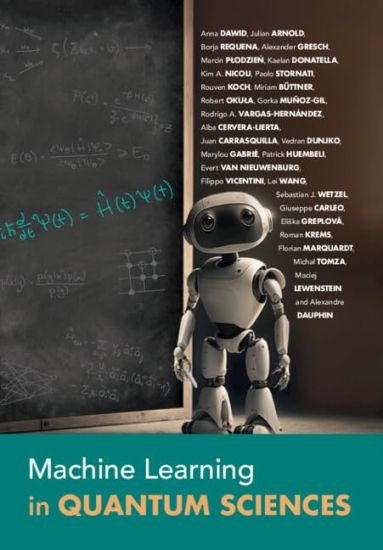
Machine Learning in Quantum Sciences

Anna Dawid; Julian Arnold; Borja Requena; Alexander Gresch; Marcin Plodzien; Kaelan Donatella; Kim A. Nicoli; Paolo Stornati; Rouven Koch; Miriam Büttner; Robert Okula; Gorka Muñoz-Gil; Rodrigo A. Vargas-Hernández; Alba Cervera-Lierta; Juan Carrasquilla; Vedran Dunjko; Marylou Gabrié; Patrick Huembeli; Evert van Nieuwenburg; Filippo Vicentini; Lei Wang; Sebastian J. Wetzel; Giuseppe Carleo; Eliška Greplová; Roman Krems; Florian Marquardt; Michal Tomza; Maciej Lewenstein; Alexandre Dauphin

Cambridge University Press
2025
sidottu
Artificial intelligence is dramatically reshaping scientific research and is coming to play an essential role in scientific and technological development by enhancing and accelerating discovery across multiple fields. This book dives into the interplay between artificial intelligence and the quantum sciences; the outcome of a collaborative effort from world-leading experts. After presenting the key concepts and foundations of machine learning, a subfield of artificial intelligence, its applications in quantum chemistry and physics are presented in an accessible way, enabling readers to engage with emerging literature on machine learning in science. By examining its state-of-the-art applications, readers will discover how machine learning is being applied within their own field and appreciate its broader impact on science and technology. This book is accessible to undergraduates and more advanced readers from physics, chemistry, engineering, and computer science. Online resources include Jupyter notebooks to expand and develop upon key topics introduced in the book.
Tensor Network Contractions

Tensor Network Contractions

Maciej Lewenstein; Gang Su; Luca Tagliacozzo

Saint Philip Street Press
2020
sidottu
Tensor network is a fundamental mathematical tool with a huge range of applications in physics, such as condensed matter physics, statistic physics, high energy physics, and quantum information sciences. This open access book aims to explain the tensor network contraction approaches in a systematic way, from the basic definitions to the important applications. This book is also useful to those who apply tensor networks in areas beyond physics, such as machine learning and the big-data analysis. Tensor network originates from the numerical renormalization group approach proposed by K. G. Wilson in 1975. Through a rapid development in the last two decades, tensor network has become a powerful numerical tool that can efficiently simulate a wide range of scientific problems, with particular success in quantum many-body physics. Varieties of tensor network algorithms have been proposed for different problems. However, the connections among different algorithms are not well discussed or reviewed. To fill this gap, this book explains the fundamental concepts and basic ideas that connect and/or unify different strategies of the tensor network contraction algorithms. In addition, some of the recent progresses in dealing with tensor decomposition techniques and quantum simulations are also represented in this book to help the readers to better understand tensor network. This open access book is intended for graduated students, but can also be used as a professional book for researchers in the related fields. To understand most of the contents in the book, only basic knowledge of quantum mechanics and linear algebra is required. In order to fully understand some advanced parts, the reader will need to be familiar with notion of condensed matter physics and quantum information, that however are not necessary to understand the main parts of the book. This book is a good source for non-specialists on quantum physics to understand tensor network algorithms and the related mathematics. This work was published by Saint Philip Street Press pursuant to a Creative Commons license permitting commercial use. All rights not granted by the work's license are retained by the author or authors.
Tensor Network Contractions

Tensor Network Contractions

Maciej Lewenstein; Gang Su; Luca Tagliacozzo

Saint Philip Street Press
2020
pokkari
Tensor network is a fundamental mathematical tool with a huge range of applications in physics, such as condensed matter physics, statistic physics, high energy physics, and quantum information sciences. This open access book aims to explain the tensor network contraction approaches in a systematic way, from the basic definitions to the important applications. This book is also useful to those who apply tensor networks in areas beyond physics, such as machine learning and the big-data analysis. Tensor network originates from the numerical renormalization group approach proposed by K. G. Wilson in 1975. Through a rapid development in the last two decades, tensor network has become a powerful numerical tool that can efficiently simulate a wide range of scientific problems, with particular success in quantum many-body physics. Varieties of tensor network algorithms have been proposed for different problems. However, the connections among different algorithms are not well discussed or reviewed. To fill this gap, this book explains the fundamental concepts and basic ideas that connect and/or unify different strategies of the tensor network contraction algorithms. In addition, some of the recent progresses in dealing with tensor decomposition techniques and quantum simulations are also represented in this book to help the readers to better understand tensor network. This open access book is intended for graduated students, but can also be used as a professional book for researchers in the related fields. To understand most of the contents in the book, only basic knowledge of quantum mechanics and linear algebra is required. In order to fully understand some advanced parts, the reader will need to be familiar with notion of condensed matter physics and quantum information, that however are not necessary to understand the main parts of the book. This book is a good source for non-specialists on quantum physics to understand tensor network algorithms and the related mathematics. This work was published by Saint Philip Street Press pursuant to a Creative Commons license permitting commercial use. All rights not granted by the work's license are retained by the author or authors.
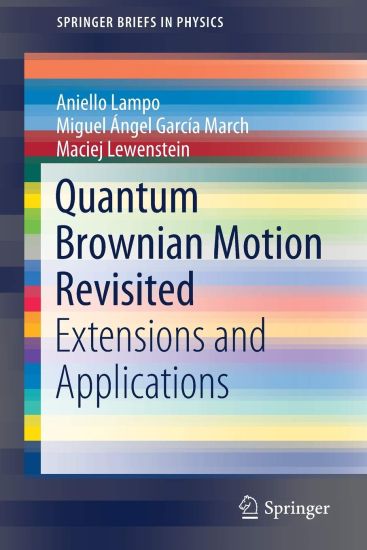
Quantum Brownian Motion Revisited

Quantum Brownian Motion Revisited

Aniello Lampo; Miguel Ángel García March; Maciej Lewenstein

Springer Nature Switzerland AG
2019
nidottu
Quantum Brownian motion represents a paradigmatic model of open quantum system, namely a system inextricably coupled to the surrounding environment. Such a model is largely used in physics, for instance in quantum foundations to approach in a quantitative manner the quantum-to-classical transition, but also for more practical purposes as the estimation of decoherence in quantum optics experiments. This book presents the main techniques aimed to treat the dynamics of the quantum Brownian particle: Born-Markov master equation, Lindblad equation and Heisenberg equations formalism. Particular attention is given to the interaction between the particle and the bath depends non-linearly on the position of the former. This generalization corresponds to the case in which the bath is not homogeneous. An immediate application is the Bose polaron, specifically an impurity embedded in an ultracold gas.
Ultracold Atoms in Optical Lattices

Ultracold Atoms in Optical Lattices

Maciej Lewenstein; Anna Sanpera; Verònica Ahufinger

Oxford University Press
2017
nidottu
Quantum computers, though not yet available on the market, will revolutionize the future of information processing. Quantum computers for special purposes like quantum simulators are already within reach. The physics of ultracold atoms, ions and molecules offer unprecedented possibilities of control of quantum many body systems and novel possibilities of applications to quantum information processing and quantum metrology. Particularly fascinating is the possibility of using ultracold atoms in lattices to simulate condensed matter or even high energy physics. This book provides a complete and comprehensive overview of ultracold lattice gases as quantum simulators. It opens up an interdisciplinary field involving atomic, molecular and optical physics, quantum optics, quantum information, condensed matter and high energy physics. The book includes some introductory chapters on basic concepts and methods, and then focuses on the physics of spinor, dipolar, disordered, and frustrated lattice gases. It reviews in detail the physics of artificial lattice gauge fields with ultracold gases. The last part of the book covers simulators of quantum computers. After a brief course in quantum information theory, the implementations of quantum computation with ultracold gases are discussed, as well as our current understanding of condensed matter from a quantum information perspective.
Ultracold Atoms in Optical Lattices

Ultracold Atoms in Optical Lattices

Maciej Lewenstein; Anna Sanpera; Verònica Ahufinger

Oxford University Press
2012
sidottu
Quantum computers, though not yet available on the market, will revolutionize the future of information processing. Quantum computers for special purposes like quantum simulators are already within reach. The physics of ultracold atoms, ions and molecules offer unprecedented possibilities of control of quantum many body systems and novel possibilities of applications to quantum information processing and quantum metrology. Particularly fascinating is the possibility of using ultracold atoms in lattices to simulate condensed matter or even high energy physics. This book provides a complete and comprehensive overview of ultracold lattice gases as quantum simulators. It opens up an interdisciplinary field involving atomic, molecular and optical physics, quantum optics, quantum information, condensed matter and high energy physics. The book includes some introductory chapters on basic concepts and methods, and then focuses on the physics of spinor, dipolar, disordered, and frustrated lattice gases. It reviews in detail the physics of artificial lattice gauge fields with ultracold gases. The last part of the book covers simulators of quantum computers. After a brief course in quantum information theory, the implementations of quantum computation with ultracold gases are discussed, as well as our current understanding of condensed matter from a quantum information perspective.