
Kirjailija
Maggie Nelson
Kirjat ja teokset yhdessä paikassa: 49 kirjaa, julkaisuja vuosilta 2001-2026, suosituimpien joukossa Kuin rakkautta. Vertaile teosten hintoja ja tarkista saatavuus suomalaisista kirjakaupoista.
49 kirjaa
Kirjojen julkaisuhaarukka 2001-2026.

Late in 2004, Maggie Nelson was looking forward to the publication of her book Jane: A Murder, a narrative in verse about the life and death of her aunt, who had been murdered thirty-five years before. The case remained unsolved, but Jane was assumed to have been the victim of an infamous serial killer in Michigan in 1969. Then, one November afternoon, Nelson received a call from her mother, who announced that the case had been reopened; a new suspect would be arrested and tried on the basis of a DNA match. Over the months that followed, Nelson found herself attending the trial with her mother and reflecting anew on the aura of dread and fear that hung over her family and childhood--an aura that derived not only from the terrible facts of her aunt's murder but also from her own complicated journey through sisterhood, daughterhood, and girlhood. The Red Parts is a memoir, an account of a trial, and a provocative essay that interrogates the American obsession with violence and missing white women, and that scrupulously explores the nature of grief, justice, and empathy.

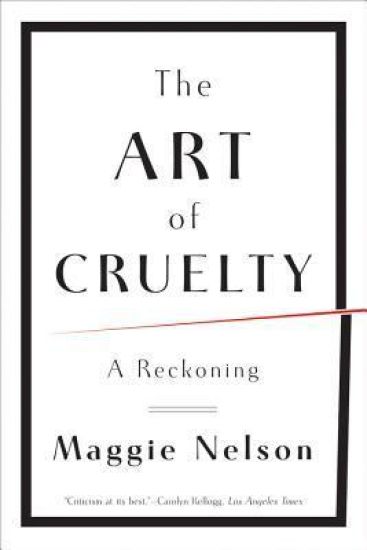
Writing in the tradition of Susan Sontag and Elaine Scarry, Maggie Nelson has emerged as one of our foremost cultural critics with this landmark work about representations of cruelty and violence in art. From Sylvia Plath’s poetry to Francis Bacon’s paintings, from the Saw franchise to Yoko Ono’s performance art, Nelson’s nuanced exploration across the artistic landscape ultimately offers a model of how one might balance strong ethical convictions with an equally strong appreciation for work that tests the limits of taste, taboo, and permissibility.

Today both reality and entertainment crowd our fields of vision with brutal imagery. The pervasiveness of images of torture, horror, and war has all but demolished the twentieth-century hope that such imagery might shock us into a less alienated state, or aid in the creation of a just social order. What to do now? When to look, when to turn away? Genre-busting author Maggie Nelson brilliantly navigates this contemporary predicament, with an eye to the question of whether or not focusing on representations of cruelty makes us cruel. In a journey through high and low culture (Kafka to reality TV), the visual to the verbal (Paul McCarthy to Brian Evenson), and the apolitical to the political (Francis Bacon to Kara Walker), Nelson offers a model of how one might balance strong ethical convictions with an equally strong appreciation for work that tests the limits of taste, taboo, and permissibility.
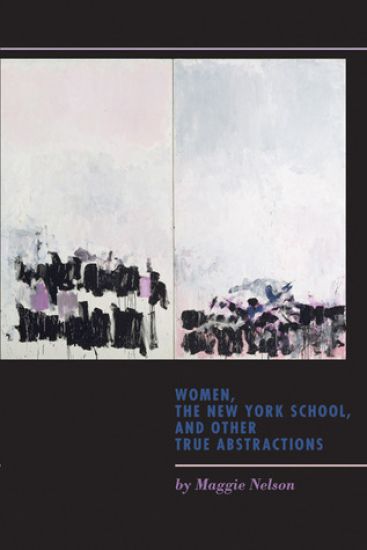
Women, the New York School, and Other True Abstractions
Maggie Nelson
University of Iowa Press
2011
nidottu
In this whip-smart study, Maggie Nelson provides the ?rst extended consideration of the roles played by women in and around the New York School of poets, from the 1950s to the present, and offers unprecedented analyses of the work of Barbara Guest, Bernadette Mayer, Alice Notley, Eileen Myles, and abstract painter Joan Mitchell as well as a reconsideration of the work of many male New York School writers and artists from a feminist perspective.With contagious enthusiasm, Women, the New York School, and Other True Abstractions ranges widely and covers collaborations between poets and painters in the 1950s and 1960s; the complex role played by the “true abstraction” of the feminine in the work of John Ashbery, Frank O’Hara, and James Schuyler; the intricate weave of verbal and visual arts throughout the postwar period, from Abstract Expressionism to Pop to Conceptualism to feminist and queer performance art; and the unfolding, diverse careers of Mayer, Notley, and Myles from the 1970s to the present. Along the way, Nelson considers provocative questions of anonymity and publicity, the solitary and the communal, the enduring and the ephemeral, domesticity, boredom, sex, and politics.By asking us to rethink the ways in which we conceptualize “schools” and “avant-gardes” and eventually drawing our attention to larger, compelling questions about how and why we read—and how gender and sexuality inform that reading in the ?rst place—Maggie Nelson not only ?lls an important gap in the history of American poetry and art but also gives an inspired performance of the kind of lively, audacious, and personally committed criticism that befits her subject.

Suppose I were to begin by saying that I had fallen in love with a color . . .A lyrical, philosophical, and often explicit exploration of personal suffering and the limitations of vision and love, as refracted through the color blue. With Bluets, Maggie Nelson has entered the pantheon of brilliant lyric essayists.Maggie Nelson is the author of numerous books of poetry and nonfiction, including Something Bright, Then Holes (Soft Skull Press, 2007) and Women, the New York School, and Other True Abstractions (University of Iowa Press, 2007). She lives in Los Angeles and teaches at the California Institute of the Arts.

Poetry. These poems manage to say everything about everything-each determining day, each shifting sense of inexhaustible person. Back of it all is an extraordinary ear for the way words find place, make a passage from here to there, blessedly keep on talking-Robert Creely. Few poets are strange and quick enough to capture the frenetic quality of contemporary life. Her poems move fast, think on their feet, hit and run with equal parts of humor, glamour, and horror. In every way, she is a thoroughly original voice for our time-Elaine Equi. THE LATEST WINTER is Nelson's follow-up to SHINER (also available from SPD). Nelson's work has appeared in many anthologies and journals including AMERICAN POETRY: THE NEXT GENERATION, THE HAT, OPEN CITY, and SHINY.

Poetry. Maggie Nelson has such drive in her language. Things do not dangle off this drive, but rather get resolutely pushed aside by her poem's forward motion. Also, she exercises the infinitesimal pause that is great poetry. Her SHINER is totally cool. She delivers the goods with fiendish delight--Eileen Myles.