Kirjojen hintavertailu. Mukana 12 390 323 kirjaa ja 12 kauppaa.
Kirjailija
Malini Johar Schueller
Kirjat ja teokset yhdessä paikassa: 5 kirjaa, julkaisuja vuosilta 2001-2026, suosituimpien joukossa Teaching Solidarity. Vertaile teosten hintoja ja tarkista saatavuus suomalaisista kirjakaupoista.
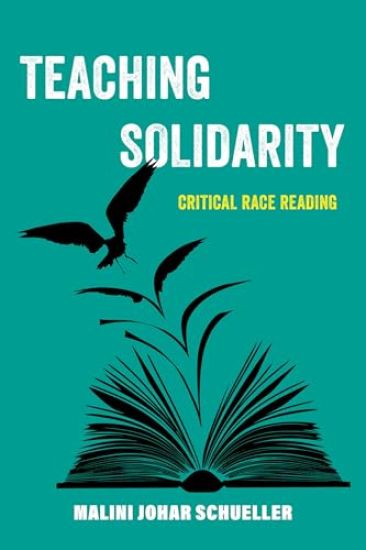
A call for critical race reading as a step towards creating progressive and democratic politics. Critical race theory (CRT) has been singled out for banning in 49 US states and been subject to a flurry of legislative acts surveilling its teaching in all levels of education. Malini Schueller argues that this is fueled by a fear of racial solidarity. To combat this, this book argues for a practice of critical race reading and activism. Teaching in Florida, the epicenter and catalyst of these harsh rebukes of CRT, Schueller challenges students to awaken to questions of racial privilege and hierarchy not through comfortable racial identification but through racial reckoning. Complete with a syllabus that any reader can learn from, Teaching Solidarity models critical ways of reading for social justice.
A call for critical race reading as a step towards creating progressive and democratic politics. Critical race theory (CRT) has been singled out for banning in 49 US states and been subject to a flurry of legislative acts surveilling its teaching in all levels of education. Malini Schueller argues that this is fueled by a fear of racial solidarity. To combat this, this book argues for a practice of critical race reading and activism. Teaching in Florida, the epicenter and catalyst of these harsh rebukes of CRT, Schueller challenges students to awaken to questions of racial privilege and hierarchy not through comfortable racial identification but through racial reckoning. Complete with a syllabus that any reader can learn from, Teaching Solidarity models critical ways of reading for social justice.
The creation of a new school system in the Philippines in 1898 and educational reforms in occupied Japan, both with stated goals of democratization, speaks to a singular vision of America as savior, following its politics of violence with benevolent recuperation. The pedagogy of recovery-in which schooling was central and natives were forced to accept empire through education-might have shown how Americans could be good occupiers, but it also created projects of Orientalist racial management: Filipinos had to be educated and civilized, while the Japanese had to be reeducated and “de-civilized.” In Campaigns of Knowledge, Malini Schueller contrapuntally reads state-sanctioned proclamations, educational agendas, and school textbooks alongside political cartoons, novels, short stories, and films to demonstrate how the U.S. tutelary project was rerouted, appropriated, reinterpreted, and resisted. In doing so, she highlights how schooling was conceived as a process of subjectification, creating particular modes of thought, behaviors, aspirations, and desires that would render the natives docile subjects amenable to American-style colonialism in the Philippines and occupation in Japan.
The creation of a new school system in the Philippines in 1898 and educational reforms in occupied Japan, both with stated goals of democratization, speaks to a singular vision of America as savior, following its politics of violence with benevolent recuperation. The pedagogy of recovery-in which schooling was central and natives were forced to accept empire through education-might have shown how Americans could be good occupiers, but it also created projects of Orientalist racial management: Filipinos had to be educated and civilized, while the Japanese had to be reeducated and “de-civilized.” In Campaigns of Knowledge, Malini Schueller contrapuntally reads state-sanctioned proclamations, educational agendas, and school textbooks alongside political cartoons, novels, short stories, and films to demonstrate how the U.S. tutelary project was rerouted, appropriated, reinterpreted, and resisted. In doing so, she highlights how schooling was conceived as a process of subjectification, creating particular modes of thought, behaviors, aspirations, and desires that would render the natives docile subjects amenable to American-style colonialism in the Philippines and occupation in Japan.
U.S. Orientalisms is the first extensive and politicized study of nineteenth century American discourses that helped build an idea of nationhood with control over three "Orients": the "Barbary" Orient; the Orient of Egypt; and the Orient of India. Malini Johar Schueller persuasively argues that current notions about the East can be better understood as latter-day manifestations of the earlier U.S. visions of the Orient refracted variously through millennial fervor, racial-cultural difference, and ideas of Westerly empire. This book begins with an examination of the literature of the "Barbary" Orient generated by the U.S. Algerian conflict in the late eighteenth century in the works of such writers as Royall Tyler, Susanna Rowson, and Washington Irving. It then moves on to the Near East Orientalist literature of the nineteenth century in light of Egyptology, theories of race, and the growth of missionary fervor in writers such as John DeForest, Maria Susanna Cummins, Herman Melville, Edgar Allan Poe, and Harriet Prescott Spofford. Finally, Schueller considers the Indic Orientalism of the period in the context of Indology, British colonialism, and the push for Asian trade in the United States, focusing particularly on Emerson and Whitman. U.S. Orientalisms demonstrates how these writers strove to create an Orientalism premised on the idea of civilization and empire moving West, from Asia, through Europe, and culminating in the New World. Schueller draws on the work of Michel Foucault, Edward Said, Homi Bhabha, Rey Chow, and Judith Butler and compellingly demonstrates how a raced, compensatory "Orientalist" discourse of empire was both contested and evoked in the literary works of a wide variety of writers. The book will be of interest to readers in American history, postcolonial studies, gender studies, and literary theory. Malini Johar Schueller is Associate Professor, Department of English, University of Florida. She is the author of The Politics of Voice: Liberalism and Social Criticism from Franklin to Kingston.