Kirjojen hintavertailu. Mukana 12 390 323 kirjaa ja 12 kauppaa.

Kirjailija

Malte C. Ebach

Kirjat ja teokset yhdessä paikassa: 7 kirjaa, julkaisuja vuosilta 2007-2026, suosituimpien joukossa Goethe's Art of Science. Vertaile teosten hintoja ja tarkista saatavuus suomalaisista kirjakaupoista.

7 kirjaa

Kirjojen julkaisuhaarukka 2007-2026.

Goethe's Art of Science

Goethe's Art of Science

Malte C. Ebach

TAYLOR FRANCIS LTD
2026
sidottu
Johann Wolfgang von Goethe contributed significantly to comparative biology and systematic theory, and he is acknowledged as both a scientist and a writer. Goethe’s area of scientific interest was plant and animal morphology; his methods are familiar to many of today’s taxonomists. What many do not appreciate is that he used his methodology with non-biological forms – rocks, landforms, colour and clouds. Although not successful in geology, his approach stimulated 18th and 19th century physics. The book provides 21st century context for Goethe’s scientific work, as well as a compendium for scholars interested in 18th century and early 19th century science. Key Features Compares Goethe’s ideas to modern systematics, physics, geology and geography Investigate how literature and architecture of Goethe’s time have influenced his scientific studies Explores the role science played in Goethe’s non-scientific works Documents Goethe’s own experiences in Switzerland, Italy and France and how that influenced his views of botany, geology and geography Includes a bibliography of Goethe’s publications and an account of his fraught relationship with his publishers Provides an account of Goethe’s critics during his lifetime and beyond.

Biotectonics of Neotropical Transition Zones

Biotectonics of Neotropical Transition Zones

Lize Hermógenes de Mendonça; Bernard Michaux; Malte C. Ebach

Springer International Publishing AG
2024
nidottu
This book offers an up-to-date review and synthesis of the role of tectonics in Neotropical bioregionalisation, in particular transition zones. The main questions are "What are transition zones?", "How would we identify them?" and, "What are the tectonic drivers of transition zones?" These questions are pertinent as they may reveal a new transition zone within the Caribbean (Antillean sub-region), and provides an up-to-date account of the biotectonics of the Caribbean. In addition, the book contains a detailed tectonic summary of the development of the Andes and the bioregionalisation of the South American Transition Zone.
Biotectonics

Biotectonics

Malte C. Ebach; Bernard Michaux

Springer Nature Switzerland AG
2020
nidottu
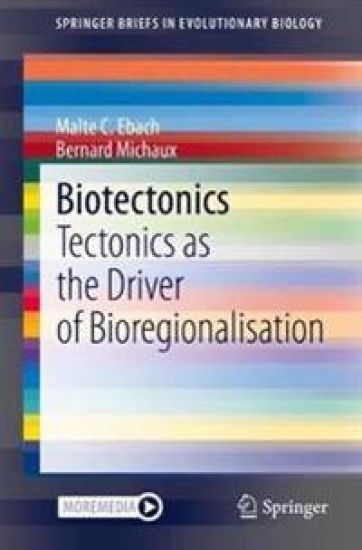
Tectonic plates are constantly moving, either crashing into one another creating a mosaic of mountains and shallow seas, or tearing apart and isolating large swathes of land. In both cases plate tectonics separates populations leading to the evolution of biota. Tectonics is also responsible for the destruction life, for instance when large coral reefs or shallow seas are compressed to form mountain peaks. Could recent research into these processes provide enough evidence to show that tectonics may be the ultimate driver of life on Earth? Our book delves into the current research in tectonics, particularly neotectonics, and its impact on rapid changes on biogeographical classification, also known as bioregionalisation. We also introduce a new term biotectonics that studies the impact of tectonics on biogeoregionalisation. The question we ask is how tectonics directly influences the distribution of biota in four case studies: the Mesozic and early Palaeogene Australides, which spans the Proto-Pacific coast of the South America, Antaractica and Australiasia; and the Neogene of Australia. To conclude we examine the role of neotectonics on tranistion zones and the Amazon Basin and make a case for biotectonic extinction.
Cladistics

Cladistics

David M. Williams; Malte C. Ebach

Cambridge University Press
2020
pokkari
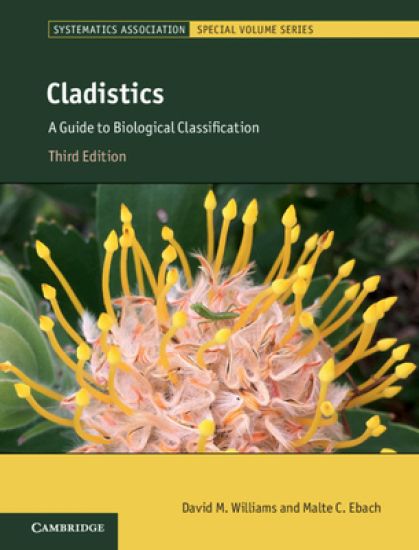
This new edition of a foundational text presents a contemporary review of cladistics, as applied to biological classification. It provides a comprehensive account of the past fifty years of discussion on the relationship between classification, phylogeny and evolution. It covers cladistics in the era of molecular data, detailing new advances and ideas that have emerged over the last twenty-five years. Written in an accessible style by internationally renowned authors in the field, readers are straightforwardly guided through fundamental principles and terminology. Simple worked examples and easy-to-understand diagrams also help readers navigate complex problems that have perplexed scientists for centuries. This practical guide is an essential addition for advanced undergraduates, postgraduates and researchers in taxonomy, systematics, comparative biology, evolutionary biology and molecular biology.
Cladistics

Cladistics

David M. Williams; Malte C. Ebach

Cambridge University Press
2020
sidottu
This new edition of a foundational text presents a contemporary review of cladistics, as applied to biological classification. It provides a comprehensive account of the past fifty years of discussion on the relationship between classification, phylogeny and evolution. It covers cladistics in the era of molecular data, detailing new advances and ideas that have emerged over the last twenty-five years. Written in an accessible style by internationally renowned authors in the field, readers are straightforwardly guided through fundamental principles and terminology. Simple worked examples and easy-to-understand diagrams also help readers navigate complex problems that have perplexed scientists for centuries. This practical guide is an essential addition for advanced undergraduates, postgraduates and researchers in taxonomy, systematics, comparative biology, evolutionary biology and molecular biology.
Foundations of Systematics and Biogeography

Foundations of Systematics and Biogeography

David M. Williams; G. Nelson; Malte C. Ebach

Springer-Verlag New York Inc.
2010
nidottu
Anyone interested in comparative biology or the history of science will find this myth-busting work genuinely fascinating. It draws attention to the seminal studies and important advances that have shaped systematic and biogeographic thinking. It traces concepts in homology and classification from the 19th century to the present through the provision of a unique anthology of scientific writings from Goethe, Agassiz, Owen, Naef, Zangerl and Nelson, among others.
Foundations of Systematics and Biogeography

Foundations of Systematics and Biogeography

David M. Williams; G. Nelson; Malte C. Ebach

Springer-Verlag New York Inc.
2007
sidottu
This volume draws attention to the seminal studies and important advances that have shaped systematic and biogeographic thinking and continue to influence its direction today. It traces concepts in homology and classification from the 19th century to the present through the provision of a unique anthology of scientific writings from Goethe, Agassiz, Geoffroy St. Hilaire, Owen, Naef, Zangerl and Nelson, among others. In addition, current attitudes and practices in comparative biology are interrogated, particularly in relation to evolutionary studies leading to a re-statement of the principal aims of the discipline.In order to alert prospective students to pitfalls common in systematics and biogeography, the book highlights three principal messages: biological classifications and their explanatory mechanisms are separate notions; most, if not all, homology concepts pre-date the works of Darwin; and that the foundation of all comparative biology is the concept of relationship - neither 'similarity' nor 'genealogical hypotheses of descent' are sufficient.