Kirjojen hintavertailu. Mukana 12 390 323 kirjaa ja 12 kauppaa.

Kirjailija

Mandla J. Radebe

Kirjat ja teokset yhdessä paikassa: 6 kirjaa, julkaisuja vuosilta 2021-2025, suosituimpien joukossa Destroying Democracy. Vertaile teosten hintoja ja tarkista saatavuus suomalaisista kirjakaupoista.

Mukana myös kirjoitusasut: Mandla J Radebe

6 kirjaa

Kirjojen julkaisuhaarukka 2021-2025.

Destroying Democracy

Destroying Democracy

Jane Duncan; Linda Gordon; Gunnett Kaaf; Dale T McKinley; Alf Gunvald Nilsen; Devan Pillay; Mandla J Radebe; Alfredo Saad-Filho; Ingar Solty

Wits University Press
2021
pokkari
A history of the erosion of democracy across the globe Democracy is being destroyed. This is a crisis that expresses itself in the rising authoritarianism visible in divisive and exclusionary politics, populist political parties and movements, increased distrust in fact-based information and news, and the withering accountability of state institutions. Over the last four decades, democracy has radically shifted to a market democracy in which all aspects of human, non-human and planetary life are commodified, with corporations becoming more powerful than states and their citizens. This is how neoliberal capitalism functions at a systemic level and if left unchecked, is the greatest threat to democracy and a sustainable planet. Volume six of the Democratic Marxism series focuses on how decades of neoliberal capitalism have eroded the global democratic project and how, in the process, authoritarian politics are gaining ground. Scholars and activists from the political left focus on four country cases – India, Brazil, South Africa and the United States of America – in which the COVID-19 pandemic has fuelled and highlighted the pre-existing crisis. They interrogate issues of politics, ecology, state security, media, access to information and political parties, and affirm the need to reclaim and re-build an expansive and inclusive democracy. Destroying Democracy is an invaluable resource for the general public, activists, scholars and students who are interested in understanding the threats to democracy and the rising tide of authoritarianism in the global south and the global north.
Destroying Democracy

Destroying Democracy

Jane Duncan; Linda Gordon; Gunnett Kaaf; Dale T McKinley; Alf Gunvald Nilsen; Devan Pillay; Mandla J Radebe; Alfredo Saad-Filho; Ingar Solty

WITS UNIVERSITY PRESS
2021
sidottu
A history of the erosion of democracy across the globe Democracy is being destroyed. This is a crisis that expresses itself in the rising authoritarianism visible in divisive and exclusionary politics, populist political parties and movements, increased distrust in fact-based information and news, and the withering accountability of state institutions. Over the last four decades, democracy has radically shifted to a market democracy in which all aspects of human, non-human and planetary life are commodified, with corporations becoming more powerful than states and their citizens. This is how neoliberal capitalism functions at a systemic level and if left unchecked, is the greatest threat to democracy and a sustainable planet. Volume six of the Democratic Marxism series focuses on how decades of neoliberal capitalism have eroded the global democratic project and how, in the process, authoritarian politics are gaining ground. Scholars and activists from the political left focus on four country cases – India, Brazil, South Africa and the United States of America – in which the COVID-19 pandemic has fuelled and highlighted the pre-existing crisis. They interrogate issues of politics, ecology, state security, media, access to information and political parties, and affirm the need to reclaim and re-build an expansive and inclusive democracy. Destroying Democracy is an invaluable resource for the general public, activists, scholars and students who are interested in understanding the threats to democracy and the rising tide of authoritarianism in the global south and the global north.
Constructing Hegemony

Constructing Hegemony

Mandla J. Radebe

TAYLOR FRANCIS LTD
2025
nidottu
Post-apartheid South Africa continues to face challenges in its attempts at economic transformation from decades of apartheid and colonisation. This need for revolution has resulted in various policy initiatives, including the ongoing demands for the nationalisation of the economy. The commercial media has a central role in shaping policy debates. But this media is an ideological tool and an economic resource since it is owned and controlled by people with political and economic interests and, therefore, tends to support and promote their interests.This book provides a Marxist critique of the representation of the nationalisation of the mines debate by the South African commercial media. Radebe examines corporate control of the media to articulate the interrelations between the State, Capital and the Media and how commercial media represents, shapes and influences public policy. He concludes that beyond factors such as ownership, commercialisation and the influence of advertising on news content, the global capitalist hegemony has a more powerful effect on the commercial media in South Africa than previously thought.Print edition not for sale in Sub Saharan Africa.
Public Sector Communication in the Digital Age
"Public sector communication in Southern Africa cannot be understood outside the factors shaped by the region's historical context, political transitions and, subsequently, the need for transparent and inclusive governance."In the past decade, digital communication technologies have surged due to the fourth industrial revolution, reshaping communication dynamics with more interactive engagement and rapid feedback. These advancements in the public sector have connected stakeholders to previously inaccessible state branches in South Africa and beyond. Public sector leaders now use digital tools to bolster their brands and demonstrate servant leadership by enhancing service delivery through improved access.This book brings together diverse scholars who contribute insights that analyse the latest theories and practices in the realm of public sector communication in the digital age. It encompasses theory-driven analyses, applied methodologies, and case studies that capture the current realities in public sector digital communication in Southern Africa.
Constructing Hegemony

Constructing Hegemony

Mandla J. Radebe

TAYLOR FRANCIS LTD
2023
sidottu
Post-apartheid South Africa continues to face challenges in its attempts at economic transformation from decades of apartheid and colonisation. This need for revolution has resulted in various policy initiatives, including the ongoing demands for the nationalisation of the economy. The commercial media has a central role in shaping policy debates. But this media is an ideological tool and an economic resource since it is owned and controlled by people with political and economic interests and, therefore, tends to support and promote their interests.This book provides a Marxist critique of the representation of the nationalisation of the mines debate by the South African commercial media. Radebe examines corporate control of the media to articulate the interrelations between the State, Capital and the Media and how commercial media represents, shapes and influences public policy. He concludes that beyond factors such as ownership, commercialisation and the influence of advertising on news content, the global capitalist hegemony has a more powerful effect on the commercial media in South Africa than previously thought.Print edition not for sale in Sub Saharan Africa.
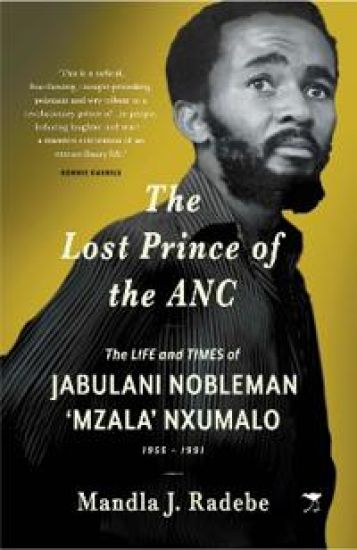
The Lost Prince of the ANC

The Lost Prince of the ANC

Mandla J. Radebe

JACANA MEDIA (PTY) LTD
2022
nidottu
Mandala J. Radebe has written the first, full account of the South African revolutionary, Jabulani Nobleman ‘Mzala’ Nxumalo. Intimate and analytical, this powerful and searching biography of one of the liberation movement’s chief critical thinkers, writer and constant questioner, The Lost Prince of the ANC traces Mzala’s life from birth to his untimely death in London in 1991, at the age of 35. Radebe’s insightful life of Mzala, is the story too, of the radical tradition of the liberation movement, which flourished during its underground days. This revolutionary book, of an intellectual who had much to offer the post-apartheid South Africa, does more than fill a gap in our history: its insight opens a door for the reader to imagine politics and society anew.