Kirjojen hintavertailu. Mukana 12 390 323 kirjaa ja 12 kauppaa.

Kirjailija

Marc J. Assael

Kirjat ja teokset yhdessä paikassa: 5 kirjaa, julkaisuja vuosilta 1996-2024, suosituimpien joukossa Commonly Asked Questions in Thermodynamics. Vertaile teosten hintoja ja tarkista saatavuus suomalaisista kirjakaupoista.

Mukana myös kirjoitusasut: Marc J Assael

5 kirjaa

Kirjojen julkaisuhaarukka 1996-2024.

Commonly Asked Questions in Thermodynamics

Commonly Asked Questions in Thermodynamics

Marc J. Assael; Geoffrey C. Maitland; Thomas Maskow; Urs von Stockar; William A. Wakeham; Stefan Will

TAYLOR FRANCIS LTD
2022
sidottu
CRC Press is pleased to introduce the new edition of Commonly Asked Questions in Thermodynamics, an indispensable resource for those in modern science and engineering disciplines from molecular science, engineering and biotechnology to astrophysics. Fully updated throughout, this edition features two new chapters focused on energy utilization and biological systems. This edition begins by setting out the fundamentals of thermodynamics, including its basic laws and overarching principles. It provides explanations of those principles in an organized manner, using questions that arise frequently from undergraduates in the classroom as the stimulus. These early chapters explore the language of thermodynamics; the first and second laws; statistical mechanical theory; measurement of thermodynamic quantities and their relationships; phase behavior in single and multicomponent systems; electrochemistry; and chemical and biochemical reaction equilibria. The later chapters explore applications of these fundamentals to a diverse set of subjects including power generation (with and without fossil fuels) for transport, industrial and domestic use; heating; decarbonization technologies; energy storage; refrigeration; environmental pollution; and biotechnology. Data sources for the properties needed to complete thermodynamic evaluations of many processes are included.The text is designed for readers to dip into to find an answer to a specific question where thermodynamics can provide some, if not all, of the answers, whether in the context of an undergraduate course or not. Thus its readership extends beyond conventional technical undergraduates to practicing engineers and also to the interested lay person who seeks to understand the discourse that surrounds the choice of particular technological solutions to current and future energy and material production problems.
Commonly Asked Questions in Thermodynamics

Commonly Asked Questions in Thermodynamics

Marc J. Assael; Geoffrey C. Maitland; Thomas Maskow; Urs von Stockar; William A. Wakeham; Stefan Will

TAYLOR FRANCIS LTD
2024
nidottu
CRC Press is pleased to introduce the new edition of Commonly Asked Questions in Thermodynamics, an indispensable resource for those in modern science and engineering disciplines from molecular science, engineering and biotechnology to astrophysics. Fully updated throughout, this edition features two new chapters focused on energy utilization and biological systems. This edition begins by setting out the fundamentals of thermodynamics, including its basic laws and overarching principles. It provides explanations of those principles in an organized manner, using questions that arise frequently from undergraduates in the classroom as the stimulus. These early chapters explore the language of thermodynamics; the first and second laws; statistical mechanical theory; measurement of thermodynamic quantities and their relationships; phase behavior in single and multicomponent systems; electrochemistry; and chemical and biochemical reaction equilibria. The later chapters explore applications of these fundamentals to a diverse set of subjects including power generation (with and without fossil fuels) for transport, industrial and domestic use; heating; decarbonization technologies; energy storage; refrigeration; environmental pollution; and biotechnology. Data sources for the properties needed to complete thermodynamic evaluations of many processes are included.The text is designed for readers to dip into to find an answer to a specific question where thermodynamics can provide some, if not all, of the answers, whether in the context of an undergraduate course or not. Thus its readership extends beyond conventional technical undergraduates to practicing engineers and also to the interested lay person who seeks to understand the discourse that surrounds the choice of particular technological solutions to current and future energy and material production problems.

Fires, Explosions, and Toxic Gas Dispersions

Fires, Explosions, and Toxic Gas Dispersions

Marc J. Assael; Konstantinos E. Kakosimos

CRC Press Inc
2010
sidottu
Today’s risk analysis is a very challenging field, and a solid understanding of the calculations procedure associated with it is essential for anyone involved. Fires, Explosions, and Toxic Gas Dispersions: Effects Calculation and Risk Analysis provides an overview of the methods used to assess the risk of fires, explosions, and toxic gas dispersion, and then deduce the subsequent effects and consequences of these events. The authors cover various aspects of such incidents, including the probability that an accident will occur, and how to calculate leaks, heat flux, overpressure, and the concentration of toxic clouds. The book follows by describing the consequences to people (injury or death) and material damages, and it concludes with a discussion of possible causes of destruction and common circumstances that can result in accidents.Some key features of this book include: Introduction of basic techniques of hazard identification, emphasizing "what if" and HAZOP analyses Step-by-step procedures for the calculation of fires (i.e., pool fire, jet fire, fire ball), explosions (VCE, BLEVE), and concentration of toxic clouds (light and heavy gases) Methods for determining probability of injuries or lethalityInvaluable to professionals, researchers, and students whose work involves predicting the consequences of accidents, this book describes simple modern methods, which are a great aid for understanding the meaning of all the variables involved—in contrast to current complicated computer packages, which produce only results. Filling the existing gap in useful literature on risk analysis, this book follows a logical structure and presents straightforward, step-by-step calculation procedures and numerous examples that will be valuable in both teaching and learning the content.
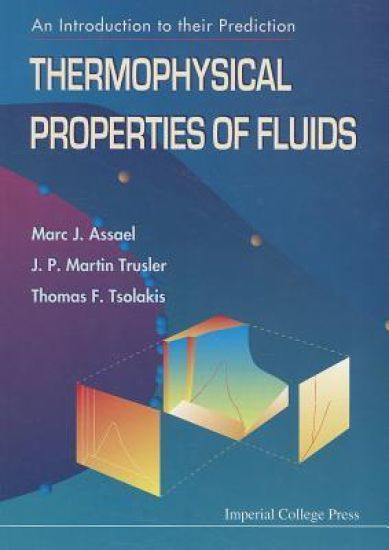
Thermophysical Properties Of Fluids: An Introduction To Their Prediction

Thermophysical Properties Of Fluids: An Introduction To Their Prediction

Marc J Assael; J P Martin Trusler; Thomas F Tsolakis

Imperial College Press
1996
nidottu
This book is concerned with the prediction of thermodynamic and transport properties of gases and liquids. The prediction of such properties is essential for the solution of many problems encountered in chemical and process engineering as well as in other areas of science and technology. The book aims to present the best of those modern methods which are capable of practical application. It begins with basic scientific principles and formal results which are subsequently developed into practical methods of prediction. Numerous examples, supported by a suite of computer programmes, illustrate applications of the methods. The book is aimed primarily at the student market (for both undergraduate and taught postgraduate courses) but it will also be useful for those engaged in research and for chemical and process engineering professionals.
Thermophysical Properties Of Fluids: An Introduction To Their Prediction

Thermophysical Properties Of Fluids: An Introduction To Their Prediction

Marc J Assael; J P Martin Trusler; Thomas F Tsolakis

Imperial College Press
1996
sidottu
This book is concerned with the prediction of thermodynamic and transport properties of gases and liquids. The prediction of such properties is essential for the solution of many problems encountered in chemical and process engineering as well as in other areas of science and technology. The book aims to present the best of those modern methods which are capable of practical application. It begins with basic scientific principles and formal results which are subsequently developed into practical methods of prediction. Numerous examples, supported by a suite of computer programmes, illustrate applications of the methods. The book is aimed primarily at the student market (for both undergraduate and taught postgraduate courses) but it will also be useful for those engaged in research and for chemical and process engineering professionals.