Kirjojen hintavertailu. Mukana 12 595 353 kirjaa ja 12 kauppaa.

Kirjailija

Marc Kéry

Kirjat ja teokset yhdessä paikassa: 5 kirjaa, julkaisuja vuosilta 2010-2024, suosituimpien joukossa Integrated Population Models. Vertaile teosten hintoja ja tarkista saatavuus suomalaisista kirjakaupoista.

5 kirjaa

Kirjojen julkaisuhaarukka 2010-2024.

Applied Statistical Modelling for Ecologists

Applied Statistical Modelling for Ecologists

Marc Kéry; Kenneth F. Kellner

Elsevier - Health Sciences Division
2024
nidottu
**2025 PROSE Award Finalist in Environmental Science** Applied Statistical Modelling for Ecologists provides a gentle introduction to the essential models of applied statistics: linear models, generalized linear models, mixed and hierarchical models. All models are fit with both a likelihood and a Bayesian approach, using several powerful software packages widely used in research publications: JAGS, NIMBLE, Stan, and TMB. In addition, the foundational method of maximum likelihood is explained in a manner that ecologists can really understand. This book is the successor of the widely used Introduction to WinBUGS for Ecologists (Kéry, Academic Press, 2010). Like its parent, it is extremely effective for both classroom use and self-study, allowing students and researchers alike to quickly learn, understand, and carry out a very wide range of statistical modelling tasks. The examples in Applied Statistical Modelling for Ecologists come from ecology and the environmental sciences, but the underlying statistical models are very widely used by scientists across many disciplines. This book will be useful for anybody who needs to learn and quickly become proficient in statistical modelling, with either a likelihood or a Bayesian focus, and in the model-fitting engines covered, including the three latest packages NIMBLE, Stan, and TMB.
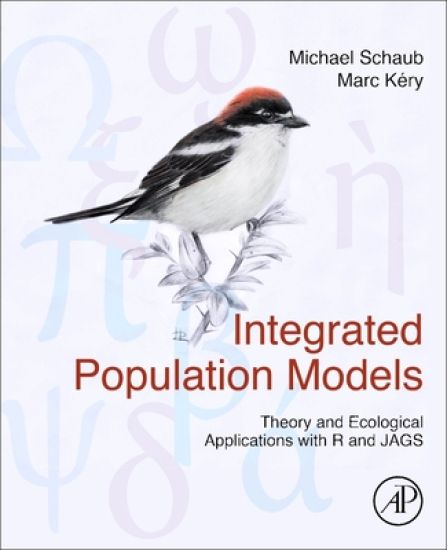
Integrated Population Models

Integrated Population Models

Michael Schaub; Marc Kéry

Academic Press Inc
2021
sidottu
Integrated Population Models: Theory and Ecological Applications with R and JAGS is the first book on integrated population models, which constitute a powerful framework for combining multiple data sets from the population and the individual levels to estimate demographic parameters, and population size and trends. These models identify drivers of population dynamics and forecast the composition and trajectory of a population. Written by two population ecologists with expertise on integrated population modeling, this book provides a comprehensive synthesis of the relevant theory of integrated population models with an extensive overview of practical applications, using Bayesian methods by means of case studies. The book contains fully-documented, complete code for fitting all models in the free software, R and JAGS. It also includes all required code for pre- and post-model-fitting analysis. Integrated Population Models is an invaluable reference for researchers and practitioners involved in population analysis, and for graduate-level students in ecology, conservation biology, wildlife management, and related fields. The text is ideal for self-study and advanced graduate-level courses.
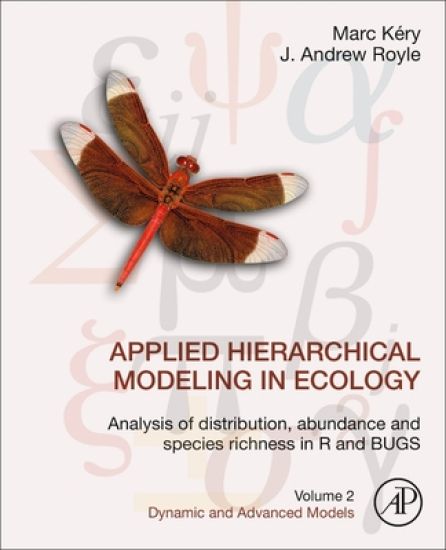
Applied Hierarchical Modeling in Ecology: Analysis of Distribution, Abundance and Species Richness in R and BUGS
Applied Hierarchical Modeling in Ecology: Analysis of Distribution, Abundance and Species Richness in R and BUGS, Volume Two: Dynamic and Advanced Models provides a synthesis of the state-of-the-art in hierarchical models for plant and animal distribution, also focusing on the complex and more advanced models currently available. The book explains all procedures in the context of hierarchical models that represent a unified approach to ecological research, thus taking the reader from design, through data collection, and into analyses using a very powerful way of synthesizing data.
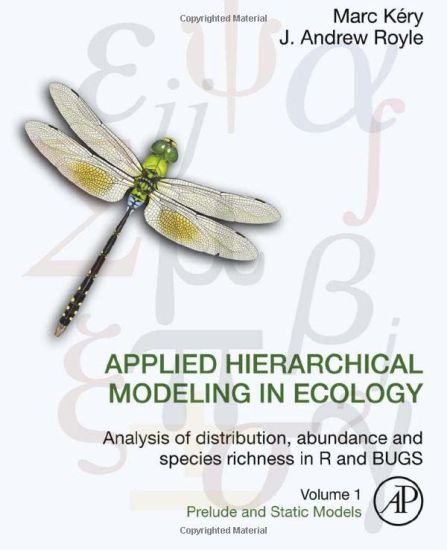
Applied Hierarchical Modeling in Ecology: Analysis of distribution, abundance and species richness in R and BUGS
Applied Hierarchical Modeling in Ecology: Distribution, Abundance, Species Richness offers a new synthesis of the state-of-the-art of hierarchical models for plant and animal distribution, abundance, and community characteristics such as species richness using data collected in metapopulation designs. These types of data are extremely widespread in ecology and its applications in such areas as biodiversity monitoring and fisheries and wildlife management. This first volume explains static models/procedures in the context of hierarchical models that collectively represent a unified approach to ecological research, taking the reader from design, through data collection, and into analyses using a very powerful class of models. Applied Hierarchical Modeling in Ecology, Volume 1 serves as an indispensable manual for practicing field biologists, and as a graduate-level text for students in ecology, conservation biology, fisheries/wildlife management, and related fields.
Introduction to WinBUGS for Ecologists

Introduction to WinBUGS for Ecologists

Marc Kéry

Academic Press Inc
2010
nidottu
Introduction to WinBUGS for Ecologists introduces applied Bayesian modeling to ecologists using the highly acclaimed, free WinBUGS software. It offers an understanding of statistical models as abstract representations of the various processes that give rise to a data set. Such an understanding is basic to the development of inference models tailored to specific sampling and ecological scenarios. The book begins by presenting the advantages of a Bayesian approach to statistics and introducing the WinBUGS software. It reviews the four most common statistical distributions: the normal, the uniform, the binomial, and the Poisson. It describes the two different kinds of analysis of variance (ANOVA): one-way and two- or multiway. It looks at the general linear model, or ANCOVA, in R and WinBUGS. It introduces generalized linear model (GLM), i.e., the extension of the normal linear model to allow error distributions other than the normal. The GLM is then extended contain additional sources of random variation to become a generalized linear mixed model (GLMM) for a Poisson example and for a binomial example. The final two chapters showcase two fairly novel and nonstandard versions of a GLMM. The first is the site-occupancy model for species distributions; the second is the binomial (or N-) mixture model for estimation and modeling of abundance.