Kirjojen hintavertailu. Mukana 12 390 323 kirjaa ja 12 kauppaa.

Kirjailija

Marc Labonte

Kirjat ja teokset yhdessä paikassa: 9 kirjaa, julkaisuja vuosilta 2003-2015, suosituimpien joukossa China's Currency & Economic Issues. Vertaile teosten hintoja ja tarkista saatavuus suomalaisista kirjakaupoista.

9 kirjaa

Kirjojen julkaisuhaarukka 2003-2015.

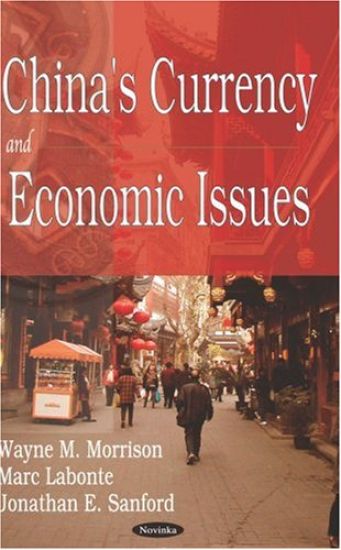
China's Currency & Economic Issues

China's Currency & Economic Issues

Wayne M Morrison; Marc Labonte; Jonathan E Sanford

Nova Science Publishers Inc
2006
nidottu
China has a policy of pegging its currency (the yuan) to the U.S. dollar. If the yuan is undervalued against the dollar, there are likely to be both benefits and costs to the U.S. economy. It would mean that imported Chinese goods are cheaper than they would be if the yuan were market determined. This lowers prices for U.S. consumers and diminishes inflationary pressures. It also lowers prices for U.S. firms that use imported inputs (such as parts) in their production, making such firms more competitive. Critics of China's peg point to the large and growing U.S. trade deficit with China as evidence that the yuan is undervalued and harmful to the U.S. economy. The relationship is more complex, for a number of reasons. First, while China runs a large trade surplus with the United States, it runs a significant trade deficit with the rest of the world. Second, an increasing level of Chinese exports are from foreign invested companies in China that have shifted production there to take advantage of China's abundant low cost labour. Third, the deficit masks the fact that China has become one of the fastest growing markets for U.S. exports. Finally, the trade deficit with China accounted for 23% of the sum of total U.S. bilateral trade deficits in 2004, indicating that the overall trade deficit is not caused by the exchange rate policy of one country, but rather the shortfall between U.S. saving and investment. This book presents a coherent examination of the details behind China's currency policies as they relate to outside factors.
Federal Reserve: Unconventional Monetary Policy Options

Federal Reserve: Unconventional Monetary Policy Options

Marc Labonte; Congressional Research Service

Lulu.com
2015
nidottu
The "Great Recession" and the ensuing weak recovery have led the Federal Reserve (Fed) to expand its monetary policy tools. Since December 2008, overnight interest rates have been near zero; at this "zero bound," they cannot be lowered further to stimulate the economy. As a result, the Fed has taken unprecedented policy steps to try to fulfill its statutory mandate of maximum employment and price stability. Congress has oversight responsibilities for ensuring that the Fed's actions are consistent with its mandate. The Fed has made large-scale asset purchases, popularly referred to as "quantitative easing" (QE), that have increased the size of its balance sheet from $0.9 trillion in 2007 to about $4 trillion at the end of 2013. In September 2012, the Fed began a third round of monthly purchases of Treasury securities and mortgage-backed securities (MBS), referred to as "quantitative easing three" or QEIII.
Is China a Threat to the U.S. Economy?

Is China a Threat to the U.S. Economy?

Craig K Elwell; Marc Labonte; Wayne M Morrison

Nova Science Publishers Inc
2008
nidottu
This book examines the implications (both challenges and opportunities) for the U.S. economy from China's rapid economic growth and its emergence as a major economic power. It also describes congressional approaches for dealing with various Chinese economic policies deemed damaging to various U.S. economic sectors.
Monetary Policy & Price Stability

Monetary Policy & Price Stability

Marc Labonte; Gail Makinen

Nova Science Publishers Inc
2006
nidottu
Monetary policy can be defined broadly as any policy relating to the supply of money. Since the main agency concerned with the supply of money is the nation's central bank, the Federal Reserve, monetary policy can also be defined in terms of the directives, policies, statements, and actions of the Federal Reserve, particularly those from its Board of Governors that have an effect on aggregate demand or national spending. The nation's financial press and markets pay particular attention to the pronouncements of the chairman of the Board of Governors, the nation's central banker. The reason for this attention is that monetary policy can have important effects on aggregate demand and through it on real Gross Domestic Product (GDP),unemployment, real foreign exchange rates, real interest rates, the composition of output, etc. It is paradoxical, however, that these important effects, to the extent that they occur, are essentially only short-run in nature. Over the longer run, the major effect of monetary policy is on the rate of inflation. Thus, while a more rapid rate of money growth may for a time stimulate the economy leading to a more rapid rate of real GDP growth and a lower unemployment rate, over the longer run these changes are undone and the economy is left with a higher rate of inflation. In some societies where high rates of inflation are endemic, more rapid rates of money growth fail to exercise any stimulating effect and are almost immediately translated into higher rates of inflation. Traditionally, two means have been used to measure the posture of monetary policy. Since monetary policy involves the Federal Reserve's contribution to aggregate demand or money spending, it would be logical to examine the growth rate of the money supply. A growing money supply is important for the subsequent growth in money spending or aggregate demand. Giving empirical content to the abstract concept of "the supply of money" has not been easy. For the United States, three different collections of assets have been defined as "money" and labelled M1, M2,and M3. Unfortunately, over the period 1990-2004 these aggregates have not been consistently linked to money spending and, consequently, they are not the major focus of monetary policy. Rather, the Federal Reserve executes monetary policy by setting a target for an overnight interest rate called the federal funds rate. Low or falling rates are usually taken as a sign of monetary ease; high or rising rates usually indicate monetary tightness. Changes in the federal funds rates affect primarily short-term interest rates, and through these changes, money spending. The book then looks more closely at five economies that have adopted a price stability goal: New Zealand (which was the first country to adopt targeting), Canada, the United Kingdom, Sweden, and the Euro area. One key finding from these case-studies is that, in practice, central banks tend to operate with greater latitude and more discretion than some targeting proponents may have envisioned. For example, central banks still tend to respond to a decline in economic activity by lowering interest rates, even though strict attention to the target might not justify it. This is possible because exceptions to the targets are granted for a variety of shocks and the definition of inflation being targeted often excludes price changes due to factors such as food, energy, and excise taxes. The book concludes with a brief analysis of the record of inflation targeting in the developing world. It finds that the improvement in economic performance following the adoption of inflation targeting is greater in the developing world. Since developing world countries often experience economic and political instability.
Economic Expansion of the 1990s

Economic Expansion of the 1990s

Marc Labonte; Gail E Makinen

Nova Biomedical
2003
nidottu
Of the ten economic expansions in the post-World War II era, three have been especially long: 1961-1969, 1982-1990, and 1991-2000. This study compares these three expansions in areas such as GDP growth, gross and net investment, growth and productivity of the labour force, the fiscal position of the federal government, and inflation. Such a comparison can provide perspective and insight into a number of perceived problems. Given the current economic turbulence we are facing, this book will serve as an important tool in studying the market cycle.