Kirjojen hintavertailu. Mukana 12 564 352 kirjaa ja 12 kauppaa.

Kirjailija

Marc R. Tool

Kirjat ja teokset yhdessä paikassa: 10 kirjaa, julkaisuja vuosilta 1985-2012, suosituimpien joukossa PRICING, VALUATION AND SYSTEMS. Vertaile teosten hintoja ja tarkista saatavuus suomalaisista kirjakaupoista.

10 kirjaa

Kirjojen julkaisuhaarukka 1985-2012.

Institutional Analysis and Economic Policy

Institutional Analysis and Economic Policy

Marc R. Tool; Paul Dale Bush

Springer-Verlag New York Inc.
2012
nidottu
The purpose of this volume is to demonstrate how contemporary institutional economic analysis can be applied to the resolution of economic problems. All of the essays in this book challenge the conventional wisdom in the problem areas addressed. They advocate policy positions that often run contrary to views widely held by academic economists and policy makers alike. The general literature of institutional economics is unorthodox, beginning with its methodological foundations and continuing through the kind of policy analysis found in these pages. The orthodox tradition in economics is commonly characterized as "neoclassical economics." Neoclassical economics fosters the myth that only "the market" can efficiently allocate a society's economic resources and equitably distribute its income. It provides the intellectual defense for in which "free markets" are championed over democratic capitalist ideology policy formation, which it contends is neither efficient nor equitable. For both professional economists and policy makers of a conservative political persuasion, neoclassical economics writes the script for a morality play in which the market is the "good guy" and the government is the "bad guy." As such, it undermines the belief that free societies can enhance economic welfare through the use of democratic processes in the formulation of economic policies.
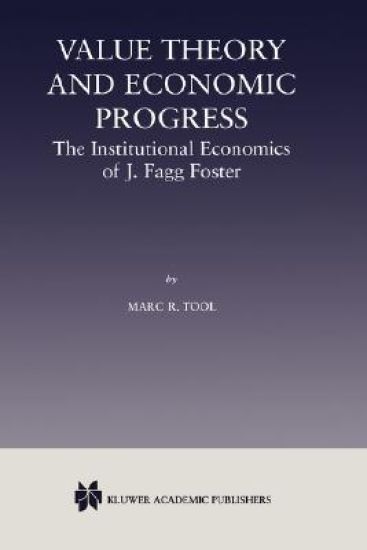
Value Theory and Economic Progress: The Institutional Economics of J. Fagg Foster
J. Fagg Foster (1907-1985) was one of the most significant creators of institutionalist economic theory in the twentieth century. He wrote and taught in the American intellectual tradition of Thorstein Weblen, John R. Commons, John Dewey and Clarence E. Ayres. This tradition shares purpose and philosophy with the European contributors, Gunnar Myrdal and K. William Kapp. Because little of Foster's scholarly work was formally published, professional knowledge of his extraordinary contribution is quite limited beyond the circle of his students and colleagues. Value Theory and Economic Progress attempts to correct that deficiency by providing an extended characterization of this missing and crucial component of the development of American heterodox economic thought. Its purpose is to demonstrate the timely relevance and significance of this model of inquiry in political economy. In addition, this volume explains that contemporary problem solving means changing `what is' into `what ought to be' through institutional adjustments; such a demonstration is at the heart of Foster's contribution to institutional thought.
Institutional Analysis and Economic Policy

Institutional Analysis and Economic Policy

Marc R. Tool; Paul Dale Bush

Springer-Verlag New York Inc.
2003
sidottu
The purpose of this volume is to demonstrate how contemporary institutional economic analysis can be applied to the resolution of economic problems. All of the essays in this book challenge the conventional wisdom in the problem areas addressed. They advocate policy positions that often run contrary to views widely held by academic economists and policy makers alike. The general literature of institutional economics is unorthodox, beginning with its methodological foundations and continuing through the kind of policy analysis found in these pages. The orthodox tradition in economics is commonly characterized as "neoclassical economics." Neoclassical economics fosters the myth that only "the market" can efficiently allocate a society's economic resources and equitably distribute its income. It provides the intellectual defense for in which "free markets" are championed over democratic capitalist ideology policy formation, which it contends is neither efficient nor equitable. For both professional economists and policy makers of a conservative political persuasion, neoclassical economics writes the script for a morality play in which the market is the "good guy" and the government is the "bad guy." As such, it undermines the belief that free societies can enhance economic welfare through the use of democratic processes in the formulation of economic policies.
Value Theory and Economic Progress: The Institutional Economics of J. Fagg Foster
J. Fagg Foster (1907-1985) was one of the most significant creators of institutionalist economic theory in the twentieth century. He wrote and taught in the American intellectual tradition of Thorstein Weblen, John R. Commons, John Dewey and Clarence E. Ayres. This tradition shares purpose and philosophy with the European contributors, Gunnar Myrdal and K. William Kapp. Because little of Foster's scholarly work was formally published, professional knowledge of his extraordinary contribution is quite limited beyond the circle of his students and colleagues. Value Theory and Economic Progress attempts to correct that deficiency by providing an extended characterization of this missing and crucial component of the development of American heterodox economic thought. Its purpose is to demonstrate the timely relevance and significance of this model of inquiry in political economy. In addition, this volume explains that contemporary problem solving means changing `what is' into `what ought to be' through institutional adjustments; such a demonstration is at the heart of Foster's contribution to institutional thought.
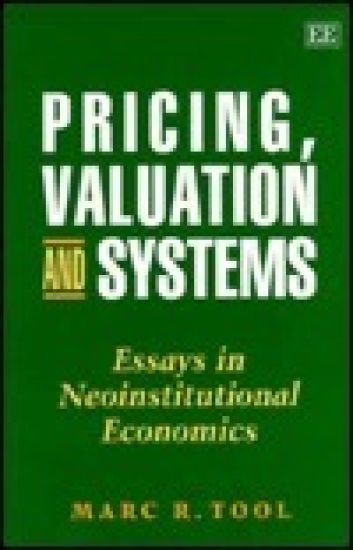
PRICING, VALUATION AND SYSTEMS

PRICING, VALUATION AND SYSTEMS

Marc R. Tool

Edward Elgar Publishing Ltd
1995
sidottu
Pricing, Valuation and Systems reintroduces American neoinstitutional economics as an alternative to the neoclassical orthodoxy. Neoinstitutionalism, Professor Tool argues, provides a pragmatic analysis that confirms that most prices and costs are set by empowered discretionary agents, not by impersonal free markets. Similarly, the institutional fabric of contemporary economic systems is shown to be defined by agents with power, not natural laws or ‘ism’ models. The author’s analysis is based upon the instrumental value theory of neoinstitutionalism rather than the utility value theory of neoclassicism. It challenges the price theory ‘heartland’ of neoclassical theory and the ‘market shock’ approach to restructuring Eastern Europe and offers neoinstitutional alternatives.
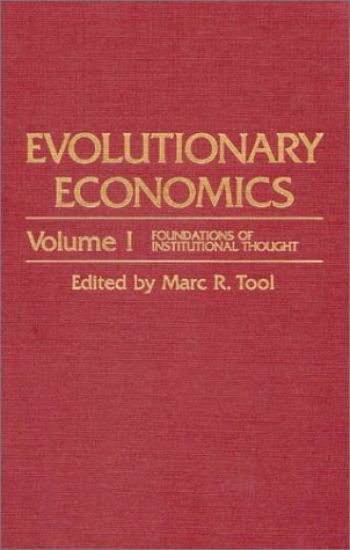
Evolutionary Economics: v. 1

Evolutionary Economics: v. 1

Marc R. Tool

M.E. Sharpe
1988
sidottu
The contributors to this volume focus on the political and value issues that, in their shared view, underlie the global environmental crisis facing us today. They argue that only by transforming our dominant values, social institutions and way of living can we avoid ecological disaster.
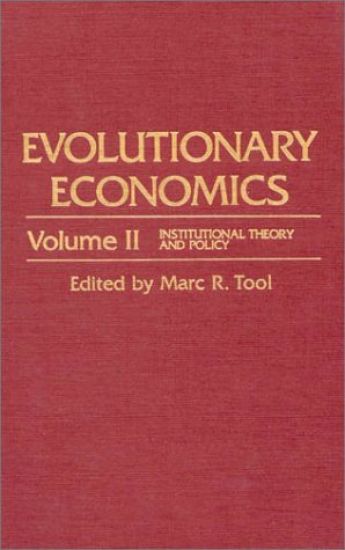
Evolutionary Economics: v. 2

Evolutionary Economics: v. 2

Marc R. Tool

M.E. Sharpe
1988
sidottu
This is part of a two-volume work intended to map the theoretical heartland of the institutionalist perspective on political economy. Volume II considers basic economic processes, institutions for stabilizing and planning economic activities, the role of power and accountability, and emerging global interdependence. Marc R. Tool is the editor of "Journal of Economic Issues".