

Kirjailija
Marcel Berger
Kirjat ja teokset yhdessä paikassa: 14 kirjaa, julkaisuja vuosilta 1970-2025, suosituimpien joukossa Geometry Revealed. Vertaile teosten hintoja ja tarkista saatavuus suomalaisista kirjakaupoista.
14 kirjaa
Kirjojen julkaisuhaarukka 1970-2025.


Both classical geometry and modern differential geometry have been active subjects of research throughout the 20th century and lie at the heart of many recent advances in mathematics and physics. The underlying motivating concept for the present book is that it offers readers the elements of a modern geometric culture by means of a whole series of visually appealing unsolved (or recently solved) problems that require the creation of concepts and tools of varying abstraction. Starting with such natural, classical objects as lines, planes, circles, spheres, polygons, polyhedra, curves, surfaces, convex sets, etc., crucial ideas and above all abstract concepts needed for attaining the results are elucidated. These are conceptual notions, each built "above" the preceding and permitting an increase in abstraction, represented metaphorically by Jacob's ladder with its rungs: the 'ladder' in the Old Testament, that angels ascended and descended... In all this, the aim of the book isto demonstrate to readers the unceasingly renewed spirit of geometry and that even so-called "elementary" geometry is very much alive and at the very heart of the work of numerous contemporary mathematicians. It is also shown that there are innumerable paths yet to be explored and concepts to be created. The book is visually rich and inviting, so that readers may open it at random places and find much pleasure throughout according their own intuitions and inclinations. Marcel Berger is the author of numerous successful books on geometry, this book once again is addressed to all students and teachers of mathematics with an affinity for geometry.

A Panoramic View of Riemannian Geometry
Marcel Berger
Springer-Verlag Berlin and Heidelberg GmbH Co. K
2012
nidottu
Riemannian geometry has today become a vast and important subject. This new book of Marcel Berger sets out to introduce readers to most of the living topics of the field and convey them quickly to the main results known to date. These results are stated without detailed proofs but the main ideas involved are described and motivated. This enables the reader to obtain a sweeping panoramic view of almost the entirety of the field. However, since a Riemannian manifold is, even initially, a subtle object, appealing to highly non-natural concepts, the first three chapters devote themselves to introducing the various concepts and tools of Riemannian geometry in the most natural and motivating way, following in particular Gauss and Riemann.

Differential Geometry: Manifolds, Curves, and Surfaces
Marcel Berger; Bernard Gostiaux
Springer-Verlag New York Inc.
2012
nidottu
This book consists of two parts, different in form but similar in spirit. The first, which comprises chapters 0 through 9, is a revised and somewhat enlarged version of the 1972 book Geometrie Differentielle. The second part, chapters 10 and 11, is an attempt to remedy the notorious absence in the original book of any treatment of surfaces in three-space, an omission all the more unforgivable in that surfaces are some of the most common geometrical objects, not only in mathematics but in many branches of physics. Geometrie Differentielle was based on a course I taught in Paris in 1969- 70 and again in 1970-71. In designing this course I was decisively influ enced by a conversation with Serge Lang, and I let myself be guided by three general ideas. First, to avoid making the statement and proof of Stokes' formula the climax of the course and running out of time before any of its applications could be discussed. Second, to illustrate each new notion with non-trivial examples, as soon as possible after its introduc tion. And finally, to familiarize geometry-oriented students with analysis and analysis-oriented students with geometry, at least in what concerns manifolds.
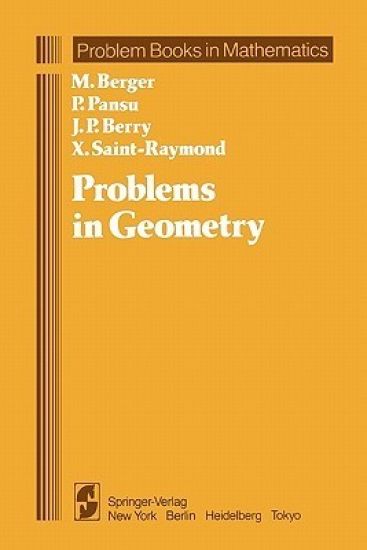
Problems in Geometry
Marcel Berger; P. Pansu; J.-P. Berry; X. Saint-Raymond
Springer-Verlag New York Inc.
2010
nidottu
Written as a supplement to Marcel Berger’s popular two-volume set, Geometry I and II (Universitext), this book offers a comprehensive range of exercises, problems, and full solutions. Each chapter corresponds directly to one in the relevant volume, from which it also provides a summary of key ideas. Where the original Geometry volumes tend toward challenging problems without hints, this book offers a wide range of material that begins at an accessible level, and includes suggestions for nearly every problem. Bountiful in illustrations and complete in its coverage of topics from affine and projective spaces, to spheres and conics, Problems in Geometry is a valuable addition to studies in geometry at many levels.
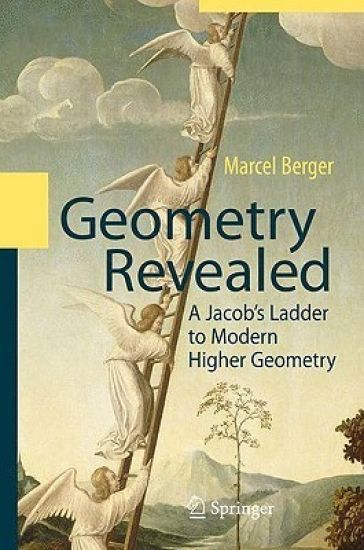
Both classical geometry and modern differential geometry have been active subjects of research throughout the 20th century and lie at the heart of many recent advances in mathematics and physics. The underlying motivating concept for the present book is that it offers readers the elements of a modern geometric culture by means of a whole series of visually appealing unsolved (or recently solved) problems that require the creation of concepts and tools of varying abstraction. Starting with such natural, classical objects as lines, planes, circles, spheres, polygons, polyhedra, curves, surfaces, convex sets, etc., crucial ideas and above all abstract concepts needed for attaining the results are elucidated. These are conceptual notions, each built "above" the preceding and permitting an increase in abstraction, represented metaphorically by Jacob's ladder with its rungs: the 'ladder' in the Old Testament, that angels ascended and descended... In all this, the aim of the book isto demonstrate to readers the unceasingly renewed spirit of geometry and that even so-called "elementary" geometry is very much alive and at the very heart of the work of numerous contemporary mathematicians. It is also shown that there are innumerable paths yet to be explored and concepts to be created. The book is visually rich and inviting, so that readers may open it at random places and find much pleasure throughout according their own intuitions and inclinations. Marcel Berger is the author of numerous successful books on geometry, this book once again is addressed to all students and teachers of mathematics with an affinity for geometry.



A Panoramic View of Riemannian Geometry
Marcel Berger
Springer-Verlag Berlin and Heidelberg GmbH Co. K
2003
sidottu
In this work the author introduces the main topics of Riemannian geometry. Since a Riemannian manifold is a subtle object, appealing to highly non-natural concepts, the first three chapters introduce the various concepts and tools of Riemannian geometry following in particular Gauss and Riemann.
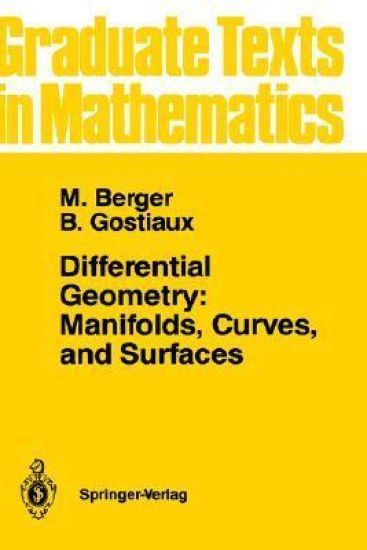
Differential Geometry: Manifolds, Curves, and Surfaces
Marcel Berger; Bernard Gostiaux
Springer-Verlag New York Inc.
1987
sidottu
This book consists of two parts, different in form but similar in spirit. The first, which comprises chapters 0 through 9, is a revised and somewhat enlarged version of the 1972 book Geometrie Differentielle. The second part, chapters 10 and 11, is an attempt to remedy the notorious absence in the original book of any treatment of surfaces in three-space, an omission all the more unforgivable in that surfaces are some of the most common geometrical objects, not only in mathematics but in many branches of physics. Geometrie Differentielle was based on a course I taught in Paris in 1969- 70 and again in 1970-71. In designing this course I was decisively influ enced by a conversation with Serge Lang, and I let myself be guided by three general ideas. First, to avoid making the statement and proof of Stokes' formula the climax of the course and running out of time before any of its applications could be discussed. Second, to illustrate each new notion with non-trivial examples, as soon as possible after its introduc tion. And finally, to familiarize geometry-oriented students with analysis and analysis-oriented students with geometry, at least in what concerns manifolds.

Problems in Geometry
Marcel Berger; P. Pansu; J.-P. Berry; X. Saint-Raymond
Springer-Verlag New York Inc.
1984
sidottu
Written as a supplement to Marcel Berger’s popular two-volume set, Geometry I and II (Universitext), this book offers a comprehensive range of exercises, problems, and full solutions. Each chapter corresponds directly to one in the relevant volume, from which it also provides a summary of key ideas. Where the original Geometry volumes tend toward challenging problems without hints, this book offers a wide range of material that begins at an accessible level, and includes suggestions for nearly every problem. Bountiful in illustrations and complete in its coverage of topics from affine and projective spaces, to spheres and conics, Problems in Geometry is a valuable addition to studies in geometry at many levels.

Le Spectre d`une Variete Riemannienne
Marcel Berger; Paul Gauduchon; Edmond Mazet
Springer-Verlag Berlin and Heidelberg GmbH Co. K
1971
nidottu

Varietes Kähleriennes Compactes
Alain Lascoux; Marcel Berger
Springer-Verlag Berlin and Heidelberg GmbH Co. K
1970
nidottu