Kirjojen hintavertailu. Mukana 12 595 353 kirjaa ja 12 kauppaa.

Kirjailija

Marco Pérez-Cisneros

Kirjat ja teokset yhdessä paikassa: 9 kirjaa, julkaisuja vuosilta 2015-2024, suosituimpien joukossa Applications of Evolutionary Computation in Image Processing and Pattern Recognition. Vertaile teosten hintoja ja tarkista saatavuus suomalaisista kirjakaupoista.

Mukana myös kirjoitusasut: Marco Perez-Cisneros, Marco Perez Cisneros

9 kirjaa

Kirjojen julkaisuhaarukka 2015-2024.

New Metaheuristic Schemes: Mechanisms and Applications

New Metaheuristic Schemes: Mechanisms and Applications

Erik Cuevas; Daniel Zaldívar; Marco Pérez-Cisneros

Springer International Publishing AG
2024
nidottu
Recently, novel metaheuristic techniques have emerged in response to the limitations of conventional approaches, leading to enhanced outcomes. These new methods introduce interesting mechanisms and innovative collaborative strategies that facilitate the efficient exploration and exploitation of extensive search spaces characterized by numerous dimensions. The objective of this book is to present advancements that discuss novel alternative metaheuristic developments that have demonstrated their effectiveness in tackling various complex problems. This book encompasses a variety of emerging metaheuristic methods and their practical applications. The content is presented from a teaching perspective, making it particularly suitable for undergraduate and postgraduate students in fields such as science, electrical engineering, and computational mathematics. The book aligns well with courses in artificial intelligence, electrical engineering, and evolutionary computation. Furthermore, the material offers valuable insights to researchers within the metaheuristic and engineering communities. Similarly, engineering practitioners unfamiliar with metaheuristic computation concepts will recognize the pragmatic value of the discussed techniques. These methods transcend mere theoretical tools that have been adapted to effectively address the significant real-world problems commonly encountered in engineering domains.
Modern Metaheuristics in Image Processing

Modern Metaheuristics in Image Processing

Diego Oliva; Noe Ortega-Sánchez; Salvador Hinojosa; Marco Pérez-Cisneros

TAYLOR FRANCIS LTD
2024
nidottu
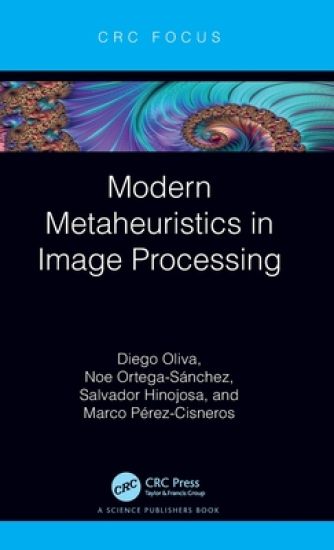
The use of metaheuristic algorithms (MA) has been increasing in recent years, and the image processing field is not the exempted of their application. In the last two years a big amount of MA has been introduced as alternatives for solving complex optimization problems. This book collects the most prominent MA of the 2019 and 2020 and verifies its use in image processing tasks. In addition, literature review of both MA and digital image processing is presented as part of the introductory information. Each algorithm is detailed explained with special focus in the tuning parameters and the proper implementation for the image processing tasks. Besides several examples permits to the reader explore and confirm the use of this kind of intelligent methods. Since image processing is widely used in different domains, this book considers different kinds of datasets that includes, magnetic resonance images, thermal images, agriculture images, among others. The reader then can have some ideas of implementation that complement the theory exposed of each optimization mechanism. Regarding the image processing problems this book consider the segmentation by using different metrics based on entropies or variances. In the same way, the identification of different shapes and the detection of objects are also covered in the corresponding chapters. Each chapter is complemented with a wide range of experiments and statistical analysis that permits the reader to judge about the performance of the MA. Finally, there is included a section that includes some discussion and conclusions. This section also provides some open questions and research opportunities for the audience.
Bio-Inspired Strategies for Modeling and Detection in Diabetes Mellitus Treatment

Bio-Inspired Strategies for Modeling and Detection in Diabetes Mellitus Treatment

Alma Y Alanis; Oscar D Sánchez; Alonso Vaca Gonzalez; Marco Perez Cisneros

ELSEVIER SCIENCE TECHNOLOGY
2024
nidottu
Bio-Inspired Strategies for Modeling and Detection in Diabetes Mellitus Treatment focuses on bioinspired techniques such as modeling to generate control algorithms for the treatment of diabetes mellitus. The book addresses the identification of diabetes mellitus using a high-order recurrent neural network trained by an extended Kalman filter. The authors also describe the use of metaheuristic algorithms for the parametric identification of compartmental models of diabetes mellitus widely used in research works such as the Sorensen model and the Dallaman model. In addition, the book addresses the modeling of time series for the prediction of risk scenarios such as hyperglycaemia and hypoglycaemia using deep neural networks. The detection of diabetes mellitus in the early stages or when current diagnostic techniques cannot detect glucose intolerance or prediabetes is proposed, carried out by means of deep neural networks present in the literature. Readers will find leading-edge research in diabetes identification based on discrete high-order neural networks trained with an extended Kalman filter; parametric identification of compartmental models used to describe diabetes mellitus; modeling of data obtained by continuous glucose-monitoring sensors for the prediction of risk scenarios such as hyperglycaemia and hypoglycaemia; and screening for glucose intolerance using glucose-tolerance test data and deep neural networks. Application of the proposed approaches is illustrated via simulation and real-time implementations for modeling, prediction, and classification.
New Metaheuristic Schemes: Mechanisms and Applications

New Metaheuristic Schemes: Mechanisms and Applications

Erik Cuevas; Daniel Zaldívar; Marco Pérez-Cisneros

Springer International Publishing AG
2023
sidottu
Recently, novel metaheuristic techniques have emerged in response to the limitations of conventional approaches, leading to enhanced outcomes. These new methods introduce interesting mechanisms and innovative collaborative strategies that facilitate the efficient exploration and exploitation of extensive search spaces characterized by numerous dimensions. The objective of this book is to present advancements that discuss novel alternative metaheuristic developments that have demonstrated their effectiveness in tackling various complex problems. This book encompasses a variety of emerging metaheuristic methods and their practical applications. The content is presented from a teaching perspective, making it particularly suitable for undergraduate and postgraduate students in fields such as science, electrical engineering, and computational mathematics. The book aligns well with courses in artificial intelligence, electrical engineering, and evolutionary computation. Furthermore, the material offers valuable insights to researchers within the metaheuristic and engineering communities. Similarly, engineering practitioners unfamiliar with metaheuristic computation concepts will recognize the pragmatic value of the discussed techniques. These methods transcend mere theoretical tools that have been adapted to effectively address the significant real-world problems commonly encountered in engineering domains.

Modern Metaheuristics in Image Processing

Modern Metaheuristics in Image Processing

Diego Oliva; Noe Ortega-Sánchez; Salvador Hinojosa; Marco Pérez-Cisneros

TAYLOR FRANCIS LTD
2022
sidottu
The use of metaheuristic algorithms (MA) has been increasing in recent years, and the image processing field is not the exempted of their application. In the last two years a big amount of MA has been introduced as alternatives for solving complex optimization problems. This book collects the most prominent MA of the 2019 and 2020 and verifies its use in image processing tasks. In addition, literature review of both MA and digital image processing is presented as part of the introductory information. Each algorithm is detailed explained with special focus in the tuning parameters and the proper implementation for the image processing tasks. Besides several examples permits to the reader explore and confirm the use of this kind of intelligent methods. Since image processing is widely used in different domains, this book considers different kinds of datasets that includes, magnetic resonance images, thermal images, agriculture images, among others. The reader then can have some ideas of implementation that complement the theory exposed of each optimization mechanism. Regarding the image processing problems this book consider the segmentation by using different metrics based on entropies or variances. In the same way, the identification of different shapes and the detection of objects are also covered in the corresponding chapters. Each chapter is complemented with a wide range of experiments and statistical analysis that permits the reader to judge about the performance of the MA. Finally, there is included a section that includes some discussion and conclusions. This section also provides some open questions and research opportunities for the audience.
Advances in Metaheuristics Algorithms: Methods and Applications

Advances in Metaheuristics Algorithms: Methods and Applications

Erik Cuevas; Daniel Zaldívar; Marco Pérez-Cisneros

Springer Nature Switzerland AG
2018
nidottu
This book explores new alternative metaheuristic developments that have proved to be effective in their application to several complex problems. Though most of the new metaheuristic algorithms considered offer promising results, they are nevertheless still in their infancy. To grow and attain their full potential, new metaheuristic methods must be applied in a great variety of problems and contexts, so that they not only perform well in their reported sets of optimization problems, but also in new complex formulations. The only way to accomplish this is to disseminate these methods in various technical areas as optimization tools. In general, once a scientist, engineer or practitioner recognizes a problem as a particular instance of a more generic class, he/she can select one of several metaheuristic algorithms that guarantee an expected optimization performance. Unfortunately, the set of options are concentrated on algorithms whose popularity and high proliferation outstrip thoseof the new developments. This structure is important, because the authors recognize this methodology as the best way to help researchers, lecturers, engineers and practitioners solve their own optimization problems.
Advances in Metaheuristics Algorithms: Methods and Applications

Advances in Metaheuristics Algorithms: Methods and Applications

Erik Cuevas; Daniel Zaldívar; Marco Pérez-Cisneros

Springer International Publishing AG
2018
sidottu
This book explores new alternative metaheuristic developments that have proved to be effective in their application to several complex problems. Though most of the new metaheuristic algorithms considered offer promising results, they are nevertheless still in their infancy. To grow and attain their full potential, new metaheuristic methods must be applied in a great variety of problems and contexts, so that they not only perform well in their reported sets of optimization problems, but also in new complex formulations. The only way to accomplish this is to disseminate these methods in various technical areas as optimization tools. In general, once a scientist, engineer or practitioner recognizes a problem as a particular instance of a more generic class, he/she can select one of several metaheuristic algorithms that guarantee an expected optimization performance. Unfortunately, the set of options are concentrated on algorithms whose popularity and high proliferation outstrip thoseof the new developments. This structure is important, because the authors recognize this methodology as the best way to help researchers, lecturers, engineers and practitioners solve their own optimization problems.
Applications of Evolutionary Computation in Image Processing and Pattern Recognition

Applications of Evolutionary Computation in Image Processing and Pattern Recognition

Erik Cuevas; Daniel Zaldívar; Marco Perez-Cisneros

Springer International Publishing AG
2016
nidottu
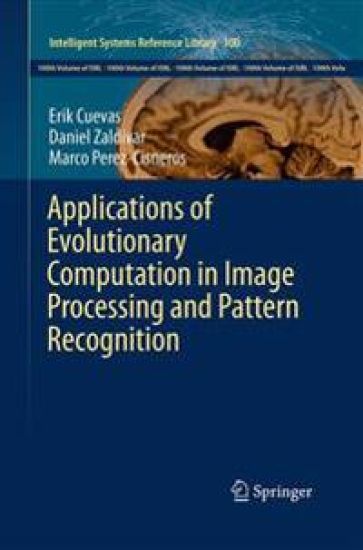
This book presents the use of efficient Evolutionary Computation (EC) algorithms for solving diverse real-world image processing and pattern recognition problems. It provides an overview of the different aspects of evolutionary methods in order to enable the reader in reaching a global understanding of the field and, in conducting studies on specific evolutionary techniques that are related to applications in image processing and pattern recognition. It explains the basic ideas of the proposed applications in a way that can also be understood by readers outside of the field. Image processing and pattern recognition practitioners who are not evolutionary computation researchers will appreciate the discussed techniques beyond simple theoretical tools since they have been adapted to solve significant problems that commonly arise on such areas. On the other hand, members of the evolutionary computation community can learn the way in which image processing and pattern recognition problems can be translated into an optimization task. The book has been structured so that each chapter can be read independently from the others. It can serve as reference book for students and researchers with basic knowledge in image processing and EC methods.
Applications of Evolutionary Computation in Image Processing and Pattern Recognition

Applications of Evolutionary Computation in Image Processing and Pattern Recognition

Erik Cuevas; Daniel Zaldívar; Marco Perez-Cisneros

Springer International Publishing AG
2015
sidottu
This book presents the use of efficient Evolutionary Computation (EC) algorithms for solving diverse real-world image processing and pattern recognition problems. It provides an overview of the different aspects of evolutionary methods in order to enable the reader in reaching a global understanding of the field and, in conducting studies on specific evolutionary techniques that are related to applications in image processing and pattern recognition. It explains the basic ideas of the proposed applications in a way that can also be understood by readers outside of the field. Image processing and pattern recognition practitioners who are not evolutionary computation researchers will appreciate the discussed techniques beyond simple theoretical tools since they have been adapted to solve significant problems that commonly arise on such areas. On the other hand, members of the evolutionary computation community can learn the way in which image processing and pattern recognition problems can be translated into an optimization task. The book has been structured so that each chapter can be read independently from the others. It can serve as reference book for students and researchers with basic knowledge in image processing and EC methods.