Kirjojen hintavertailu. Mukana 12 595 353 kirjaa ja 12 kauppaa.

Kirjailija

Marcus Feldman

Kirjat ja teokset yhdessä paikassa: 8 kirjaa, julkaisuja vuosilta 1981-2026, suosituimpien joukossa Rural Livelihood and Environmental Sustainability in China. Vertaile teosten hintoja ja tarkista saatavuus suomalaisista kirjakaupoista.

8 kirjaa

Kirjojen julkaisuhaarukka 1981-2026.

Rural Livelihood and Environmental Sustainability in China

Rural Livelihood and Environmental Sustainability in China

Jie Li; Shuzhuo Li; Gretchen C. Daily; Marcus Feldman

SPRINGER VERLAG, SINGAPORE
2021
nidottu
The book considers the challenge of poverty and deterioration of the ecological environment in China, particularly in rural areas. Examining key factors such as the overuse of natural resources and the loss of biodiversity in the face of an expanding population and rapidly developing economy. It focuses on examining the frameworks of rural households in poor mountainous areas in rural China, considering their livelihood choices and decision-making processes. It analyses the relationship between these households’ livelihoods and their environment, notably farmers’ attitudes and perceptions towards ecological conservation policies, and their use of forest resources. Cutting across the fields of population studies, sociology, economy and environment, this is an important read for scholars and students interested in how China is dealing with the challenges of natural resources exploitation, sustainable development and social welfare.

Rural Livelihood and Environmental Sustainability in China

Rural Livelihood and Environmental Sustainability in China

Jie Li; Shuzhuo Li; Gretchen C. Daily; Marcus Feldman

Springer Verlag, Singapore
2020
sidottu
The book considers the challenge of poverty and deterioration of the ecological environment in China, particularly in rural areas. Examining key factors such as the overuse of natural resources and the loss of biodiversity in the face of an expanding population and rapidly developing economy. It focuses on examining the frameworks of rural households in poor mountainous areas in rural China, considering their livelihood choices and decision-making processes. It analyses the relationship between these households’ livelihoods and their environment, notably farmers’ attitudes and perceptions towards ecological conservation policies, and their use of forest resources. Cutting across the fields of population studies, sociology, economy and environment, this is an important read for scholars and students interested in how China is dealing with the challenges of natural resources exploitation, sustainable development and social welfare.
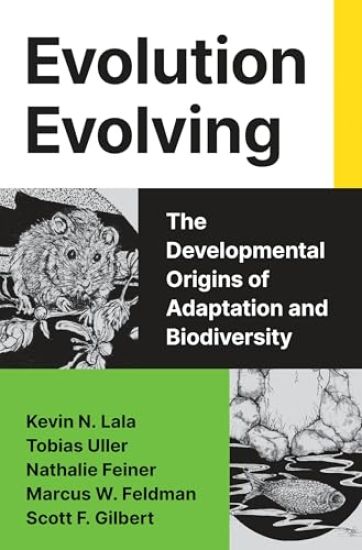
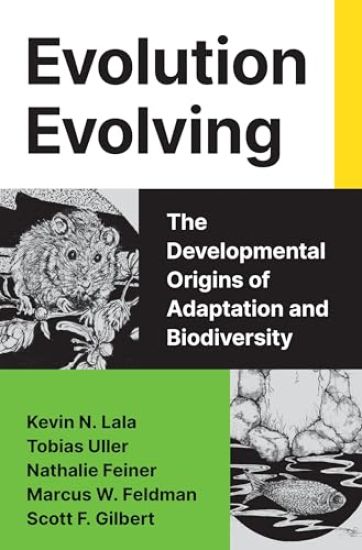
Evolution Evolving

Evolution Evolving

Kevin N. Lala; Tobias Uller; Nathalie Feiner; Marcus Feldman; Scott F. Gilbert

PRINCETON UNIVERSITY PRESS
2026
pokkari
A new account of the central role developmental processes play in evolution A new scientific view of evolution is emerging—one that challenges and expands our understanding of how evolution works. Recent research demonstrates that organisms differ greatly in how effective they are at evolving. Whether and how each organism adapts and diversifies depends critically on the mechanistic details of how that organism operates—its development, physiology, and behavior. That is because the evolutionary process itself has evolved over time, and continues to evolve. The scientific understanding of evolution is evolving too, with groundbreaking new ways of explaining evolutionary change. In this book, a group of leading biologists draw on the latest findings in evolutionary genetics and evo-devo, as well as novel insights from studies of epigenetics, symbiosis, and inheritance, to examine the central role that developmental processes play in evolution. Written in an accessible style, and illustrated with fascinating examples of natural history, the book presents recent scientific discoveries that expand evolutionary biology beyond the classical view of gene transmission guided by natural selection. Without undermining the central importance of natural selection and other Darwinian foundations, new developmental insights indicate that all organisms possess their own characteristic sets of evolutionary mechanisms. The authors argue that a consideration of developmental phenomena is needed for evolutionary biologists to generate better explanations for adaptation and biodiversity. This book provides a new vision of adaptive evolution.
Evolution Evolving

Evolution Evolving

Kevin N. Lala; Tobias Uller; Nathalie Feiner; Marcus Feldman; Scott F. Gilbert

PRINCETON UNIVERSITY PRESS
2024
sidottu
A new account of the central role developmental processes play in evolutionA new scientific view of evolution is emerging—one that challenges and expands our understanding of how evolution works. Recent research demonstrates that organisms differ greatly in how effective they are at evolving. Whether and how each organism adapts and diversifies depends critically on the mechanistic details of how that organism operates—its development, physiology, and behavior. That is because the evolutionary process itself has evolved over time, and continues to evolve. The scientific understanding of evolution is evolving too, with groundbreaking new ways of explaining evolutionary change. In this book, a group of leading biologists draw on the latest findings in evolutionary genetics and evo-devo, as well as novel insights from studies of epigenetics, symbiosis, and inheritance, to examine the central role that developmental processes play in evolution.Written in an accessible style, and illustrated with fascinating examples of natural history, the book presents recent scientific discoveries that expand evolutionary biology beyond the classical view of gene transmission guided by natural selection. Without undermining the central importance of natural selection and other Darwinian foundations, new developmental insights indicate that all organisms possess their own characteristic sets of evolutionary mechanisms. The authors argue that a consideration of developmental phenomena is needed for evolutionary biologists to generate better explanations for adaptation and biodiversity. This book provides a new vision of adaptive evolution.
Mathematical Evolutionary Theory

Mathematical Evolutionary Theory

Marcus Feldman

Princeton University Press
2016
sidottu
An international group of distinguished scientists presents an up-to-date survey of quantitative problems at the forefront of modern evolutionary theory. Their articles illustrate results from the latest research in population and behavioral genetics, molecular evolution, and ecology. Each author gives careful attention to the exposition of the models, the logic of their analysis, and the legitimacy of qualitative biological inferences. The topics covered include stochastic models of finite populations and the sorts of diffusion approximations that are valid for their study, models of migration, kin selection, geneculture coevolution, sexual selection, life-history evolution, the statistics of linkage disequilibrium, and the molecular evolution of repeated DNA sequences and the HLA system in humans. The fourteen contributions are presented in two sections: Part I, Stochastic and Deterministic Genetic Theory, and Part II, Behavior, Ecology, and Evolutionary Genetics. Marcus W. Feldman provides an introduction to each part. The contributors are J. G. Bodmer, W. F. Bodmer, L. L. Cavalli Sforza, F. B. Christiansen, C. Cockerham, W. J. Ewens, M. W. Feldman, J. H. Gillespie, R. R. Hudson, N. L. Kaplan, S. Lessard, U. Liberman, M.E.N. Majerus, P. O'Donald, J. Roughgarden, S. Tavar, M. K. Uyenoyama, G. A. Watterson, and B. Weir. Originally published in 1989. The Princeton Legacy Library uses the latest print-on-demand technology to again make available previously out-of-print books from the distinguished backlist of Princeton University Press. These editions preserve the original texts of these important books while presenting them in durable paperback and hardcover editions. The goal of the Princeton Legacy Library is to vastly increase access to the rich scholarly heritage found in the thousands of books published by Princeton University Press since its founding in 1905.
Mathematical Evolutionary Theory

Mathematical Evolutionary Theory

Marcus Feldman

Princeton University Press
2014
pokkari
An international group of distinguished scientists presents an up-to-date survey of quantitative problems at the forefront of modern evolutionary theory. Their articles illustrate results from the latest research in population and behavioral genetics, molecular evolution, and ecology. Each author gives careful attention to the exposition of the models, the logic of their analysis, and the legitimacy of qualitative biological inferences. The topics covered include stochastic models of finite populations and the sorts of diffusion approximations that are valid for their study, models of migration, kin selection, geneculture coevolution, sexual selection, life-history evolution, the statistics of linkage disequilibrium, and the molecular evolution of repeated DNA sequences and the HLA system in humans. The fourteen contributions are presented in two sections: Part I, Stochastic and Deterministic Genetic Theory, and Part II, Behavior, Ecology, and Evolutionary Genetics. Marcus W. Feldman provides an introduction to each part. The contributors are J. G. Bodmer, W. F. Bodmer, L. L. Cavalli Sforza, F. B. Christiansen, C. Cockerham, W. J. Ewens, M. W. Feldman, J. H. Gillespie, R. R. Hudson, N. L. Kaplan, S. Lessard, U. Liberman, M.E.N. Majerus, P. O'Donald, J. Roughgarden, S. Tavar, M. K. Uyenoyama, G. A. Watterson, and B. Weir. Originally published in 1989. The Princeton Legacy Library uses the latest print-on-demand technology to again make available previously out-of-print books from the distinguished backlist of Princeton University Press. These editions preserve the original texts of these important books while presenting them in durable paperback and hardcover editions. The goal of the Princeton Legacy Library is to vastly increase access to the rich scholarly heritage found in the thousands of books published by Princeton University Press since its founding in 1905.
Niche Construction

Niche Construction

F. John Odling-Smee; Kevin N. Lala; Marcus Feldman

Princeton University Press
2003
pokkari
The seemingly innocent observation that the activities of organisms bring about changes in environments is so obvious that it seems an unlikely focus for a new line of thinking about evolution. Yet niche construction--as this process of organism-driven environmental modification is known--has hidden complexities. By transforming biotic and abiotic sources of natural selection in external environments, niche construction generates feedback in evolution on a scale hitherto underestimated--and in a manner that transforms the evolutionary dynamic. It also plays a critical role in ecology, supporting ecosystem engineering and influencing the flow of energy and nutrients through ecosystems. Despite this, niche construction has been given short shrift in theoretical biology, in part because it cannot be fully understood within the framework of standard evolutionary theory. Wedding evolution and ecology, this book extends evolutionary theory by formally including niche construction and ecological inheritance as additional evolutionary processes. The authors support their historic move with empirical data, theoretical population genetics, and conceptual models. They also describe new research methods capable of testing the theory. They demonstrate how their theory can resolve long-standing problems in ecology, particularly by advancing the sorely needed synthesis of ecology and evolution, and how it offers an evolutionary basis for the human sciences. Already hailed as a pioneering work by some of the world's most influential biologists, this is a rare, potentially field-changing contribution to the biological sciences.
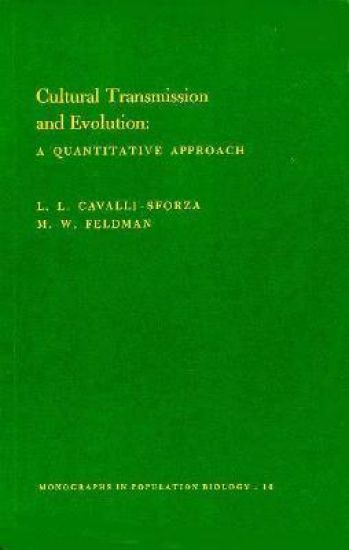
Cultural Transmission and Evolution

Cultural Transmission and Evolution

L L Cavalli-sforza; Marcus Feldman

Princeton University Press
1981
pokkari
A number of scholars have found that concepts such as mutation, selection, and random drift, which emerged from the theory of biological evolution, may also explain evolutionary phenomena in other disciplines as well. Drawing on these concepts, Professors Cavalli-Sforza and Feldman classify and systematize the various modes of transmitting "culture" and explore their consequences for cultural evolution. In the process, they develop a mathematical theory of the non-genetic transmission of cultural traits that provides a framework for future investigations in quantitative social and anthropological science. The authors use quantitative models that incorporate the various modes of transmission (for example, parent-child, peer-peer, and teacher-student), and evaluate data from sociology, archaeology, and epidemiology in terms of the models. They show that the various modes of transmission in conjunction with cultural and natural selection produce various rates of cultural evolution and various degrees of diversity within and between groups. The same framework can be used for explaining phenomena as apparently unrelated as linguistics, epidemics, social values and customs, and diffusion of innovations. The authors conclude that cultural transmission is an essential factor in the study of cultural change.