Kirjojen hintavertailu. Mukana 12 657 676 kirjaa ja 12 kauppaa.

Kirjailija

Marcus Steinweg

Kirjat ja teokset yhdessä paikassa: 13 kirjaa, julkaisuja vuosilta 2015-2025, suosituimpien joukossa Jean-Luc Nancy. Gott, Gerechtigkeit, Liebe, Schönheit.<BR>Vier Vorträge für Kinder. Bebildert von Rosemarie Trockel. Vertaile teosten hintoja ja tarkista saatavuus suomalaisista kirjakaupoista.

13 kirjaa

Kirjojen julkaisuhaarukka 2015-2025.

Markus Vater - Objects of Significance
Objects of Significance is an artist's book that grew out of a series of photographs and writings which Markus Vater (b. Dusseldorf, 1970; lives and works in London and Dusseldorf) collected over several years. They show and describe what matters to the artist: objects fraught with meaning, questions, relationships, memories. It is a creative and philosophical book, as funny as it is serious, delving into questions like: What do you see when you close your eyes and turn your head toward the sun? Or: How much does a cloud weigh? Vater has interviewed the North Sea for the book and ponders the wind. He sheds light on the conditions in which art comes into being and meditates on what holes are.
Thomas Hirschhorn

Thomas Hirschhorn

Kathleen Bühler; Ann Cotten; Julia Gelshorn; José Gsell; Wiebke Hahn; Thomas Hirschhorn; Marcus Steinweg; Gabriela Pereira; JeanPierre Rochat; Armin Senser; Jules Sturm

Hatje Cantz
2020
nidottu
For three months Biel, Switzerland, hosted a special kind of sculpture. It was special not simply because it was by one of Switzerland’s most famous contemporary artists—Thomas Hirschhorn—and dedicated to one of the most prominent authors in the history of Swiss literature, Robert Walser. Beyond that, this sculpture was a redefinition of sculpture itself, because what takes on a plastic form here is not made of stone, steel, or bronze. It is society itself that helped to develop this work of art. In 2016 Thomas Hirschhorn and the curator Kathleen Bühler began doing field research in Biel, the city of Robert Walser’s birth, connecting with residents, clubs, artists, literati, and experts. This resulted in a multifaceted agenda. Every day the two offered events such as readings, walking tours, lectures, and children’s activities. All of this ultimately comprised the Robert Walser-Sculpture. Never before has an entire city been integrated into a temporary work of art in this way.
Inconsistencies

Inconsistencies

Marcus Steinweg

MIT Press
2017
pokkari
Meditations, aphorisms, maxims, notes, and comments construct a philosophy of thought congruent with the inconsistency of our reality.Those who continue to think never return to their point of departure.-InconsistenciesThese 130 short texts-aphoristic, interlacing, and sometimes perplexing-target a perennial philosophical problem: Our consciousness and our experience of reality are inconsistent, fragmentary, and unstable; God is dead, and our identity as subjects discordant. How can we establish a new mode of thought that does not cling to new gods or the false security of rationality? Marcus Steinweg, as he did in his earlier book The Terror of Evidence, constructs a philosophical position from fragments, maxims, meditations, and notes, formulating a philosophy of thought that expresses and enacts the inconsistency of our reality. Steinweg considers, among other topics, life as a game ("To think is to play because no thought is firmly grounded"); sexuality ("wasteful, contradictory, and contingent"); desire ("Desire has a thousand names; It's earned none of them"); reality ("overdetermined and excessively complex"); and world ("a nonconcept"). He disposes of philosophy in one sentence ("Philosophy is a continual process of its own redefinition.") but spends multiple pages on "A Tear in Immanence," invoking Nietzsche, Heidegger, Sartre, and others. He describes "Wandering with Foucault" ("Thought entails wandering as well as straying into madness") and brings together Derrida and Debord. He poses a question: "Why should a cat be more mysterious than a dog?" and later answers one: "Beauty is truth because truth is beauty." By the end, we have accompanied Steinweg on converging trains of thought. "Thinking means continuing to think," he writes, adding "But thinking can only pose questions by answering others." The question of inconsistency? Asked and answered, and asked.
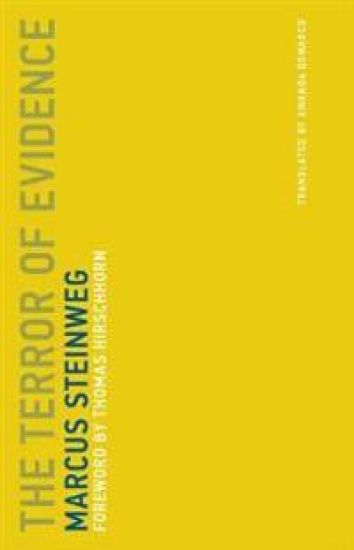
The Terror of Evidence

The Terror of Evidence

Marcus Steinweg; Thomas Hirschhorn

MIT Press
2017
pokkari
Meditations, maxims, aphorisms, notes, and comments address topics that range from pathos and genius to careerism and club sandwiches.Marcus Steinweg's capacity to implicate the other is beautiful, bright, precise, and logical, grounded in everyday questions, which to him are always big questions.-from the foreword by Thomas HirschhornThe houses of philosophy need not be palaces.-Marcus Steinweg, "House," The Terror of EvidenceThis is the first book by the prolific German philosopher Marcus Steinweg to be available in English translation. The Terror of Evidence offers meditations, maxims, aphorisms, notes, and comments-191 texts ranging in length from three words to three pages-the deceptive simplicity of which challenges the reader to think. "Thinking means getting lost again and again," Steinweg observes. Reality is the ever-broken promise of consistency; "the terror of evidence" arises from the inconsistency before our eyes. Thinking is a means of coping with that inconsistency. Steinweg is known for his collaborations with Thomas Hirschhorn and the lectures and texts he has provided for many of Hirschhorn's projects. This translation of The Terror of Evidence includes a foreword by Hirschhorn written especially for the MIT Press edition. The subjects of these short texts vary widely. ("The table of contents is in itself excessive and ambitious," writes Hirschhorn.) They include pathos, passivity, genius, resentment, love, horror, catastrophe, and racism. And club sandwiches (specifically, Foucault's love for this American specialty), blow jobs, and dance. Also: "Two Kinds of Obscurantism," "Putting Words in Spinoza's Mouth," "Note on Rorty," and "Doubting Doubt." The Terror of Evidence can be considered a guidebook to thinking: the daily journey of exploration, the incessant questioning of reality that Steinweg sees as the task of philosophy.