Kirjailija
Margaret C. Harrell
Kirjat ja teokset yhdessä paikassa: 27 kirjaa, julkaisuja vuosilta 2000-2018, suosituimpien joukossa Sustaining the Qatar National Research Fund. Vertaile teosten hintoja ja tarkista saatavuus suomalaisista kirjakaupoista.
Mukana myös kirjoitusasut: Margaret C Harrell
27 kirjaa
Kirjojen julkaisuhaarukka 2000-2018.

Prepared for the Office of the Secretary of Defense.
Aligning the Stars
Margaret C. Harrell; Harry J. Thie; Peter Schirmer; Kevin Brancato
RAND
2004
pokkari
Recommends alternative promotion models to address the high turr over of the military's general and flag officers. The Department of Defense (DoD) experiences a high turnover from its general and flag officers (G/FOs). A concern exists that simply lengthening the stay of senior officers will only clog the system, stagnating promotions through out the entire officer corps. In response to this, RAND researchers analyzed the current system, reviewed literature on corporate management practices, and modeled different ways of managing G/FOs. In addition to proposing variations to the promotion model, the authors address the concerns expressed by those in DoD and Congress about implementing such changes.
As a competitive employer in the US, the Department of Defense strives to maintain benefits comparable to those of the public and private sector. This book explores the greater use of extended leaves as part of the department's strategic human resource plan.
Aft and Fore
Harry J. Thie; Margaret C. Harrell; Kevin Brancato; Jefferson P. Marquis; Clifford M. Graf II; Roland J. Yardley; Jerry M Sollinger
RAND
2003
pokkari
Focusing on its ability to meet current and future demands, the Navy recently examined its officer structure and asked RAND to analyze changes in authorizations and inventory, to compare authorizations and inventory and potential gaps in costs related to them, and to estimate personnel requirements for the years 2010 and 2017. Based on their research, the authors determine trends and cycles in officer requirements and inventory as well as the evolution of policy and the management of the officer corps. (PW)
One-liner: The authors assess the current status of gender representation in U.S. military occupations newly opened to women, focusing on specific issues for 10 selected occupations. Has opening new skills and units been enough to create equal opportunities for women in the U.S. military? Success has been mixed, in part because of the circumstances of individual occupations, and some issues affect men as much as they do women. Among the authors1 recommendations are that career counseling include both opportunities and potential drawbacks and that longer-term studies on specific issues are merited. (pmg)
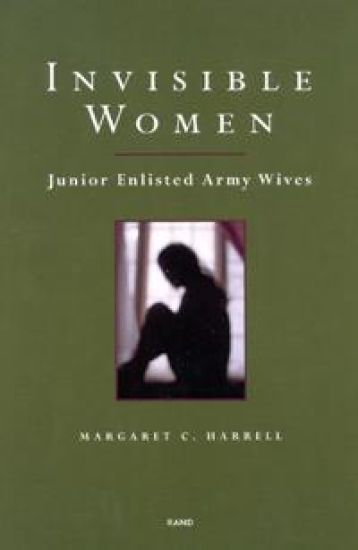
Military manpower policy is often crafted by policymakers without an in-depth understanding of the life experiences and views of junior enlisted personnel. It is plausible to expect that some policymakers attribute the attitudes and experiences of these young soldiers to such features as youth or lack of an advanced education and may thus believe themselves able to empathize with this population group by recalling their own parallel life experiences. However, this approach oversimplifies the life experiences of these families and neglects the reality that most policymakers and professional managers have never experienced the compendium of problems these couples face, such as youth, lack of education, financial difficulties, emotional and physical distance from extended family, and invisibility in a large bureaucracy. At the center of this book are the personal stories of three junior enlisted spouses, told in their own voices and selected to emphasize the dilemmas numerous enlisted families face. The stories provide insight into the experiences and attitudes of other junior enlisted families.Those interested or involved in the military, or those who live a military lifestyle--at any pay grade--will find these stories both useful and engaging.
While some headlines have accented the negative side of gender integration in the military, this study paints a brighter picture. Gender integration has had only small effects on the matters that count most: defense readiness, unit cohesion, and morale. Among the officers and enlisted personnel of both sexes who participated in the study, there is a consensus that leadership, training, and workload are the primary influences on how well their units function. They also agree that servicewomen perform about as well as men. However, there are some areas of concern, such as confusion and anxiety about what constitutes sexual harassment and how the charges are handled; perceived double standards about physical requirements, and the effects of pregnancy on the readiness of units that are already understaffed or that include disproportionate numbers of women. The authors encountered a wide range of reaction to the women's expanded presence and roles. Taken together, however, the surveys, interviews and focus groups yielded a positive portrait of life in the integrated military.