Kirjojen hintavertailu. Mukana 12 595 353 kirjaa ja 12 kauppaa.

Kirjailija

Margaret Carr

Kirjat ja teokset yhdessä paikassa: 11 kirjaa, julkaisuja vuosilta 2001-2024, suosituimpien joukossa Understanding the Te Whariki Approach. Vertaile teosten hintoja ja tarkista saatavuus suomalaisista kirjakaupoista.

11 kirjaa

Kirjojen julkaisuhaarukka 2001-2024.

Young Children Visit Museums

Young Children Visit Museums

Margaret Carr; Brenda Soutar; Leanne Clayton; Bronwen Cowie; Jeanette Clarkin-Phillips; Shelley Butler

TAYLOR FRANCIS LTD
2024
nidottu
Bringing different cultural perspectives on creativity with them, teachers and children in two early childhood education sites in Aotearoa New Zealand were using museum visits as jumping off places to hone their creative capacity building. As a contribution to Tim Ingold’s discussion of anthropology and/as education, and also finding John Dewey’s writing valuable (specifically his framing of ‘enduring attitudes’), the authors employ a navigation metaphor throughout the discussion. They describe a coming together of four Cultural Anchors (thinking from materials) with four Coordinates (creative capacity builders) to describe ways in which the children were making creative sense of the museum exhibits, while at the same time gathering information about them. They take these travel metaphors from a star cluster in the southern hemisphere night sky, Matariki, which provided early sea-going Maori with guidance as they navigated wide stretches of ocean in their sea-going canoes to reach Aotearoa New Zealand. A Maori immersion early childhood centre and school, and a New Zealand kindergarten provided lively examples of children’s and teachers’ responses to the treasured artefacts (taonga) in their local museums. The book describes an ecosocial framing, from ‘little to big’, and illustrates the different cultural perspectives on creativity. The Mana Tamariki kaiako (teachers) gifted us a title—He taonga, he rerenga arorangi (Where there are treasured objects, the spirit is nurtured and creativity will be inspired).
Young Children Visit Museums

Young Children Visit Museums

Margaret Carr; Brenda Soutar; Leanne Clayton; Bronwen Cowie; Jeanette Clarkin-Phillips; Shelley Butler

TAYLOR FRANCIS LTD
2022
sidottu
Bringing different cultural perspectives on creativity with them, teachers and children in two early childhood education sites in Aotearoa New Zealand were using museum visits as jumping off places to hone their creative capacity building. As a contribution to Tim Ingold’s discussion of anthropology and/as education, and also finding John Dewey’s writing valuable (specifically his framing of ‘enduring attitudes’), the authors employ a navigation metaphor throughout the discussion. They describe a coming together of four Cultural Anchors (thinking from materials) with four Coordinates (creative capacity builders) to describe ways in which the children were making creative sense of the museum exhibits, while at the same time gathering information about them. They take these travel metaphors from a star cluster in the southern hemisphere night sky, Matariki, which provided early sea-going Maori with guidance as they navigated wide stretches of ocean in their sea-going canoes to reach Aotearoa New Zealand. A Maori immersion early childhood centre and school, and a New Zealand kindergarten provided lively examples of children’s and teachers’ responses to the treasured artefacts (taonga) in their local museums. The book describes an ecosocial framing, from ‘little to big’, and illustrates the different cultural perspectives on creativity. The Mana Tamariki kaiako (teachers) gifted us a title—He taonga, he rerenga arorangi (Where there are treasured objects, the spirit is nurtured and creativity will be inspired).
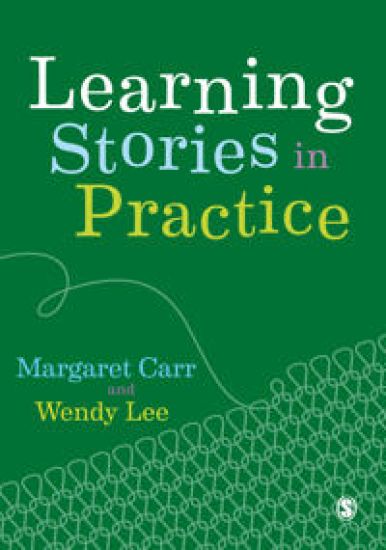
Learning Stories in Practice

Learning Stories in Practice

Margaret Carr; Wendy Lee

SAGE Publications Ltd
2019
sidottu
Margaret Carr and Wendy Lee have often been asked for a follow-on practical companion to their seminal 2012 book Learning Stories; a complimentary book that provides practical advice for teachers who are embarking on a ‘narrative assessments-for-learning’ journey. After much anticipation that book is here at last! Packed with a wide range of full-colour examples of real life learning stories from all over the world this practical guide is influenced by their ongoing work with teachers across many countries and the thoughtful comments and questions that teachers have asked during conversations at conferences, lectures and professional development programmes. They have turned these conversations with teachers and students into key ideas, and a practical framework on how to initiate and create good learning stories and why they are valuable. They show you how to write stories that capture the magic and excitement of each young child's journey through the early years and how to develop a deep professional understanding of the learning that takes place during this special and influential time in their lives.
Learning Stories in Practice

Learning Stories in Practice

Margaret Carr; Wendy Lee

SAGE Publications Ltd
2019
nidottu
Margaret Carr and Wendy Lee have often been asked for a follow-on practical companion to their seminal 2012 book Learning Stories; a complimentary book that provides practical advice for teachers who are embarking on a ‘narrative assessments-for-learning’ journey. After much anticipation that book is here at last! Packed with a wide range of full-colour examples of real life learning stories from all over the world this practical guide is influenced by their ongoing work with teachers across many countries and the thoughtful comments and questions that teachers have asked during conversations at conferences, lectures and professional development programmes. They have turned these conversations with teachers and students into key ideas, and a practical framework on how to initiate and create good learning stories and why they are valuable. They show you how to write stories that capture the magic and excitement of each young child's journey through the early years and how to develop a deep professional understanding of the learning that takes place during this special and influential time in their lives.
Understanding the Te Whariki Approach

Understanding the Te Whariki Approach

Wendy Lee; Margaret Carr; Brenda Soutar; Linda Mitchell

Routledge
2012
sidottu
Understanding the Te Whariki Approach is a much–needed source of information for those wishing to extend and consolidate their understanding of the Te Whariki approach, introducing the reader to an innovative bicultural curriculum developed for early childhood services in New Zealand. It will enable the reader to analyse the essential elements of this approach to early childhood and its relationship to quality early years practice.Providing students and practitioners with the relevant information about a key pedagogical influence on high quality early years practice in the United Kingdom, the book explores all areas of the curriculum, emphasising: strong curriculum connections to families and the wider community; a view of teaching and learning that focuses on responsive and reciprocal relationships with people, places and things; a view of curriculum content as cross-disciplinary and multi-modal; the aspirations for children to grow up as competent and confident learners and communicators, healthy in mind, body, and spirit, secure in their sense of belonging and in the knowledge that they make a valued contribution to society; a bicultural framework in which indigenous voices have a central place.Written to support the work of all those in the field of early years education and childcare, this is a vital text for students, early years and childcare practitioners, teachers, early years professionals, children’s centre professionals, lecturers, advisory teachers, head teachers and setting managers.
Understanding the Te Whariki Approach

Understanding the Te Whariki Approach

Wendy Lee; Margaret Carr; Brenda Soutar; Linda Mitchell

Routledge
2012
nidottu
Understanding the Te Whariki Approach is a much–needed source of information for those wishing to extend and consolidate their understanding of the Te Whariki approach, introducing the reader to an innovative bicultural curriculum developed for early childhood services in New Zealand. It will enable the reader to analyse the essential elements of this approach to early childhood and its relationship to quality early years practice.Providing students and practitioners with the relevant information about a key pedagogical influence on high quality early years practice in the United Kingdom, the book explores all areas of the curriculum, emphasising: strong curriculum connections to families and the wider community; a view of teaching and learning that focuses on responsive and reciprocal relationships with people, places and things; a view of curriculum content as cross-disciplinary and multi-modal; the aspirations for children to grow up as competent and confident learners and communicators, healthy in mind, body, and spirit, secure in their sense of belonging and in the knowledge that they make a valued contribution to society; a bicultural framework in which indigenous voices have a central place.Written to support the work of all those in the field of early years education and childcare, this is a vital text for students, early years and childcare practitioners, teachers, early years professionals, children’s centre professionals, lecturers, advisory teachers, head teachers and setting managers.
Learning Stories

Learning Stories

Margaret Carr; Wendy Lee

SAGE Publications Ltd
2012
sidottu
Margaret Carr's seminal work on Learning Stories was first published by SAGE in 2001, and this widely acclaimed approach to assessment has since gained a huge international following. In this new full-colour book, the authors outline the philosophy behind Learning Stories and refer to the latest findings from the research projects they have led with teachers on learning dispositions and learning power, to argue that Learning Stories can construct learner identities in early childhood settings and schools. By making the connection between sociocultural approaches to pedagogy and assessment, and narrative inquiry, this book contextualizes Learning Stories as a philosophical approach to education, learning and pedagogy. Chapters explore how Learning Stories: - help make connections with families - support the inclusion of children and family voices - tell us stories about babies - allow children to dictate their own stories - can be used to revisit children's learning journeys - can contribute to teaching and learning wisdom This ground-breaking book expands on the concept of Learning Stories and includes examples from practice in both New Zealand and the UK. It outlines the philosophy behind this pedagogical tool for documenting how learning identities are constructed and shows, through research evidence, why the early years is such a critical time in the formation of learning dispositions. Margaret Carr is a Professor of Education at the University of Waikato, New Zealand. Wendy Lee is Director of the Educational Leadership Project, New Zealand.
Learning Stories

Learning Stories

Margaret Carr; Wendy Lee

SAGE Publications Ltd
2012
nidottu
Margaret Carr's seminal work on Learning Stories was first published by SAGE in 2001, and this widely acclaimed approach to assessment has since gained a huge international following. In this new full-colour book, the authors outline the philosophy behind Learning Stories and refer to the latest findings from the research projects they have led with teachers on learning dispositions and learning power, to argue that Learning Stories can construct learner identities in early childhood settings and schools. By making the connection between sociocultural approaches to pedagogy and assessment, and narrative inquiry, this book contextualizes Learning Stories as a philosophical approach to education, learning and pedagogy. Chapters explore how Learning Stories: - help make connections with families - support the inclusion of children and family voices - tell us stories about babies - allow children to dictate their own stories - can be used to revisit children's learning journeys - can contribute to teaching and learning wisdom This ground-breaking book expands on the concept of Learning Stories and includes examples from practice in both New Zealand and the UK. It outlines the philosophy behind this pedagogical tool for documenting how learning identities are constructed and shows, through research evidence, why the early years is such a critical time in the formation of learning dispositions. Margaret Carr is a Professor of Education at the University of Waikato, New Zealand. Wendy Lee is Director of the Educational Leadership Project, New Zealand.
Assessment in Early Childhood Settings

Assessment in Early Childhood Settings

Margaret Carr

SAGE Publications Inc
2001
sidottu
`This is an invigorating and very thought-provoking text, that I would recommend to all early years professionals, parents and citizens interested in developing their understanding of early years philosophy in action, which is directly linked to a compelling research paradigm and deep reflection alongside a sound theoretical base' - Early Years `I would recommend this book to practitioners interested in reflecting on their own practice and approach to assessment. The insights provided are thought-provoking and promote a practical and positive approach to early years assessment' - Early Talk `This thoughtful book challenges the standard assessment process that is commonly employed within the context of early years provision. For any practitioners working in early years setting this is a powerful and exciting book that helps to remind us that the child must be placed centrally within the assessment process, not as a recipient but as a proactive contributor to the situation'- Child Language Teaching and Therapy `This is a highly relevant text as some UK early childhood educators become engulfed with avalanches of tick sheets! A most useful book which contributes to the current vital debate about when, what and how we should access young children's progress' - T.A.C.T.Y.C Newsletter `I found Margaret Carr's book fascinating… the ideas and arguments put forward are well worth mulling over' - Early Years Educator `This is an inspiring book from bilingual, bicultural New Zealand about revolutionizing the assessment of young children's learning and progress.... I hope this book inspires United Kingdom practitioners to set out on learning story journeys' - Nursery World `This book manages to blend recognized theory and recent research with practice. I found it easy, and sometimes enjoyable, to read; it provided plenty of "food for thought" as well as references on "how to". I would recommend it to all early childhood practitioners, not just those considering their current assessment procedures, as the chapters focusing on the child as a learner are of value on their own' - Julia Browne, Goldsmiths Association for Early Childhood This book shows that an early childhood setting can be described as a learning place in which children develop learning dispositions such as resilience in the face of uncertainty, confidence to express their ideas, and collaborative and thoughtful approaches to problem-solving. These dispositions provide the starting point for life-long learning. The author asks: How can we assess and track children's learning in the early years in a way that includes learning dispositions and avoids the pitfalls of over-formal methods, whilst being helpful for practitioners, interesting for families, and supportive for learners? The book - describes a way of assessment that stays close to the children's real experiences and provides an alternative to mechanistic and fragmented approaches, - shows how practitioners can assess what really matters: those learning dispositions (interest, involvement and perseverance for example) that provide a foundation for life-long learning. The book is about weaving theory and practice: theorizing development and learning as reflected in assessment practice. The author also argues that unless we find ways to assess complex outcomes in early childhood they will be excluded from the teaching and the learning. Simple and low level outcomes and goals will take their place. The theoretical ideas and arguments are illustrated throughout by transcripts and stories of children in a range of early childhood settings. At every turn in the journey it asks: How is this reflected in a real life context? It documents the voices of children, practitioners and parents as the learning story develops.
Assessment in Early Childhood Settings

Assessment in Early Childhood Settings

Margaret Carr

SAGE Publications Inc
2001
nidottu
`This is an invigorating and very thought-provoking text, that I would recommend to all early years professionals, parents and citizens interested in developing their understanding of early years philosophy in action, which is directly linked to a compelling research paradigm and deep reflection alongside a sound theoretical base' - Early Years `I would recommend this book to practitioners interested in reflecting on their own practice and approach to assessment. The insights provided are thought-provoking and promote a practical and positive approach to early years assessment' - Early Talk `This thoughtful book challenges the standard assessment process that is commonly employed within the context of early years provision. For any practitioners working in early years setting this is a powerful and exciting book that helps to remind us that the child must be placed centrally within the assessment process, not as a recipient but as a proactive contributor to the situation'- Child Language Teaching and Therapy `This is a highly relevant text as some UK early childhood educators become engulfed with avalanches of tick sheets! A most useful book which contributes to the current vital debate about when, what and how we should access young children's progress' - T.A.C.T.Y.C Newsletter `I found Margaret Carr's book fascinating… the ideas and arguments put forward are well worth mulling over' - Early Years Educator `This is an inspiring book from bilingual, bicultural New Zealand about revolutionizing the assessment of young children's learning and progress.... I hope this book inspires United Kingdom practitioners to set out on learning story journeys' - Nursery World `This book manages to blend recognized theory and recent research with practice. I found it easy, and sometimes enjoyable, to read; it provided plenty of "food for thought" as well as references on "how to". I would recommend it to all early childhood practitioners, not just those considering their current assessment procedures, as the chapters focusing on the child as a learner are of value on their own' - Julia Browne, Goldsmiths Association for Early Childhood This book shows that an early childhood setting can be described as a learning place in which children develop learning dispositions such as resilience in the face of uncertainty, confidence to express their ideas, and collaborative and thoughtful approaches to problem-solving. These dispositions provide the starting point for life-long learning. The author asks: How can we assess and track children's learning in the early years in a way that includes learning dispositions and avoids the pitfalls of over-formal methods, whilst being helpful for practitioners, interesting for families, and supportive for learners? The book - describes a way of assessment that stays close to the children's real experiences and provides an alternative to mechanistic and fragmented approaches, - shows how practitioners can assess what really matters: those learning dispositions (interest, involvement and perseverance for example) that provide a foundation for life-long learning. The book is about weaving theory and practice: theorizing development and learning as reflected in assessment practice. The author also argues that unless we find ways to assess complex outcomes in early childhood they will be excluded from the teaching and the learning. Simple and low level outcomes and goals will take their place. The theoretical ideas and arguments are illustrated throughout by transcripts and stories of children in a range of early childhood settings. At every turn in the journey it asks: How is this reflected in a real life context? It documents the voices of children, practitioners and parents as the learning story develops.