Kirjojen hintavertailu. Mukana 12 152 606 kirjaa ja 12 kauppaa.

Kirjailija

Margaret Davies

Kirjat ja teokset yhdessä paikassa: 8 kirjaa, julkaisuja vuosilta 2007-2024, suosituimpien joukossa Property. Vertaile teosten hintoja ja tarkista saatavuus suomalaisista kirjakaupoista.

8 kirjaa

Kirjojen julkaisuhaarukka 2007-2024.

EcoLaw

EcoLaw

Margaret Davies

TAYLOR FRANCIS LTD
2024
nidottu
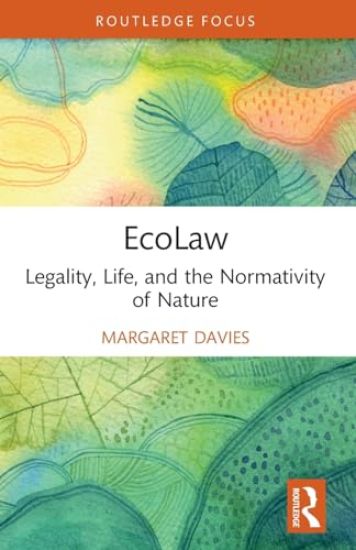
This book re-imagines law as ecolaw.The key insight of ecological thinking, that everything is connected to everything else – at least on the earth, and possibly in the cosmos – has become a truism of contemporary theory. Taking this insight as a starting point for understanding law involves suspending theoretical certainties and boundaries. It involves suspending theory itself as a conceptual project and practicing it as an embodied and material project. Although an ecological imagining of law can be metaphorical, and can be highly imaginative and suggestive, this book shows that it is also literal. Law is part of the material ‘everything’ that is connected to everything else. This means that once the previous certainties of legal thinking have been dismantled, it is after all possible to think of law as ‘natural’ – as embedded in and emergent from a normative biophysical nature. The book proposes that there exists a natural nomos: animals, plants, and Earth systems that produce their own values and norms from which human norms and laws emerge. This book, then, proposes a new way to understand law, and pursues specific arguments to demonstrate the feasibility of law as ecolaw.Drawing inspiration from current trends in the post-humanities, socioecological thought, and developments across the natural sciences in their specific intersections with humanities and social science disciplines, this book will appeal both to legal theorists and to others with interests in these areas.
EcoLaw

EcoLaw

Margaret Davies

TAYLOR FRANCIS LTD
2022
sidottu
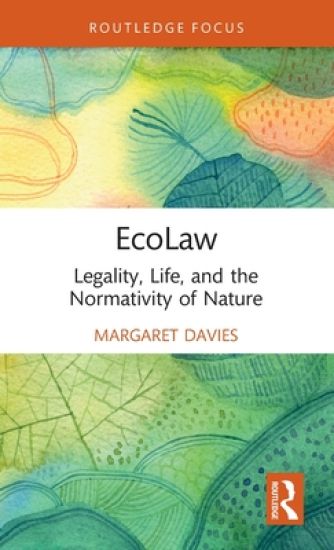
This book re-imagines law as ecolaw.The key insight of ecological thinking, that everything is connected to everything else – at least on the earth, and possibly in the cosmos – has become a truism of contemporary theory. Taking this insight as a starting point for understanding law involves suspending theoretical certainties and boundaries. It involves suspending theory itself as a conceptual project and practicing it as an embodied and material project. Although an ecological imagining of law can be metaphorical, and can be highly imaginative and suggestive, this book shows that it is also literal. Law is part of the material ‘everything’ that is connected to everything else. This means that once the previous certainties of legal thinking have been dismantled, it is after all possible to think of law as ‘natural’ – as embedded in and emergent from a normative biophysical nature. The book proposes that there exists a natural nomos: animals, plants, and Earth systems that produce their own values and norms from which human norms and laws emerge. This book, then, proposes a new way to understand law, and pursues specific arguments to demonstrate the feasibility of law as ecolaw.Drawing inspiration from current trends in the post-humanities, socioecological thought, and developments across the natural sciences in their specific intersections with humanities and social science disciplines, this book will appeal both to legal theorists and to others with interests in these areas.
Law Unlimited

Law Unlimited

Margaret Davies

Routledge
2018
nidottu
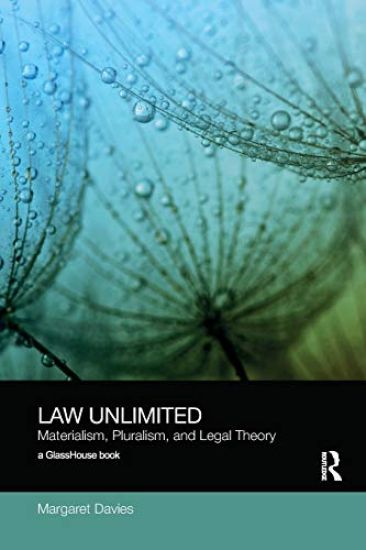
This book engages with a traditional yet persistent question of legal theory – what is law? However, instead of attempting to define and limit law, the aim of the book is to unlimit law, to take the idea of law beyond its conventionally accepted boundaries into the material and plural domains of an interconnected human and nonhuman world. Against the backdrop of analytical jurisprudence, the book draws theoretical connections and continuities between different experiences, spheres, and modalities of law. Taking up the many forms of critical and socio-legal thought, it presents a broad challenge to legal essentialism and abstraction, as well as an important contribution to more general normative theory. Reading, crystallising, and extending themes that have emerged in legal thought over the past century, this book is the culmination of the author’s 25 years of engagement with legal theory. Its bold attempt to forge a thoroughly contemporary approach to law will be of enormous value to those with interests in legal and socio-legal theory.
Law Unlimited

Law Unlimited

Margaret Davies

Routledge
2017
sidottu
This book engages with a traditional yet persistent question of legal theory – what is law? However, instead of attempting to define and limit law, the aim of the book is to unlimit law, to take the idea of law beyond its conventionally accepted boundaries into the material and plural domains of an interconnected human and nonhuman world. Against the backdrop of analytical jurisprudence, the book draws theoretical connections and continuities between different experiences, spheres, and modalities of law. Taking up the many forms of critical and socio-legal thought, it presents a broad challenge to legal essentialism and abstraction, as well as an important contribution to more general normative theory. Reading, crystallising, and extending themes that have emerged in legal thought over the past century, this book is the culmination of the author’s 25 years of engagement with legal theory. Its bold attempt to forge a thoroughly contemporary approach to law will be of enormous value to those with interests in legal and socio-legal theory.
Property

Property

Margaret Davies

Routledge Cavendish
2007
sidottu
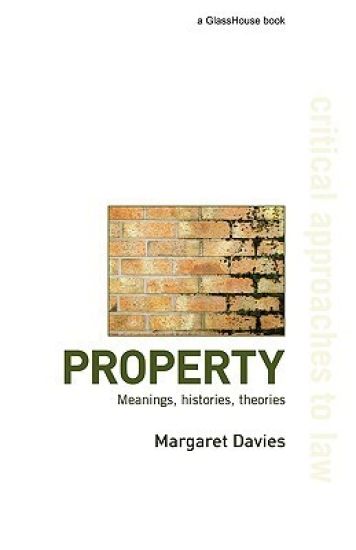
This critique of property examines its classical conception: addressing its ontology and history, as well as considering its symbolic aspects and connection to social relations of power.It is organized around three themes: the ways in which concepts of property are symbolically and practically connected to relations of powerthe 'objects' of property in changing contexts of materialismchallenges to the Western idea of property posed by colonial and post-colonial contexts, such as the disempowerment through property of whole cultures, the justifications for colonial expansion and bio piracy.Dealing with the symbolism of property, its history, traditional philosophical accounts and cultural difference, Margaret Davis has written an invaluable volume for all law students interested in property law.
Property

Property

Margaret Davies

Routledge Cavendish
2007
nidottu
This critique of property examines its classical conception: addressing its ontology and history, as well as considering its symbolic aspects and connection to social relations of power.It is organized around three themes: the ways in which concepts of property are symbolically and practically connected to relations of powerthe 'objects' of property in changing contexts of materialismchallenges to the Western idea of property posed by colonial and post-colonial contexts, such as the disempowerment through property of whole cultures, the justifications for colonial expansion and bio piracy.Dealing with the symbolism of property, its history, traditional philosophical accounts and cultural difference, Margaret Davis has written an invaluable volume for all law students interested in property law.