Kirjojen hintavertailu. Mukana 12 290 406 kirjaa ja 12 kauppaa.

Kirjailija

Maria C Lytell

Kirjat ja teokset yhdessä paikassa: 22 kirjaa, julkaisuja vuosilta 2011-2024, suosituimpien joukossa Retention of Racial-Ethnic Minorities in the Regular Army. Vertaile teosten hintoja ja tarkista saatavuus suomalaisista kirjakaupoista.

Mukana myös kirjoitusasut: Maria C. Lytell

22 kirjaa

Kirjojen julkaisuhaarukka 2011-2024.

Retention of Racial-Ethnic Minorities in the Regular Army

Retention of Racial-Ethnic Minorities in the Regular Army

Maria C Lytell; Michael L Hansen; Avery Calkins; Matthew D Baird; Nastassia Reed; Kristin J Leuschner; Clifford A Grammich

RAND Corporation
2024
pokkari
The authors examined retention of racial-ethnic minorities in the Regular Army's enlisted and officer ranks and how racial-ethnic composition changes as soldiers progress in their careers. The authors also explored reasons that individuals stay in the Army or leave at given points, how unit leader decisionmaking affects such decisions, and what influences promotion decisions.
Evaluation of the Strength Aptitude Test and Other Fitness Tests to Qualify Air Force Recruits for Physically Demanding Specialties

Evaluation of the Strength Aptitude Test and Other Fitness Tests to Qualify Air Force Recruits for Physically Demanding Specialties

Sean Robson; Stephanie Pezard; Maria C Lytell; Carra S Sims; John E Boon; Jason Michel Etchegaray; Michael Robbins; David Schulker; Jerry M Sollinger; Jason H Campbell; Anthony Atler; Stephan B Seabrook; Deborah L Gebhardt; Todd A Baker; Erica K Volpe; Kathryn A Linnenkohl

RAND
2018
nidottu
The Air Force uses the Strength Aptitude Test (SAT) to determine whether recruits meet the fitness levels needed to perform the duties of various Air Force specialties with physical strength requirements. However, these duties may have changed since the SAT was developed. This report evaluates the SAT and related fitness tests to identify strategies for ensuring airmen can meet job-related physical requirements.
Assessing Competencies and Proficiency of Army Intelligence Analysts Across the Career Life Cycle
U.S. Army military intelligence analysts work in increasingly complex and dynamic operational environments requiring intangible competencies, such as critical thinking and adaptability. This report describes the development and implementation of a process to assess key analytic competencies and proficiency of the U.S. Army's analysts in the 35F military occupational specialty and the design of a protocol for ongoing evaluation.
Nontechnical Attribute Training and Development for United States Air Force Special Warfare

Nontechnical Attribute Training and Development for United States Air Force Special Warfare

Sean Robson; Tracy C Krueger; Maria C Lytell; Susan G Straus; Lewis Schneider

RAND Corporation
2024
pokkari
Initial skills training is designed to teach warfighters the technical knowledge and skills needed to perform an occupational specialty. However, a focus on training technical skills alone may miss opportunities to develop valuable nontechnical skills that are important to prepare for current and future missions. This report offers a roadmap for systematically integrating nontechnical attribute development into early and initial skills training.
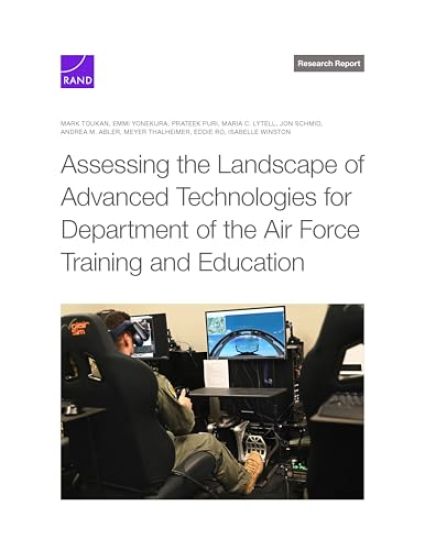
Assessing the Landscape of Advanced Technologies for Department of the Air Force Training and Education

Assessing the Landscape of Advanced Technologies for Department of the Air Force Training and Education

Mark Toukan; Emmi Yonekura; Prateek Puri; Maria C Lytell; Jon Schmid; Andrea M Abler; Meyer Thalheimer; Eddie Ro; Isabelle Winston

RAND Corporation
2024
pokkari
This report identifies promising advanced training-technology investments and steps that the U.S. Department of the Air Force can take to track and integrate them. The authors assess the technology landscape using a quantitative modeling approach, stakeholder perspectives on these technologies and developmental priorities, and an expert panel's analysis of the maturity, benefits, applicability, and adoption barriers for a subset of technologies.
Support to the Dod Cyber Workforce Zero-Based Review

Support to the Dod Cyber Workforce Zero-Based Review

Molly F McIntosh; Sasha Romanosky; Thomas Deen; Samantha E Dinicola; Christopher Ferris; Jonathan Fujiwara; Priya Gandhi; Henry Hargrove; Kirsten M Keller; Maria C Lytell; Mace Moesner; Isabelle Nazha; Zhan Okuda-Lim; Nina Ryan; Karen Schwindt; Amanda Wicker

RAND Corporation
2022
pokkari
Section 1652 of the fiscal year 2020 National Defense Authorization Act tasks the U.S. Department of Defense (DoD) to perform a zero-based review (ZBR)--a detailed review rather than a simple comparison with previous size or budget--of its cybersecurity and information technology workforces. The ZBR process described in this report constitutes a transparent, repeatable process with which DoD can conduct ZBRs across the DoD cyber enterprise.
Advancement and Retention Barriers in the U.S. Air Force Civilian White Collar Workforce

Advancement and Retention Barriers in the U.S. Air Force Civilian White Collar Workforce

Kirsten M Keller; Maria C Lytell; David Schulker; Kimberly Curry Hall; Louis T Mariano; John S Crown; Miriam Matthews; Brandon Crosby; Lisa Saum-Manning; Douglas Yeung; Leslie Adrienne Payne; Felix Knutson; Leann Caudill

RAND
2021
nidottu
This report documents the results of a study examining challenges that Air Force civilian women, racial/ethnic minorities, and individuals with disabilities may face in advancing to higher pay grades as well as factors influencing retention decisions. The study analyzed demographic differences in advancement and retention patterns and conducted focus groups and interviews with close to 300 participants.
Tailoring Medical Standards for Air Force Personnel

Tailoring Medical Standards for Air Force Personnel

Sean Robson; Maria C Lytell; Miriam Matthews; Carra S Sims; Tracy C Krueger; Spencer R Case; Katherine Costello; Sydne Newberry

RAND
2021
nidottu
Service members must meet U.S. Department of Defense standards to ensure that they are fit to serve. However, the services set standards for specific career fields. To meet critical needs, the Air Force seeks to better align personnel to certain fields (those with higher technical levels but lower physical demands). The authors explore the implications to Air Force culture of tailoring standards to expand or limit the pool of qualified personnel.
A Review of the Air Force Fitness Assessment

A Review of the Air Force Fitness Assessment

Sean Robson; Isabel Leamon; Maria C Lytell; Miriam Matthews; Margaret Chamberlin

RAND
2021
nidottu
Military readiness requires service members to be mentally and physically fit to perform duties in various environments. To determine whether U.S. Air Force (AF) personnel are maintaining physical fitness, a fitness assessment (FA) is administered to airmen. This report presents an overview of research about FA components to ensure airmen readiness, support the National Defense Strategy, and promote a culture of health and well-being in the AF.
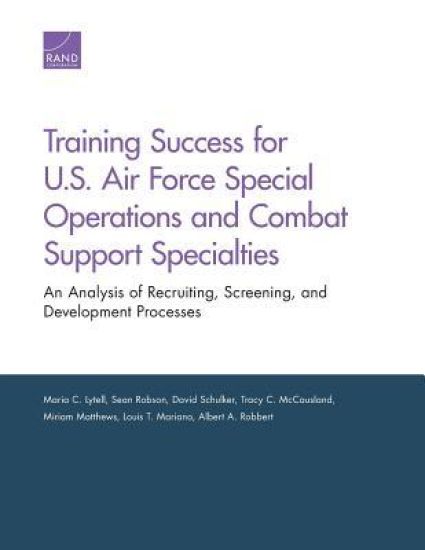
Training Success for U.S. Air Force Special Operations and Combat Support Specialties

Training Success for U.S. Air Force Special Operations and Combat Support Specialties

Maria C Lytell; Sean Robson; David Schulker; Tracy C McCausland; Miriam Matthews; Louis T Mariano; Albert A Robbert

RAND
2018
nidottu
The Air Force's special operations and combat support specialties in the enlisted force are among the highest in demand by the service yet have persistently high rates of attrition in initial skills training. This report addresses challenges for implementing new approaches to these high-demand, high-attrition specialties' recruiting, screening, and development processes, and takes a holistic approach to identifying methods to fill process gaps.
Fit for Duty?

Fit for Duty?

Sean Robson; Maria C Lytell; Carra S Sims; Stephanie Pezard; Thomas Manacapilli; Amanda Anderson; Therese Bohusch; Abigail Haddad

RAND
2017
nidottu
Military occupations can be physically demanding, yet few attempts have been made to determine the physical readiness of today's airmen to perform their jobs. As part of a broader Air Force effort to measure the physical readiness of airmen to perform their jobs, this report describes a methodology for establishing physical fitness standards for four physically demanding Air Force occupational specialties.
Diversity Leadership in the U.S. Department of Defense

Diversity Leadership in the U.S. Department of Defense

Maria C. Lytell; Kirsten M. Keller; Beth Katz; Jefferson P. Marquis; Jerry M. Sollinger

RAND
2016
pokkari
This study identifies the knowledge, skills, abilities, and other personal characteristics needed in individuals who will be responsible for implementing strategic diversity plans in the Department of Defense (DoD). The authors interviewed more than 60 diversity leaders in industry, the public sector (including DoD), and academia and reviewed relevant scientific literature, education programs, and advertised job requirements.
Force Drawdowns and Demographic Diversity

Force Drawdowns and Demographic Diversity

Maria C. Lytell; Kenneth Kuhn; Abigail Haddad; Jefferson P. Marquis; Nelson Lim; Kimberly Curry Hall; Robert Stewart; Jennie W. Wenger

RAND
2015
pokkari
In January 2012, the Department of Defense (DoD) announced plans for a large-scale reduction or drawdown of its military force, which could have unintended consequences for demographic diversity. The Office of Diversity Management and Equal Opportunity (ODMEO) in the Office of the Under Secretary of Defense (Personnel and Readiness) asked RAND to analyze how force reductions could affect the demographic diversity of the DoD workforce."
Strength Testing in the Air Force

Strength Testing in the Air Force

Carra S. Sims; Chaitra M. Hardison; Maria C. Lytell; Abby Robyn; Eunice C. Wong

RAND
2014
pokkari
Since 1987, the Air Force has used the Strength Aptitude Test (SAT), a test of physical strength, to screen and classify enlisted personnel into career specialties. In this study, RAND evaluated the usefulness, validity, and fairness of the SAT, focusing on implementation of the SAT at military entrance processing stations and the process for setting strength requirements for career fields.