Kirjojen hintavertailu. Mukana 12 595 353 kirjaa ja 12 kauppaa.

Kirjailija

Maria Heim

Kirjat ja teokset yhdessä paikassa: 9 kirjaa, julkaisuja vuosilta 2004-2025, suosituimpien joukossa Über die Kunst des Loslassens. Vertaile teosten hintoja ja tarkista saatavuus suomalaisista kirjakaupoista.

9 kirjaa

Kirjojen julkaisuhaarukka 2004-2025.

Words for the Heart

Words for the Heart

Maria Heim

PRINCETON UNIVERSITY PRESS
2024
pokkari
A richly diverse collection of classical Indian terms for expressing the many moods and subtleties of emotional experienceWords for the Heart is a captivating treasury of emotion terms drawn from some of India’s earliest classical languages. Inspired by the traditional Indian genre of a “treasury”—a wordbook or anthology of short texts or poems—this collection features 177 jewellike entries evoking the kinds of phenomena English speakers have variously referred to as emotions, passions, sentiments, moods, affects, and dispositions. These entries serve as beautiful literary and philosophical vignettes that convey the delightful texture of Indian thought and the sheer multiplicity of conversations about emotions in Indian texts. An indispensable collection, Words for the Heart reveals how Indian ways of interpreting human experience can challenge our assumptions about emotions and enrich our lives.Brings to light a rich lexicon of emotion from ancient IndiaUses the Indian genre of a “treasury,” or wordbook, to explore the contours of classical Indian thought in three of the subcontinent’s earliest languages—Sanskrit, Pali, and PrakritFeatures 177 alphabetical entries, from abhaya (“fearlessness”) to yoga (“the discipline of calm”)Draws on a wealth of literary, religious, and philosophical writings from classical IndiaIncludes synonyms, antonyms, related words, and suggestions for further readingInvites readers to engage in the cross-cultural study of emotionsReveals the many different ways of naming and interpreting human experience
Words for the Heart

Words for the Heart

Maria Heim

PRINCETON UNIVERSITY PRESS
2022
sidottu
A richly diverse collection of classical Indian terms for expressing the many moods and subtleties of emotional experienceWords for the Heart is a captivating treasury of emotion terms drawn from some of India’s earliest classical languages. Inspired by the traditional Indian genre of a “treasury”—a wordbook or anthology of short texts or poems—this collection features 177 jewellike entries evoking the kinds of phenomena English speakers have variously referred to as emotions, passions, sentiments, moods, affects, and dispositions. These entries serve as beautiful literary and philosophical vignettes that convey the delightful texture of Indian thought and the sheer multiplicity of conversations about emotions in Indian texts. An indispensable collection, Words for the Heart reveals how Indian ways of interpreting human experience can challenge our assumptions about emotions and enrich our lives.Brings to light a rich lexicon of emotion from ancient IndiaUses the Indian genre of a “treasury,” or wordbook, to explore the contours of classical Indian thought in three of the subcontinent’s earliest languages—Sanskrit, Pali, and PrakritFeatures 177 alphabetical entries, from abhaya (“fearlessness”) to yoga (“the discipline of calm”)Draws on a wealth of literary, religious, and philosophical writings from classical IndiaIncludes synonyms, antonyms, related words, and suggestions for further readingInvites readers to engage in the cross-cultural study of emotionsReveals the many different ways of naming and interpreting human experience

Buddhist Ethics

Buddhist Ethics

Maria Heim

Cambridge University Press
2020
pokkari
'Ethics' was not developed as a separate branch of philosophy in Buddhist traditions until the modern period, though Buddhist philosophers have always been concerned with the moral significance of thoughts, emotions, intentions, actions, virtues, and precepts. Their most penetrating forms of moral reflection have been developed within disciplines of practice aimed at achieving freedom and peace. This Element first offers a brief overview of Buddhist thought and modern scholarly approaches to its diverse forms of moral reflection. It then explores two of the most prominent philosophers from the main strands of the Indian Buddhist tradition – Buddhaghosa and Santideva – in a comparative fashion.
Voice of the Buddha

Voice of the Buddha

Maria Heim

Oxford University Press Inc
2018
sidottu
How did ancient Buddhists read and interpret the Buddha's words? In Voice of the Buddha, Maria Heim reads the early Buddhist scriptures with Buddhaghosa, the principal commentator, editor, and translator of the Theravada intellectual tradition. Buddhaghosa considers the Buddha to be omniscient and his words "oceanic." Every word, passage, bookindeed, the corpus as a wholeis taken to be "endless and immeasurable." Commentarial practice thus requires disciplined methods of expansion, drawing out the endless possibilities for meaning and application. Heim considers Buddhagohsa's theories of scripture and follows his practices of exegesis to yield fresh insight into all three collections of the early Pali texts: Vinaya, the Suttas, and the Abhidhamma.
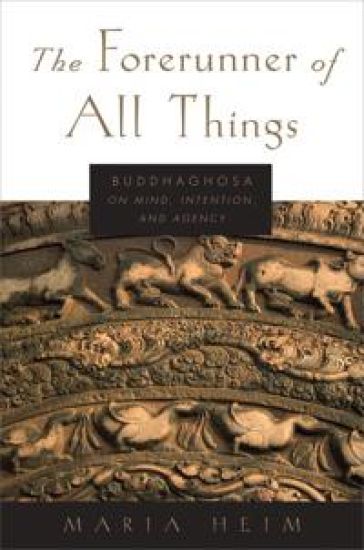
The Forerunner of All Things

The Forerunner of All Things

Maria Heim

Oxford University Press Inc
2013
nidottu
Scholars have long been intrigued by the Buddha's defining action (karma) as intention. This book explores systematically how intention and agency were interpreted in all genres of early Theravada thought. It offers a philosophical exploration of intention and motivation as they are investigated in Buddhist moral psychology. At stake is how we understand karma, the nature of moral experience, and the possibilities for freedom. In contrast to many studies that assimilate Buddhist moral thinking to Western theories of ethics, the book attends to distinctively Buddhist ways of systematizing and theorizing their own categories. Arguing that meaning is a product of the explanatory systems used to explore it, the book pays particular attention to genre and to the 5th-century commentator Buddhaghosa's guidance on how to read Buddhist texts. The book treats all branches of the Pali canon (the Tipitaka, that is, the Suttas, the Abhidhamma, and the Vinaya), as well as narrative sources (the Dhammapada and the Jataka commentaries). In this sense it offers a comprehensive treatment of intention in the canonical Theravada sources. But the book goes further than this by focusing explicitly on the body of commentarial thought represented by Buddhaghosa. His work is at the center of the book's investigations, both insofar as he offers interpretative strategies for reading canonical texts, but also as he advances particular understandings of agency and moral psychology. The book offers the first book-length study devoted to Buddhaghosa's thought on ethics
The Forerunner of All Things

The Forerunner of All Things

Maria Heim

Oxford University Press Inc
2013
sidottu
Scholars have long been intrigued by the Buddha's defining action (karma) as intention. This book explores systematically how intention and agency were interpreted in all genres of early Theravada thought. It offers a philosophical exploration of intention and motivation as they are investigated in Buddhist moral psychology. At stake is how we understand karma, the nature of moral experience, and the possibilities for freedom. In contrast to many studies that assimilate Buddhist moral thinking to Western theories of ethics, the book attends to distinctively Buddhist ways of systematizing and theorizing their own categories. Arguing that meaning is a product of the explanatory systems used to explore it, the book pays particular attention to genre and to the 5th-century commentator Buddhaghosa's guidance on how to read Buddhist texts. The book treats all branches of the Pali canon (the Tipitaka, that is, the Suttas, the Abhidhamma, and the Vinaya), as well as narrative sources (the Dhammapada and the Jataka commentaries). In this sense it offers a comprehensive treatment of intention in the canonical Theravada sources. But the book goes further than this by focusing explicitly on the body of commentarial thought represented by Buddhaghosa. His work is at the center of the book's investigations, both insofar as he offers interpretative strategies for reading canonical texts, but also as he advances particular understandings of agency and moral psychology. The book offers the first book-length study devoted to Buddhaghosa's thought on ethics