Kirjojen hintavertailu. Mukana 12 595 353 kirjaa ja 12 kauppaa.

Kirjailija

Maria Kateri

Kirjat ja teokset yhdessä paikassa: 6 kirjaa, julkaisuja vuosilta 2014-2026, suosituimpien joukossa Foundations of Bayesian Statistics for Data Scientists. Vertaile teosten hintoja ja tarkista saatavuus suomalaisista kirjakaupoista.

6 kirjaa

Kirjojen julkaisuhaarukka 2014-2026.

Foundations of Bayesian Statistics for Data Scientists

Foundations of Bayesian Statistics for Data Scientists

Alan Agresti; Maria Kateri; Ranjini Grove; Antonietta Mira

TAYLOR FRANCIS LTD
2026
nidottu
This book is an overview of the Bayesian approach to applying the most important inferential methods of statistical science. It is designed as a textbook for advanced undergraduate and master’s students in Data Science, Statistics, or Mathematics who are interested in learning about Bayesian statistics. The reader should be familiar with calculus and should have taken a statistical inference Statistics course covering the basic rules of probability, probability distributions and expectations, as well as the fundamentals of the traditional, frequentist approach to statistics, including sampling distributions, likelihood functions, basic inferential methods such as point estimation, confidence intervals, significance tests, and linear regression models. Key Features: ? Uses real world data examples and contains numerous exercises. ? Includes software appendices in R and Python. ? Offers slides, labs, and other materials on the book’s website. Each chapter begins with a brief review of the primary frequentist methods for its topic before introducing corresponding Bayesian methods. This book presents some substantive theory as well as the methods, and is therefore intended for a reader who wishes to understand Bayesian methods rather than merely apply them. The focus is not just on presenting statistical methodologies but also on demonstrating how to implement them with modern software, emphasizing appropriate simulation methods.
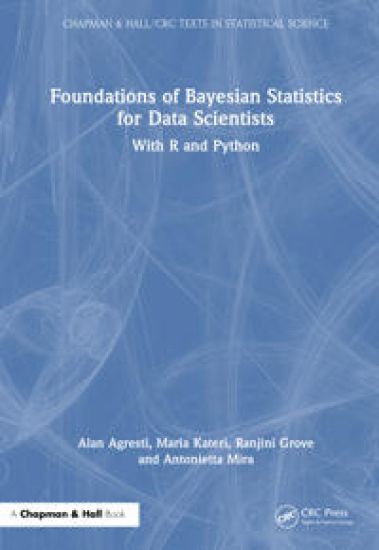
Foundations of Bayesian Statistics for Data Scientists

Foundations of Bayesian Statistics for Data Scientists

Alan Agresti; Maria Kateri; Ranjini Grove; Antonietta Mira

TAYLOR FRANCIS LTD
2026
sidottu
This book is an overview of the Bayesian approach to applying the most important inferential methods of statistical science. It is designed as a textbook for advanced undergraduate and master’s students in Data Science, Statistics, or Mathematics who are interested in learning about Bayesian statistics. The reader should be familiar with calculus and should have taken a statistical inference Statistics course covering the basic rules of probability, probability distributions and expectations, as well as the fundamentals of the traditional, frequentist approach to statistics, including sampling distributions, likelihood functions, basic inferential methods such as point estimation, confidence intervals, significance tests, and linear regression models. Key Features: ? Uses real world data examples and contains numerous exercises. ? Includes software appendices in R and Python. ? Offers slides, labs, and other materials on the book’s website. Each chapter begins with a brief review of the primary frequentist methods for its topic before introducing corresponding Bayesian methods. This book presents some substantive theory as well as the methods, and is therefore intended for a reader who wishes to understand Bayesian methods rather than merely apply them. The focus is not just on presenting statistical methodologies but also on demonstrating how to implement them with modern software, emphasizing appropriate simulation methods.
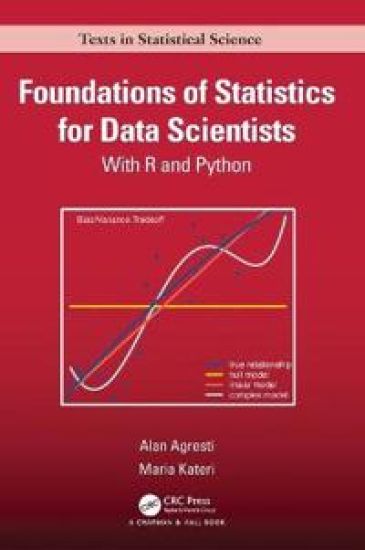
Foundations of Statistics for Data Scientists

Foundations of Statistics for Data Scientists

Alan Agresti; Maria Kateri

CRC Press
2021
sidottu
Foundations of Statistics for Data Scientists: With R and Python is designed as a textbook for a one- or two-term introduction to mathematical statistics for students training to become data scientists. It is an in-depth presentation of the topics in statistical science with which any data scientist should be familiar, including probability distributions, descriptive and inferential statistical methods, and linear modeling. The book assumes knowledge of basic calculus, so the presentation can focus on "why it works" as well as "how to do it." Compared to traditional "mathematical statistics" textbooks, however, the book has less emphasis on probability theory and more emphasis on using software to implement statistical methods and to conduct simulations to illustrate key concepts. All statistical analyses in the book use R software, with an appendix showing the same analyses with Python.Key Features:Shows the elements of statistical science that are important for students who plan to become data scientists.Includes Bayesian and regularized fitting of models (e.g., showing an example using the lasso), classification and clustering, and implementing methods with modern software (R and Python).Contains nearly 500 exercises.The book also introduces modern topics that do not normally appear in mathematical statistics texts but are highly relevant for data scientists, such as Bayesian inference, generalized linear models for non-normal responses (e.g., logistic regression and Poisson loglinear models), and regularized model fitting. The nearly 500 exercises are grouped into "Data Analysis and Applications" and "Methods and Concepts." Appendices introduce R and Python and contain solutions for odd-numbered exercises. The book's website (http://stat4ds.rwth-aachen.de/) has expanded R, Python, and Matlab appendices and all data sets from the examples and exercises.
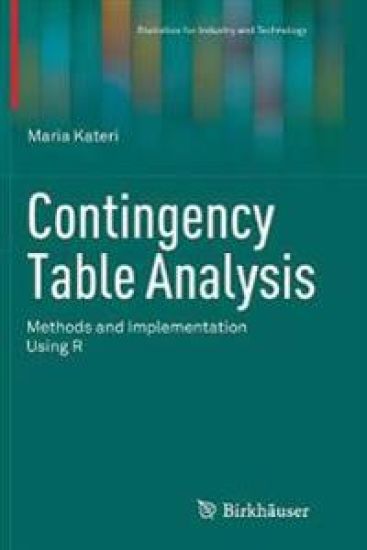
Contingency Table Analysis

Contingency Table Analysis

Maria Kateri

Birkhauser Boston Inc
2016
nidottu
Contingency tables arise in diverse fields, including life sciences, education, social and political sciences, notably market research and opinion surveys. Their analysis plays an essential role in gaining insight into structures of the quantities under consideration and in supporting decision making.Combining both theory and applications, this book presents models and methods for the analysis of two- and multidimensional-contingency tables. The author uses a threefold approach, presenting fundamental models and related inference, highlighting their interpretational aspects, and demonstrating their practical usefulness. Emphasis is on applications and methods of fitting models using standard statistical tools - such as SPSS, R, and BUGS - and on interpretation of the results. An excellent reference for advanced undergraduates, graduate students, and practitioners in statistics as well as biosciences, social sciences, education, and economics, the work may also be used as a textbook for a course on categorical data analysis. Prerequisites include basic background on statistical inference and knowledge of statistical software packages.
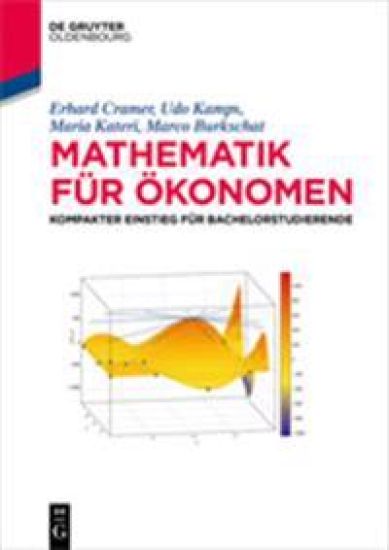
Mathematik für Ökonomen

Mathematik für Ökonomen

Erhard Cramer; Udo Kamps; Maria Kateri; Marco Burkschat

Walter de Gruyter
2015
pokkari
This textbook presents in succinct and targeted form the fundamental mathematical concepts and methods needed by undergraduate students in the business sciences, clearly illustrated with a large number of exercises. Learning and retention are enhanced with visual aids, many of them multi-colored.
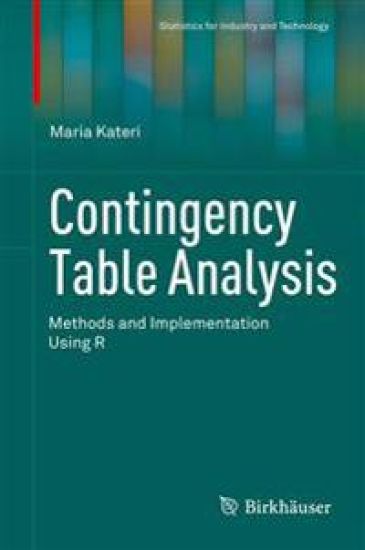
Contingency Table Analysis

Contingency Table Analysis

Maria Kateri

Birkhauser Boston Inc
2014
sidottu
Contingency tables arise in diverse fields, including life sciences, education, social and political sciences, notably market research and opinion surveys. Their analysis plays an essential role in gaining insight into structures of the quantities under consideration and in supporting decision making.Combining both theory and applications, this book presents models and methods for the analysis of two- and multidimensional-contingency tables. The author uses a threefold approach, presenting fundamental models and related inference, highlighting their interpretational aspects, and demonstrating their practical usefulness. Emphasis is on applications and methods of fitting models using standard statistical tools - such as SPSS, R, and BUGS - and on interpretation of the results. An excellent reference for advanced undergraduates, graduate students, and practitioners in statistics as well as biosciences, social sciences, education, and economics, the work may also be used as a textbook for a course on categorical data analysis. Prerequisites include basic background on statistical inference and knowledge of statistical software packages.