Kirjojen hintavertailu. Mukana 12 559 294 kirjaa ja 12 kauppaa.

Kirjailija

Maria Luisa Ardizzone

Kirjat ja teokset yhdessä paikassa: 4 kirjaa, julkaisuja vuosilta 2002-2018, suosituimpien joukossa Dante as Political Theorist. Vertaile teosten hintoja ja tarkista saatavuus suomalaisista kirjakaupoista.

4 kirjaa

Kirjojen julkaisuhaarukka 2002-2018.

Dante as Political Theorist

Dante as Political Theorist

Maria Luisa Ardizzone; Maria Luisa Ardizzone

Cambridge Scholars Publishing
2018
sidottu
Dante's Latin treatise Monarchia inscribes itself within the long medieval conflict between Pope and Emperor and the debate that opposed the theorists of theocracy to the supporters of the empire. The Monarchia, traditionally assumed to be a subversive work as its tormented reception testifies – it remained listed in the Index of Prohibited Books from 1559 to the end of the 19th century – results from the strong connection Dante emphasized between politics and ethics. The bene esse of human beings is the crucial issue that the treatise discusses since its very beginning. More than focusing on power and sovereignty, the Monarchia aims to demonstrate that the government of a single universal ruler guarantees the achievement of the natural goal of human life. The central role assigned to the Emperor discloses, in fact, the importance the poet gives to earthly happiness and to the temporal dimension of humanitas. The essays in this volume are the result of the first International Symposium of the Global Dante Project of New York, a scholarly initiative committed to the systematic study of the whole of Dante's opus. Held in 2015 and devoted to the Monarchia, this inaugural event saw the participation of scholars from Europe and the USA who investigated Dante's political treatise addressing diverse issues and from multiple and innovative methodological perspectives. The fertile discussion generated on that occasion and the insights it produced animate this book.
Reading As the Angels Read

Reading As the Angels Read

Maria Luisa Ardizzone

University of Toronto Press
2016
sidottu
An uncompleted manuscript that combines lyric poetry and prose commentary, the Banquet (or Convivio) is one of Dante Alighieri’s most important and least understood philosophical texts. As Maria Luisa Ardizzone shows, its language and logic are deeply connected to medieval culture and the philosophical debates of the thirteenth and early fourteenth centuries. In Reading as the Angels Read, Ardizzone reconstructs the cultural and socio-political background that provided the motivation for the Banquet and offers a bold new reading of this ambitious work. Drawing on a deep knowledge of Dante’s engagement with biblical, Augustinian, Neoplatonic, and Aristotelian philosophy, she suggests that the Banquet is not an encyclopedia of learning as many have claimed, but Dante’s attempt to articulate a theory of human happiness in which perfect knowledge is the natural basis for a well-organized political community.
Dante. Il Paradigma Intellettuale. Un'inventio Degli Anni Fiorentini

Dante. Il Paradigma Intellettuale. Un'inventio Degli Anni Fiorentini

Maria Luisa Ardizzone

Casa Editrice Leo S. Olschki
2011
nidottu
This volume is a study of intellectual history focusing on the theological-philosophical and rhetorical-poetic nature of Dantean culture. It searches for and establishes a continuity-discontinuity between Vita Nova, the theme of the loda and the first two canzoni Dante will comment on in the Convivio. Dante's attempt to find relationships among different cultural models is part of what is researched.The methodology of Convivio seems to be announced.
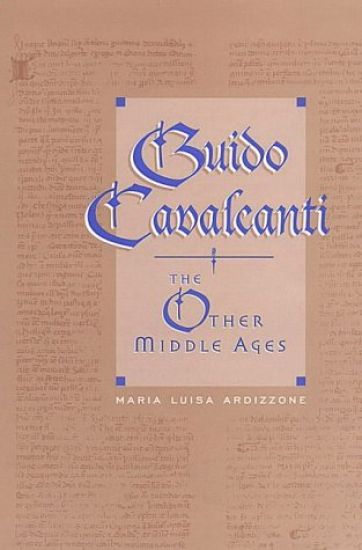
Guido Cavalcanti

Guido Cavalcanti

Maria Luisa Ardizzone

University of Toronto Press
2002
sidottu
Guido Cavalcanti (d. 1300) is one of the greatest Italian poets of all time. His legacy consists of some fifty poems, of which his canzone on the nature of love, Donna me prega (A lady asks me) is the most famously difficult and complex. The poem is important not only because it sheds light on fundamental intellectual debates during the time of Dante, but also because of its influence on generations of poets and philosophers. In this study, Maria Luisa Ardizzone sets Donna me prega in an entirely new light - first, by examining its role in Cavalcanti's poetic practice, and second, by placing it in the context of ancient and medieval science and philosophy. The book deals with issues that are part of the intellectual history of Europe in the thirteenth century. Cavalcanti's work is interpreted by reconstructing the debate of ideas in which it partecipates, and the new model of poetry devised by Cavalcanti is one of the subjects of this book. For Cavalcanti, as for Dante, Aristotle was a master. But unlike Dante, who followed a more orthodox interpretation of Aristotle's text, Cavalcanti preferred the Aristotelianism which derived from the Arabic commentator Averroes, whose approach was responsible for introducing a radical rereading of Aristotle incompatible with basic tenets of the Christian faith. In this alternative view, human desires and difficulties were resolved not through theology but through biology, natural philosophy, and medicine. While other scholars have noted Cavalcanti's Averroism, Ardizzone is the first to analyse it in light of sciences such as optics or logic, focusing on new issues of intellectual debate of Cavalcanti's time, as, for instance, the medieval theory of matter.