Kirjojen hintavertailu. Mukana 12 123 005 kirjaa ja 12 kauppaa.

Kirjailija

Marianne Constable

Kirjat ja teokset yhdessä paikassa: 5 kirjaa, julkaisuja vuosilta 1994-2014, suosituimpien joukossa Our Word Is Our Bond. Vertaile teosten hintoja ja tarkista saatavuus suomalaisista kirjakaupoista.

5 kirjaa

Kirjojen julkaisuhaarukka 1994-2014.

Our Word Is Our Bond

Our Word Is Our Bond

Marianne Constable

Stanford University Press
2014
pokkari
Words can be misspoken, misheard, misunderstood, or misappropriated; they can be inappropriate, inaccurate, dangerous, or wrong. When speech goes wrong, law often steps in as itself a speech act or series of speech acts. Our Word Is Our Bond offers a nuanced approach to language and its interaction and relations with modern law. Marianne Constable argues that, as language, modern law makes claims and hears claims of justice and injustice, which can admittedly go wrong. Constable proposes an alternative to understanding law as a system of rules, or as fundamentally a policy-making and problem-solving tool. Constable introduces and develops insights from Austin, Cavell, Reinach, Nietzsche, Derrida and Heidegger to show how claims of law are performative and passionate utterances or social acts that appeal implicitly to justice. Our Word Is Our Bond explains that neither law nor justice are what lawyers and judges say, nor what officials and scholars claim they are. However inadequate our law and language may be to the world, Constable argues that we know our world and name our ways of living and being in it through law and language. Justice today, however impossible to define and difficult to determine, depends on relations we have with one another through language and on the ways in which legal speech—the claims and responses that we make to one another in the name of the law—acts.
Our Word Is Our Bond

Our Word Is Our Bond

Marianne Constable

Stanford University Press
2014
sidottu
Words can be misspoken, misheard, misunderstood, or misappropriated; they can be inappropriate, inaccurate, dangerous, or wrong. When speech goes wrong, law often steps in as itself a speech act or series of speech acts. Our Word Is Our Bond offers a nuanced approach to language and its interaction and relations with modern law. Marianne Constable argues that, as language, modern law makes claims and hears claims of justice and injustice, which can admittedly go wrong. Constable proposes an alternative to understanding law as a system of rules, or as fundamentally a policy-making and problem-solving tool. Constable introduces and develops insights from Austin, Cavell, Reinach, Nietzsche, Derrida and Heidegger to show how claims of law are performative and passionate utterances or social acts that appeal implicitly to justice. Our Word Is Our Bond explains that neither law nor justice are what lawyers and judges say, nor what officials and scholars claim they are. However inadequate our law and language may be to the world, Constable argues that we know our world and name our ways of living and being in it through law and language. Justice today, however impossible to define and difficult to determine, depends on relations we have with one another through language and on the ways in which legal speech—the claims and responses that we make to one another in the name of the law—acts.
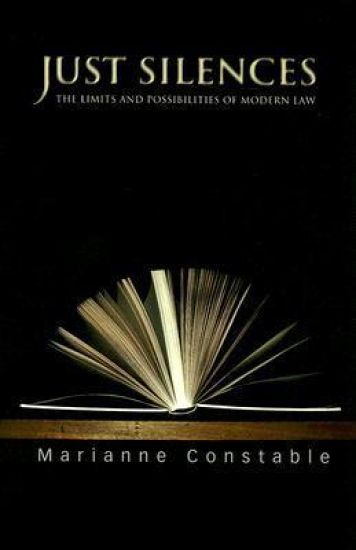
Just Silences

Just Silences

Marianne Constable

Princeton University Press
2007
pokkari
Is the Miranda warning, which lets an accused know of the right to remain silent, more about procedural fairness or about the conventions of speech acts and silences? Do U.S. laws about Native Americans violate the preferred or traditional "silence" of the peoples whose religions and languages they aim to "protect" and "preserve"? In Just Silences, Marianne Constable draws on such examples to explore what is at stake in modern law: a potentially new silence as to justice. Grounding her claims about modern law in rhetorical analyses of U.S. law and legal texts and locating those claims within the tradition of Nietzsche, Heidegger, and Foucault, Constable asks what we are to make of silences in modern law and justice. She shows how what she calls "sociolegal positivism" is more important than the natural law/positive law distinction for understanding modern law. Modern law is a social and sociological phenomenon, whose instrumental, power-oriented, sometimes violent nature raises serious doubts about the continued possibility of justice. She shows how particular views of language and speech are implicated in such law. But law--like language--has not always been positivist, empirical, or sociological, nor need it be. Constable examines possibilities of silence and proposes an alternative understanding of law--one that emerges in the calling, however silently, of words to justice. Profoundly insightful and fluently written, Just Silences suggests that justice today lies precariously in the silences of modern positive law.
The Law of the Other

The Law of the Other

Marianne Constable

University of Chicago Press
1994
nidottu
The "mixed jury" doctrine allowed resident foreigners to have law suits against English natives tried before juries composed half of natives and half of aliens like themselves. As she traces the transformations in this doctrine from the Middle Ages to its abolition in 1870, Constable also reveals the emergence of a world where law rooted in actual practices and customs of communities is replaced by law determined by officials, where juries no longer strive to speak the truth but to ascertain the facts.
The Law of the Other

The Law of the Other

Marianne Constable

University of Chicago Press
1994
sidottu
This is an account of the English doctrine of the "mixed jury". Constable's excavation of the historical, rhetorical and theoretical foundations of modern law recasts our legal and sociological understandings of the American jury and our contemporary conceptions of law, citizenship and truth. The "mixed jury" doctrine allowed resident foreigners to have law suits against English natives tried before juries composed half of natives and half of aliens like themselves. As she traces the transformations in this doctrine from the Middle Ages to its abolition in 1870, Constable also reveals the emergence of a world where law rooted in actual practices and customs of communities is replaced by law determined by officials, where juries no longer strive to speak the truth but to ascertain the facts.