Kirjojen hintavertailu. Mukana 12 657 676 kirjaa ja 12 kauppaa.

Kirjailija

Mariano Artigas

Kirjat ja teokset yhdessä paikassa: 7 kirjaa, julkaisuja vuosilta 2004-2025, suosituimpien joukossa Learn With Us Now: Level 1: Student Book with Online Practice BLOCK CAPS edition. Vertaile teosten hintoja ja tarkista saatavuus suomalaisista kirjakaupoista.

7 kirjaa

Kirjojen julkaisuhaarukka 2004-2025.

Oracles of Science

Oracles of Science

Karl Giberson; Mariano Artigas

Oxford University Press Inc
2009
nidottu
Oracles of Science examines the popular writings of the six scientists who have been the most influential in shaping our perception of science, how it works, and how it relates to other fields of human endeavor, especially religion. Biologists Stephen Jay Gould, Richard Dawkins, and Edward O. Wilson, and physicists Carl Sagan, Stephen Hawking, and Steven Weinberg, have become public intellectuals, articulating a much larger vision for science and what role it should play in the modern worldview. The scientific prestige and literary eloquence of each of these great thinkers combine to transform them into what can only be called oracles of science. Their controversial, often personal, sometimes idiosyncratic opinions become widely known and perceived by many to be authoritative. Curiously, the leading 'oracles of science' are predominantly secular in ways that don't reflect the distribution of religious beliefs within the scientific community. Many of them are even hostile to religion, creating a false impression that science as a whole is incompatible with religion. Karl Giberson and Mariano Artigas offer an informed analysis of the views of these six scientists, carefully distinguishing science from philosophy and religion in the writings of the oracles. This book will be welcomed by many who are disturbed by the tone of the public discourse on the relationship between science and religion and will challenge others to reexamine their own preconceptions about this crucial topic.
Oracles of Science

Oracles of Science

Karl Giberson; Mariano Artigas

Oxford University Press Inc
2007
sidottu
Biologists Stephen Jay Gould, Richard Dawkins, and Edward O. Wilson, and physicists Carl Sagan, Stephen Hawking, and Steven Weinberg have become public intellectuals, articulating a much larger vision for science and what role it should play in the modern worldview. The scientific prestige and literary eloquence of each of these great thinkers combine to transform them into what can only be called oracles of science. Curiously, the leading "oracles of science" are predominantly secular in ways that don't reflect the distribution of religious beliefs within the scientific community. Many of them are even hostile to religion, creating a false impression that science as a whole is incompatible with religion. Karl Giberson and Mariano Artigas offer an informed analysis of the views of these six scientists, carefully distinguishing science from philosophy and religion in the writings of the oracles.
Negotiating Darwin

Negotiating Darwin

Mariano Artigas; Thomas F. Glick; Rafael A. Martínez

Johns Hopkins University Press
2006
sidottu
Drawing on primary sources made available to scholars only after the archives of the Holy Office were unsealed in 1998, Negotiating Darwin chronicles how the Vatican reacted when six Catholics-five clerics and one layman-tried to integrate evolution and Christianity in the decades following the publication of Darwin's Origin of Species. As Mariano Artigas, Thomas F. Glick, and Rafael A. Martinez reconstruct these cases, we see who acted and why, how the events unfolded, and how decisions were put into practice. With the long shadow of Galileo's condemnation hanging over the Church as the Scientific Revolution ushered in new paradigms, the Church found it prudent to avoid publicly and directly condemning Darwinism and thus treated these cases carefully. The authors reveal the ideological and operational stance of the Vatican and describe its secret deliberations. In the process, they provide insight into current debates on evolution and religious belief.
Knowing Things for Sure

Knowing Things for Sure

Mariano Artigas

University Press of America
2006
nidottu
In science it is obvious that we are certain about many things, but among philosophers there is little agreement as to why we know these things. In Knowing Things for Sure physicist and realist philosopher, Mariano Artigas traces the confusion to non-realist philosophies and argues that practitioners of experimental science do reach logical truths about reality. This comprehensive survey of the philosophy of science and mini-history of science uses historical evidence to discuss the aim of science and show how scientists achieve inter-subjective agreement, reach truths about reality, and ultimately impact philosophy. Some of the scientific discoveries and methods referenced include the discovery of elements and the role of the periodic table, Mendel's mathematization of heredity through experiments with peas, Darwin's hypothesis as a framework theory, the prediction of the existence of the blood-brain barrier and its confirmation 70 years later, the discovery of superconductivity and its explanation 60 years later, the use of the uncertainty principle by physicists to estimate magnitudes of particles and duration, the existence of atoms and sub-atomic particles, and the explanatory power of the DNA double helix. Knowing Things for Sure also cites and critiques numerous philosophies from philosophers such as Aristotle, Comte, Mach, Reichenbach, Carnap, and Popper.
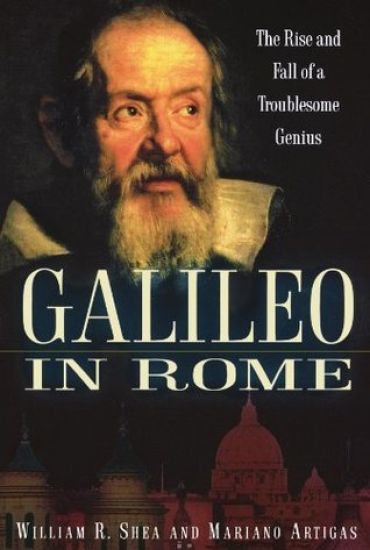
Galileo in Rome

Galileo in Rome

William R. Shea; Mariano Artigas

Oxford University Press Inc
2004
nidottu
Galileo's trial by the Inquisition is one of the most dramatic incidents in the history of science and religion. Today, we tend to see this event in black and white--Galileo all white, the Church all black. Galileo in Rome presents a much more nuanced account of Galileo's relationship with Rome. The book offers a fascinating account of the six trips Galileo made to Rome, from his first visit at age 23, as an unemployed mathematician, to his final fateful journey to face the Inquisition. The authors reveal why the theory that the Earth revolves around the Sun, set forth in Galileo's Dialogue, stirred a hornet's nest of theological issues, and they argue that, despite these issues, the Church might have accepted Copernicus if there had been solid proof. More interesting, they show how Galileo dug his own grave. To get the imprimatur, he brought political pressure to bear on the Roman Censor. He disobeyed a Church order not to teach the heliocentric theory. And he had a character named Simplicio (which in Italian sounds like simpleton) raise the same objections to heliocentrism that the Pope had raised with Galileo. The authors show that throughout the trial, until the final sentence and abjuration, the Church treated Galileo with great deference, and once he was declared guilty commuted his sentence to house arrest. Here then is a unique look at the life of Galileo as well as a strikingly different view of an event that has come to epitomize the Church's supposed antagonism toward science.